

Have you ever wondered why guitars have frets and violins do not? I didn’t think so. I guess I better tell you what a fret is now. A fret is a thin strip of metal that runs perpendicular to the strings on a guitar. In theory it makes it easier to play a correct note. On a fretless instrument you have to rely in your ear and not a fret to play the correct note.
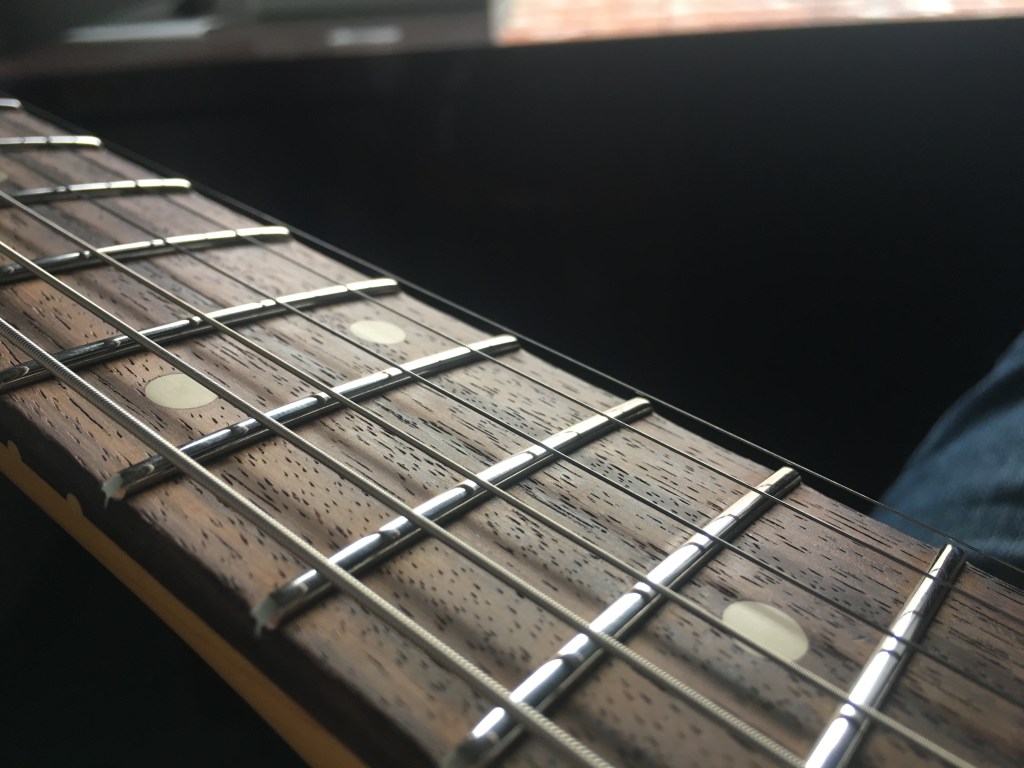
I do not own a violin but I spent a little time with one in my first round of college. I kept asking the wrong questions. Where is C? I should have asked, What does C sound like? I have come a long way since then on guitar. And I am beginning to understand why the concert music world did not respect the guitar until players like Andreas Segovia and Julian Bream paved the way for classical guitar in the twentieth century. I suppose I might as well tell you now that the guitar is out of tune. Or you could say it is equally in and out of tune. And this has bothered me for years.
I discovered this issue as a young player when I realized that guitars need regular maintenance. You need to tune a guitar’s open strings every time you play, but occasionally you have to check the guitars intonation. That means you make sure that the guitar is in tune at the 12th fret octave as well as the open string. If it is flat at the octave you can adjust the guitar’s bridge to make the string shorter and therefore sharpen the pitch. You lengthen the string to flatten it if the pitch is sharp at the octave. But there is a mathematical problem with tuning that is highlighted on fretted instruments: you can either have the octaves in tune, or the Fifths in tune, but not both. (Fifths are the fifth degree of the major scale and are the foundation of western music.) I did not have this information all of those years ago, I just noticed that I could never get the tuning perfect. And I thought there was something wrong with my instrument. It turns out it was not my guitar, but the whole tuning system in general. The piano suffers from the same problem.
There have been a number of attempts made to deal with this issue over the past thousand or so years. Various temperaments, or tuning systems have been developed to to mitigate the Pythagorean Comma, or tuning gap. Apparently Pythagorus- yes that Pythagorus from your geometry class- wrestled with this issue.
Now that we have the tuning system worked out people only want to write four chord pop songs.
Enter the guitar around 500 years ago. I’d like to think that a prototypical guitar player invented the guitar. He was probably aware of the tuning issues, and thought, What if I just put these frets on the neck, make everything straight, and hope for the best? Guitar players are infamous for not being able to read music. Maybe he put frets on the fingerboard because he was tired of guessing where to put his fingers. Maybe he didn’t want to memorize notes but was happy to play patterns. At any rate guitars have been using equal temperament tuning since the renaissance and pianos waited to adopt it until right after the Boer Wars. And I think that’s why the guitar didn’t start gaining notoriety until the 1930s. Equal temperament tuning compromises the fifths in each key so the instrument can play fairly in tune across all the keys. This is why I have never been able to tune my guitar to my idealists standards. That brings me a small amount of psychological pain. But I have fallen in love with the guitar and I believe we can work our differences out.
Imagine now if this tuning phenomenon did not plague musicians and instrument makers. What if we could have the octaves and the fifths in tune? I don’t think that music would be what it is today. Part of the beauty of music is figuring out what works and what doesn’t. If everything was perfect there would be no dissonance, and how could we write music about pain and suffering without dissonance? J.S. Bach wrote his masterpiece The Well Tempered Clavier on an imperfect instrument. He wrote a piece of music in every key for the Harpsichord or Clavichord. These are stringed keyboard instruments that predated the piano. The genius of these pieces are the notes that he avoids because the well tempered tuning system still had some major dissonance issues. This piece is still studied today by aspiring pianists.
Think about this: more than likely, all of the piano music that you have ever heard in your whole life has not been in tune.
I suppose every good story needs a moral. Life is not always perfect. It can be frustrating to find the perfect balance because there may be no perfect balance. You just have to do the best that you can do with what you have. And often that ends up being the most beautiful thing anyway.
 Mostly From Memory