Fog

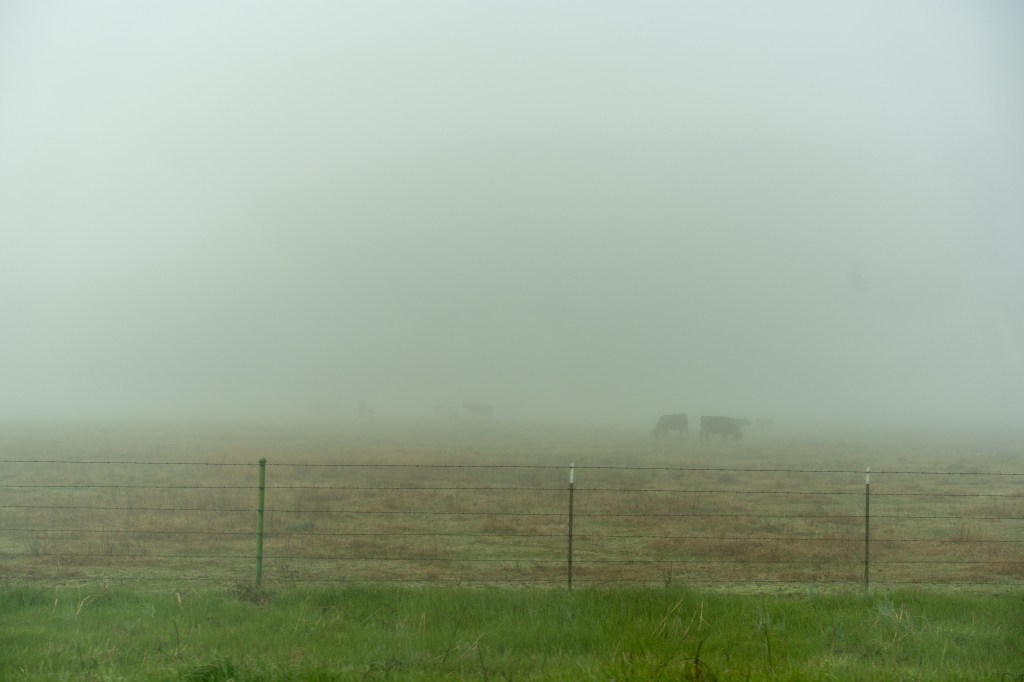
I had to drive in the fog this week. I’m not talking about the kind of patchy fog you drive through while you’re crossing a bridge and then you are back in the sunshine. No. I drove for two and half hours through the kind of fog in which Edgar Allan Poe set all of his stories.

I had to drive in the fog this week. I’m not talking about the kind of patchy fog you drive through while you’re crossing a bridge and then you are back in the sunshine. No. I drove for two and a half hours through the kind of fog in which Edgar Allan Poe set all of his stories. At least that’s the thick fog that I imagine when I read him. So naturally, I decided to do some drive-by photography. I love a good foggy morning; it makes me feel like Sherlock Holmes. A damp haze like this gives me a craving for a good mystery. For whatever reason, fog pulls on my creative nature. I was feeling pretty inspired and artistic in this dreamy landscape until I passed a big chicken truck that had turned over in the ditch just outside of Natchitoches. That wreck halted my daydreaming and caused me to slow down and give my undivided attention to the road, at least for a little while. Then I began to wonder if any of those chickens made their escape into the mist. I hope they did. I love a good escape story as much as I love a foggy morning. Maybe they took up with the herons in the swamp.

As much as the fog tugs on my imagination, I’m glad that it isn’t foggy all of the time. It can be stressful when you cannot see very far ahead of you. I imagine that’s what happened to that poor truck driver. He probably had to take evasive action to avoid killing someone he only saw at the last split second. Who knows?

The wrecked truck reminded me of something I learned about as a teenager following the progress of Operation Iraqi Freedom in the newspaper; The Fog of War. Originally a German term, it describes how the chaos of battle brings confusion and situational uncertainty to soldiers—and even top brass—who often become disoriented and are unsure of what to do next. I have never been in combat, but I have been in a lot of fog, and I can appreciate the analogy. My cousin Mark got disoriented in the fog on the Coosa River once during a fishing tournament. He navigated his bass boat by GPS right up out of the river and into the woods. I think the problem with disorientation is you don’t know you are disoriented until it is too late.

The vicissitudes of life can put us in a fog. The beauty of that fog and the creativity that it inspires is hardly ever seen in the moment except by the rare longsighted optimists, or the visionaries who are gifts to humanity. The rest of us only see the beauty in hindsight-that is if we make it through. There have been a few-and thank God only a few-truly foggy patches in my life. Times when you can only see as far as the next step and you aren’t fully sure of that; when you have all but lost direction; and when the mist has nearly halted any progress you thought you were making. It may take a while, but eventually we can look back and see the beauty of those times. And, with a twinkle in our eye and compassion in our voice, even recall them with joy and hope, and tell about them to someone going through their own fog.

We are often tossed and driven on the restless seas of time

Somber skies and howling tempests oft succeed the bright sunshine

But in that land of perfect day, when the mist has rolled away

We will understand it better by and by

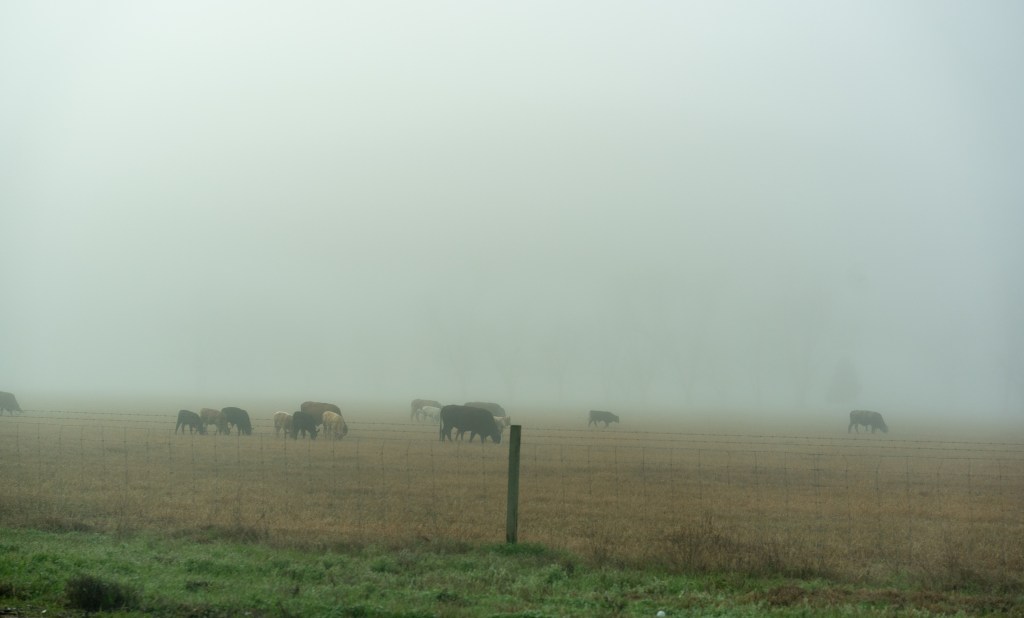
This fog the other day covered a large swath of Louisiana. A friend who was working on the other side of the State that morning was telling me how foggy it was for him too. I’m glad I wasn’t in it alone. Eventually the fog “burnt off” as he put it, and it turned out to be a bright sunny day. But I’m glad I got these pictures. I didn’t want you to think I was exaggerating.
Left Behind: Musician Thoughts

What a person prefers about music depends largely on the memories associated with that music, and how broad their musical tastes were while this theoretical window was open.

I was listening to a song this morning on the way in to work. It was Christian Pop and I liked it. It wasn’t the sort of song that I would think to play at church, but it was uplifting nonetheless. Quite often Christian popular music takes its cues from secular pop. The phenomenon of secular-or profane-musical influence on church music has been going on for at least a thousand years. I noticed that the influences on the song I heard this morning sounded a little dated. I checked the release date on the song, and low and behold the song was twenty years old. Two decades. No wonder the influences sounded dated.

There is a theory that each generation thinks that their music was the best. I believe that each person has a window in which their musical tastes are established. What a person prefers about music depends largely on the memories associated with that music, and how broad their musical tastes were while this theoretical window was open. It takes effort to broaden that window and learn to appreciate music that doesn’t fit an individual’s concept of what sounds good. Especially as we get older.

I have seen this theory proved in the two decades that I have been fortunate to play music at church. I have met musicians willing to quit church before they were willing to learn a new type of music. Do you recall about twenty years ago when churches were splitting over traditional versus contemporary music? If you are yet a teenager and cannot recall, I am here to tell you that the Christian pop music that sounds so dated now was powerful enough to split churches.

When you are young it is easy to point your finger at an older generation for not being willing to learn anything new-including music. I have watched older musicians who struggled to keep up with new trends in church music (electric guitars, drums, click tracks, drum loops, synths, etc.): some overcame, some did not. I have also witnessed those who downright refused to learn anything new. It made me realize that staying relevant-this word has been blunted by Christendom- as a seasoned musician will take more than a moderate amount of effort.

On the other hand, seasoned musicians do have the advantage of being able to recognize the influences on modern music. And not all influences are good. Seasoned musicians also have developed a voice on their instrument that usually only comes with years of hard work. Also a seasoned musician’s repertoire is one of their most valuable assets. Having a large catalog of songs goes a long way in picking the right song for the moment. For all that, there is a fear of being left behind as a musician. So what does a musician need to do in order to not be left behind?

I would say the principle thing is to stay in love with music. I have many friends that no longer play an instrument. They will tell you a lot of reasons why they stopped playing, but the underlying cause is that they do not love it anymore. It is hard to play with musicians whose heart is not involved.

I Chronicles 25:6 All these were under the hands of their father for song in the house of the Lord, with cymbals, psalteries, and harps, for the service of the house of God, according to the king's order to Asaph, Jeduthun, and Heman.

7 So the number of them, with their brethren that were instructed in the songs of the Lord, even all that were cunning, was two hundred fourscore and eight.

8 And they cast lots, ward against ward, as well the small as the great, the teacher as the scholar.

I think the pinnacle for a musician is to be chosen for the service in the House of God. In David’s Tabernacle musicians were chosen by lot. Chronicles categorizes them as small or great (young and old), and teachers or scholars (students). I believe that this is still the model for God’s ideal music team. Young and old, teacher and students.

In order for a church’s music team to be healthy there must be a relationship between teachers and students. A teacher must have a commitment to teach and the student must have a commitment to learn. Musicians must never stop learning. When you get to the point where you do not think you need to learn anything new then you will not learn anything new. Conversely, there comes a time when musicians truly become masters of their craft and it is their responsibility to teach the students. When this relationship breaks down then the team becomes dysfunctional. Lazy students will not grow and this holds back the progress of the whole team. Disengaged teachers will cause eager students to seek out other teachers, whether good or bad influences. And what they learn will have a profound effect on the entire congregation. Just ask anyone that remembers all the church splits at the turn of the century.