
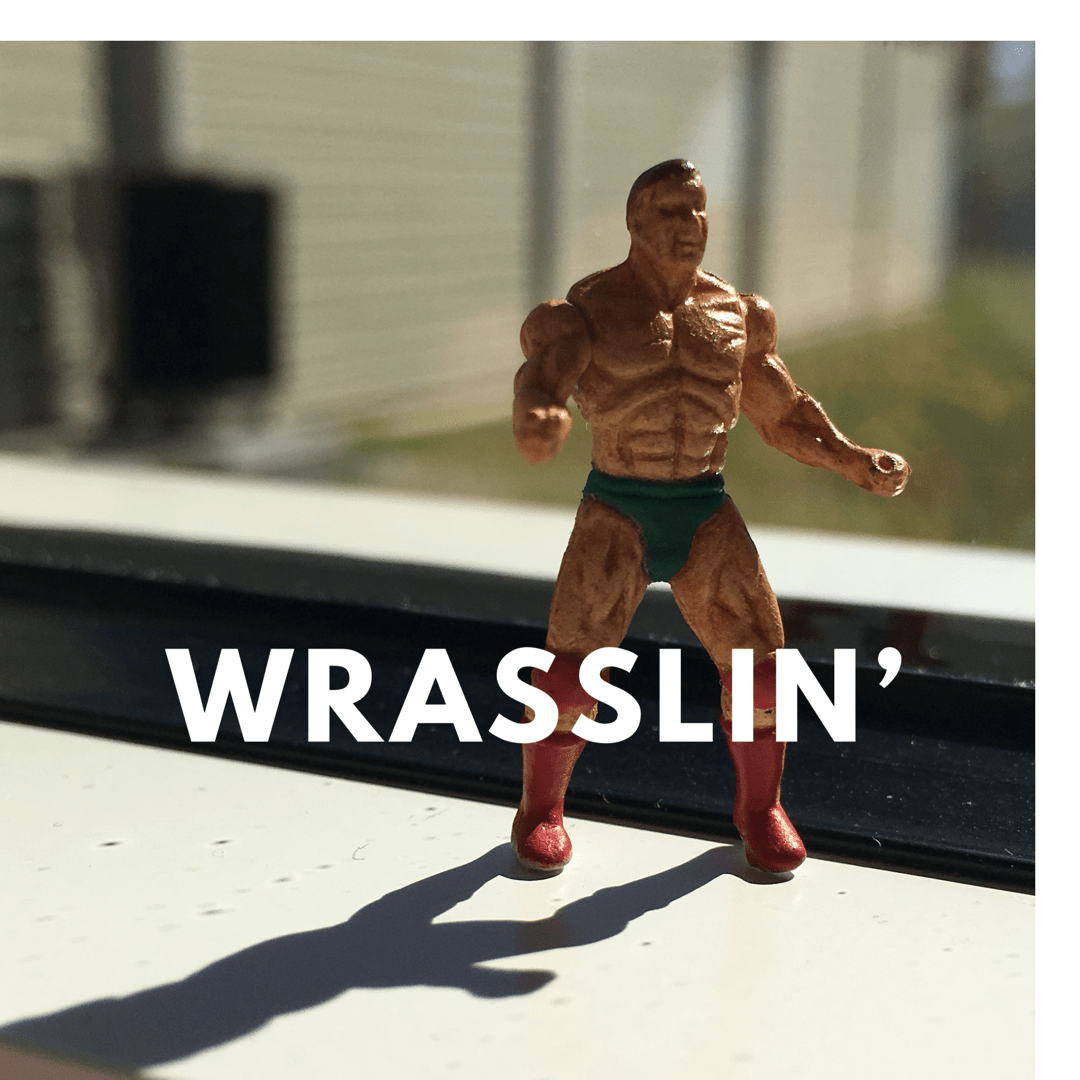
 When I was about three years old, I convinced Mom to get me a Deluxe Hulkmania Workout Set, complete with a set of dumbbells, jump rope, hand gripper, a headband, a Hulk Hogan poster, and a cassette tape of Hulk Hogan giving a forty minute inspirational speech and walking you through a workout regimen, not to mention some pretty sweet 80’s hair metal music. I thought Hulk Hogan was the strongest man in the world.
Dad taught us how to wrestle when we were just barely old enough to walk. He’d lay in the floor and we’d climb over him. It was great fun. For the most part, Zach dominated me in the wrestling ring. He was overgrown for his age, I think he might have been born with a full set of teeth. The only time that I got the best of Zach in a wrestling match was when I wiped a booger the size of cornflake on him.
It took a few years for me and my brother to realize that professional wrestling was entertainment and the wrestlers were acting. If you suplex somebody for real, it hurts. Every week my family would have supper at least once at my grandparents, that’s where Zach and I would watch wrestling on their television. To a little boy there are not many things cooler than a man with painted face and baseball bat dropping out of the ceiling by a cable to fight a man who had 24 inch biceps who had just ripped his shirt off.
During the commercial breaks, Zach would try out any new moves that he had learned. On me. We’d usually wrestle until we knocked a whole in the sheetrock, or I got a bloody nose. It’s a wonder that we didn’t tear the house down.
From time to time, Mom would go to the grocery store leaving us at home with strict instructions to behave. We’d give her about five minutes to get down the road before we moved the coffee table out of the way and set up a wrestling ring. The living room had everything you needed for a wrestling match, a couple of comfortable chairs, an ottoman, a couch, and forty-‘leven pillows to help soften the landing as your brother pile drived you. There were always a bunch of decorations that we’d have to move too, like the ducks. Mom had about half a dozen wooden ducks that contributed no practical purpose to the functionality of the room. Over the years, we broke the head off of every single one of those ducks while we were wrestling. We’d spend about five minutes wrestling, and twenty five minutes in veterinary surgery supergluing duck heads back on. She didn’t notice either. We finally told her after we’d gotten married.
My great grandparents went to Boaz, Alabama to a live wrestling event at the National Guard Armory, because that’s what classy people did for entertainment in late 50’s. I think that armory was about the only thing in Boaz, but I might be wrong. Even today, it’s hard to imagine driving to town like Boaz for anything. The main wrestling event involved Tojo Yamamoto, a Hawaiian born American wrestler whose real name was Harold Watanabe. The wrestling company capitalized on the strong anti-Japanese sentiment that was still very much alive in the decades following the war, especially in the South, and Tojo played the bad guy.
Tojo Yamamoto was booed and heckled as he entered the ring. In the microphone, he indicated that he wanted to “Make aporogy.”
“My country, they bomb Pearl Harbor. I so sorry.” The arena went deadly quiet as he continued. “It wrong thing to do. I so sorry.” Now the crowd began to cheer
“I wish instead they bomb BOAZ!”
I grew up hearing this story every so often and it always produced uncontrollable laughter in a few of my kinfolks. Mainly my dad, who often has a hard time finishing a funny story once he gets “Tickled.”
The fact that this story has survived and still produces a strong reaction gives me hope that my ancestors understood that there was a strong element of show business in professional wrestling, and I’d like to believe that they went to the wrestling match for the humor.
 Mostly From Memory