Some Thoughts on Truth

Resisting the truth is what keeps many conflicts alive.

While I was working my way through college I noticed a phenomenon that happened with alarming frequency. Things that I had been taught in high school as fact were now being challenged and subjected to heavy source criticism.

Post-truth: relating to or denoting circumstances in which objective facts are less influential in shaping public opinion than appeals to emotion and personal belief.

It was the Oxford Dictionaries word of the year in 2016.

“Never have human societies known so much…but agreed so little about what they collectively know.”

Dan Kahan, psychology and law professor

It is safe to say that we live in a post-truth society. What does this mean for the Church? As Christians we are people who are very concerned with truth and how we view truth is a matter of grave importance. This is in no way an exhaustive work, but a mere peering into mirrored surface of the profound pool of truth.

Truth can be known.

Jesus said in John 8:31 “…And ye shall know the truth, and the truth shall make you free.”

You cannot know a lie. Neither do lies bring freedom. You can only believe a lie.

But truth is knowable. It is stable foundation that can built upon. When everything is falling apart in your life you can cling to something that you know is true.

You can know this today: There is a God who loves you.

Truth must be purchased.

While there is some truth that can be immediately transmitted into our knowledge, truth must be purchased; sought out. You have to get it for yourself, not just because some body told you.

Buy the truth, and sell it not; also wisdom, and instruction, and understanding. Proverbs 23:23

In order to be purchased, truth must be valued. You will not purchase something that you do not think is valuable. Lies can also be purchased. What people value determines the market. Truth is precious. It is rare. Lies have no value. Unfortunately, many unsuspecting-or rather undiscerning-people have been sold so many lies at immense costs.

What you value matters to God. The highest level of value is love. If you do not love truth, God will hide it from you.

II Thessalonians 2:8-12 And then shall that Wicked be revealed, whom the Lord shall consume with the spirit of his mouth, and shall destroy with the brightness of his coming: Even him, whose coming is after the working of Satan with all power and signs and lying wonders, And with all deceivableness of unrighteousness in them that perish; because they received not the love of the truth, that they might be saved. And for this cause God shall send them strong delusion, that they should believe a lie: That they all might be damned who believed not the truth, but had pleasure in unrighteousness.

Truth Demands a Response.

Response to truth is reflected in behavior. When truth is resisted corrupt behavior is manifested.

II Timothy 3:1 This know also, that in the last days perilous times shall come. For men shall be lovers of their own selves, covetous, boasters, proud, blasphemers, disobedient to parents, unthankful, unholy, without natural affection, trucebreakers, false accusers, incontinent, fierce, despisers of those that are good, traitors, heady, highminded, lovers of pleasures more than lovers of God; Having a form of godliness, but denying the power thereof: from such turn away. For of this sort are they which creep into houses, and lead captive silly women laden with sins, led away with divers lusts, Ever learning, and never able to come to the knowledge of the truth. Now as Jannes and Jambres withstood Moses, so do these also resist the truth: men of corrupt minds, reprobate concerning the faith.

Truth will always be resisted, and as time draws near to the end, it will be resisted more. People will always try to hide the truth, and it will be reflected in their fruit.

Truth is Liberating.

John 8:31 “…And ye shall know the truth, and the truth shall make you free.”

With truth comes a freedom that nothing else can bring. Hiding the truth breeds fear. There is nothing to fear when you can tell the truth.

If you tell the truth, you won’t have to worry about someone else telling it.

New Beginnings

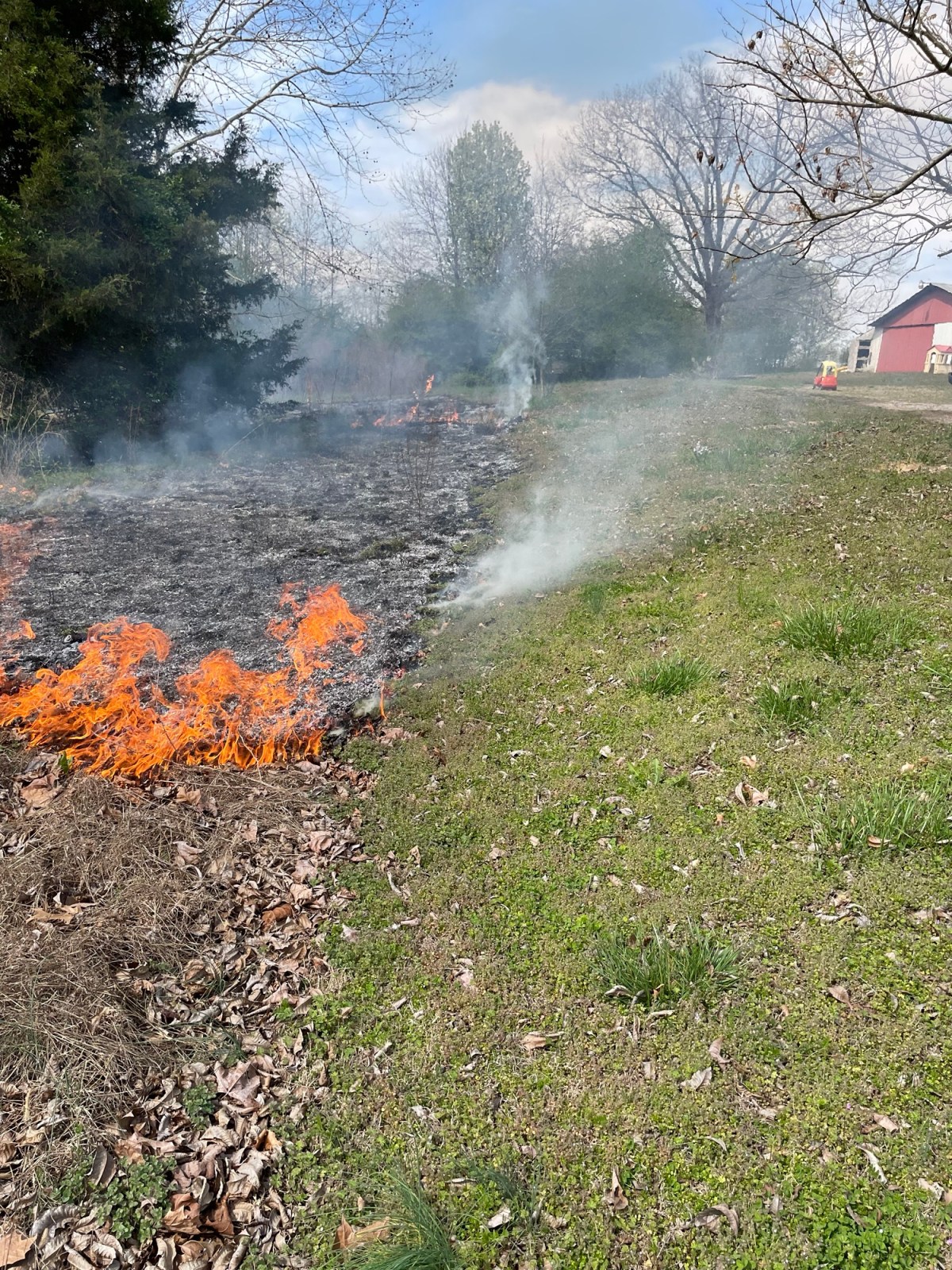
I burnt off half of my yard earlier this year. Because I did not want to mow it, I allowed the brush to grow up to the point where I could not mow it. While it is not the only way to tidy up a yard, burning is perhaps the best way to begin a clean start. It is a conflicting feeling to watch the fire take over the yard. The flames will not selectively burn just the overgrown, stubborn weeds that have begun to harden into pithy stalks, it also consumes the tender grass. And then there is the waiting. And in the waiting the questions. How long will this lay waste in ashes? Will it come back?

It does come back. And better.

During The Fire.
After The Fire.

This is a follow up to Controlled Burn.

Fiddlesticks

It was my grandmother’s most often used expletive. She only used it in frustration. Like when you’re pouring oil out of a frying pan into a glass jar through a strainer to use later and you spill the oil everywhere; that’s a proper time to say fiddlesticks! There was always a tinge of resignation in her voice when she said it, as if it was declaration of surrender to the task that had just outmaneuvered her.

Inevitably there would be someone standing by who saw the humor in the situation, and they would laugh. Gram would laugh too. No sense in staying upset all day over something silly.

Mom’s favorite wooden cuss-word was “Cat Hair!”

Apparently, people have been using fiddlesticks in this way since the 18th century. Whenever she said it I would imagine someone knocking over a bucket of violin bows. Have you ever priced a violin bow? Or I would visualize a couple of bows crossed above Gram’s head like some musical coat of arms. Or perhaps a barrage of fiddlesticks raining down on her. It is funny what you think as a child.

I had always assumed that a fiddlestick was the bow of the violin, and that is the original definition. But fiddlesticks is also what you call a pair of sticks that a second person plays on the strings of a violin to add percussion to a fiddle tune. It is quite common in Cajun fiddle tunes. But I didn’t grow up listening to Cajun folk music, much less seeing people play it. I was reminded of this word-and Gram- today because I saw someone playing the fiddlesticks in this video.

Hard Questions

“Will the Lord cast off for ever? and will he be favourable no more? Is his mercy clean gone for ever? doth his promise fail for evermore? Hath God forgotten to be gracious? hath he in anger shut up his tender mercies? Selah.”
‭‭Psalm‬ ‭77‬:‭7‬-‭9‬ ‭

David has some of the most pointed and direct questions in the Bible.

“Will the Lord cast off for ever? and will he be favourable no more? Is his mercy clean gone for ever? doth his promise fail for evermore? Hath God forgotten to be gracious? hath he in anger shut up his tender mercies? Selah.”
‭‭Psalm‬ ‭77‬:‭7‬-‭9‬ ‭

“How long, Lord? wilt thou hide thyself for ever? shall thy wrath burn like fire? Remember how short my time is: wherefore hast thou made all men in vain? What man is he that liveth, and shall not see death? shall he deliver his soul from the hand of the grave? Selah. Lord, where are thy former lovingkindnesses, which thou swarest unto David in thy truth?”
‭‭Psalm‬ ‭89‬:‭46‬-‭49‬ ‭

I’m glad those questions are in the Bible. It is comforting to see such relatable humanity in a character like David. It is human to question things. It is how God created us. David isn’t the only one with questions in the Bible.

Job had some hard questions. Legitimate questions. Questions about pain, justice, equity, and integrity. The Disciples of Jesus had questions. Questions about roles in the Kingdom, when Jesus was returning, and why they failed to cast out demons. Nicodemus had questions. Questions about who Jesus really was. Paul had questions. Questions about why God wouldn’t take away the thorn in his flesh. And Zane has questions. And maybe you have questions.

“God can handle your questions.

-Joel Booker

Sometimes I look at the calendar and I see holidays that I don’t understand. Or holidays that I understand and don’t observe. I’m not sure if it is on your calendar, but October is Pastor Appreciation month. I learned about this as an adult. I don’t recall observing this when I was a kid. I probably missed a lot as a kid though. I observe Pastor Appreciation but I don’t limit it to the month of October.

A pastor, we read in the English dictionary, is a minister in charge of a Christian church or congregation. I like Webster’s definition better, a spiritual overseer. The Bible likens pastors to shepherds and the people of God as sheep. In my childlike mind I understood that my pastor was the man who preached to me. He was The Preacher. There are many today that feel like preaching is irrelevant, and to use a Bible word foolish, but God still thinks that preaching is pretty important.

For after that in the wisdom of God the world by wisdom know not God, it pleased God by the foolishness of preaching to save them that believe. I Corinthians 1:21

“At some point, whether you want to admit it now or not, you are going to need a preacher, if only to put you in the ground.”

-Perry Wells

The words of the Preacher, the son of David, King in Jerusalem. Ecclesiastes 1:1

Solomon was a preacher. A wise preacher. Solomon gives us three of the five books of the Bible that are considered wisdom literature: Song of Solomon, Proverbs, and Ecclesiastes. In these books he gives us sound doctrine in how to conduct our relationships with our spouse, our fellow man, and pleasure. Solomon, to quote my father, was “Something else.”

Anyone can give you an answer, not everyone can give you wisdom.

And when the queen of Sheba heard of the fame of Solomon concerning the name of the Lord, she came to prove him with hard questions…And Solomon told her all her questions: there was not any thing hid from the king, which he told her not. I Kings 10:1-3

The Queen of Sheba came to test Solomon with questions. Hard questions. Let’s just see how brilliant this guy is. I’ve asked some questions like that before too. Sometimes you have to ask a few of those test questions just to make sure you’re not smarter that the person you are asking. Maybe the Queen also began that way. I can see her sashaying up to Solomon with a list of riddles and sharp hypothetical questions that she already knew the answer to, trying to catch him in a trap, and one after one Solomon answers her questions without any loss of composure. Maybe her attitude then shifted from snarky to the sincere and she began to ask questions about things that she really didn’t have a handle on but was too embarrassed to ask. After all, when you’re the Queen, you’re supposed to have all the answers.

I still have a lot of questions that I don’t feel comfortable asking just anyone. I believe that Pastors are a gift from God for the perfecting of the saints. I have come to appreciate my pastor so much more than simply his irreplaceable role as the The Preacher. At this season in my life my pastor has been someone who I can ask hard questions. Which leads me to this question: If you can’t ask your pastor hard questions is he really your pastor?

My Pastor, Rev. Zachary B. Wells.

How To Write About Grief

I have been working on this draft for almost a year. The fact is, I don’t want to write about grief. I would rather write something that will make you laugh. Laughter, as the scripture says, does good like a medicine. But I feel compelled to write about grief. And reluctance to write about it won’t make it go away anymore than ignoring makes actual grief go away. It is natural to want to avoid anything to do with grief. This is a truth: We cannot avoid the events in life that will bring us grief. Dealing with grief is part of living.

Blessed are they that mourn: for they shall be comforted. Matthew 5:4

Do you remember when you were a little kid and lost your parents at the grocery store because you were not paying attention? Losing your parents as an adult feels the same way except you are little embarrassed about calling out for them. That crying out is grief. I understand that everyone grieves differently. What has helped me has been writing my feelings. Maybe that can help you grieve too.

Stages of grief: denial, anger, bargaining, depression, acceptance.

When an event happens that triggers grief it is natural to feel these emotions, but that doesn’t change the fact that we can often feel embarrassed because we are experiencing them. After all, aren’t we adults who have everything together? Being shocked is an uncomfortable feeling. Especially for us who enjoy stability, quiet, and don’t like change. Denial can make us begin to question things we know are true. Being angry can also be humiliating because we feel like we have lost our self composure. It is where we say things like This is not fair! This is wrong! and we are further frustrated because we know what we are saying is true, but there is nothing we can do about it. Bargaining when you are unstable will usually get you a bad deal. You’ll end to doing something rash or in haste. Depression is a life sucking monster that strangles us to inaction. I’m not a licensed counselor, but I believe that one of the reasons that people end up going to counseling for grief is because they never complete the process but get hung up in one of the stages. Whenever that happens, no matter the stage, bitterness can develop.

Follow peace with all men, and holiness, without which no man shall see the Lord: Looking diligently lest any man fail of the grace of God; lest any root of bitterness springing up trouble you, and thereby many be defiled; Lest there be any fornicator, or profane person, as Esau, who for one morsel of meat sold his birthright. Hebrews 12:14-16

Bitterness is not merely an emotion, it is a parasitic root that gets in your spirit. The things that grow out of this root can’t be dealt with on the surface. Dealing with the surface is like cutting a stubborn hedge down to the ground only to realize that you simply pruned it and now it is destined to grow back even more unruly. Bitterness is a deeply inward issue that not only troubles you, but defiles many around you.

In the case of my Dad I believe I began the grief process as soon as he received the cancer diagnosis. I was shocked and tried to deny it: Cancer was something we heard about other people getting. I was scared to death of cancer as a child. I didn’t know exactly what it was and that made it even scarier. Shock and fear are not the same. I was not afraid when I heard the news, I was paralyzed with shock. I think I walked around numb for a few days.

I don’t remember being angry, but that doesn’t mean I wasn’t. And probably a big part of that is I believe in the power of prayer. I should say that although this article is about how writing about your feelings can help you through grief, it is my ardent conviction that prayer works far better. Prayer is where I did all my bargaining.

I do remember the depression stage. I didn’t want to do anything. I knew there was nothing I could do, yet I felt guilty for not doing anything and not being able to do anything. Whenever I experience depression, I eat. I think I gained 20 or 30 pounds following my Dad’s death.

I reached the acceptance stage one night before he died and while he was still coherent. That’s when I sat down and wrote this article in acceptance of his imminent death. Portrait of a Southern Gentleman, or Things I Learned From My Dad. It is a great comfort to know that he was able to read it. And he was able to brag on me a little bit, which is a source of laughter for me. I can tell you now that when I wrote that article I poured all of my emotions into those words. I cried the whole time. There was something special that happened when I was able to share those words with everyone. To know that someone else was able to experience my grief somehow made the burden lighter.

I will never forget the feeling of release when my Dad finally passed. It was as if I had been walking around carrying a couple of cross ties and somehow they just floated away.

From the end of the earth will I cry unto thee, when my heart is overwhelmed: lead me to the rock that is higher that I. Psalm 61:2

“You need someone to walk with you through the valley of the shadow of death. And when your heart is overwhelmed you will need someone to lead you to the rock, because you can’t find the way yourself.”

I did the same thing when my Mom died but she didn’t get a chance to read it, and knowing this I think allowed me to achieve a greater degree of acceptance.

Since then, I have made writing a part of my grief process. Which seems like an odd thing to say. I never thought about death as a child, but it is a steady growing part of my life now that I look more and more like Alfred and less and less like Bruce Wayne. Writing has helped me grieve the loss kids that were in my youth group-Oh Brandon!, family-Funeral Processions , Dan Theo Wells 1935-2021 , and dear friends- J.L. Parker. Not to mention countless things I have written in my journal.

So how do you write about grief? I think it is important to establish that putting your feelings and thoughts into written words while you are grieving is one of the most honest and genuine expressions of yourself. There should be no pressure to write to impress someone. This is you and your feelings. Putting those thoughts onto paper is a conscious going out of yourself. You have captured and placed in the visible an idea that has been floating around in the invisible. You have conquered that thought, and it can never escape. No one is grading you on content, grammar, or proper punctuation. And you do not have to share it with anyone. No one may ever see it. But it may help to allow a friend to help bear your burden. I know it does for me.

I still miss my parents every day. And I probably always will. I feel strong emotions every once in a while, but never denial, anger, or bargaining, only acceptance, peace, and most often sadness. If it gets bad I’ll go back and read what I wrote when it was still fresh and that helps.

I wish I could’ve talked to my Dad this week, because I am in a new process of grieving. But I already feel better having written this.

Clapping: Your First Lesson in Rhythm

I have a little nephew and all he knows how to do is fill up diapers and clap.

O clap your hands, all ye people; shout unto God with the voice of triumph. Psalm 47:1

Did you grow up around live music? If so you probably clapped along, and probably never had to be taught how to clap. Its one of the first things you ever did. I have a little nephew and all he knows how to do is fill up diapers and clap. Its just in us naturally and most of us never even think about it.

Every once in a while I get to lead worship and I like to sing old songs. You know; country songs. Duple meter hillbilly gospel music. You can call me nostalgic and you’ll probably be right, but I also once had a kid rap at Youth Camp. You can’t please all of the people all of the time. Anyway, whenever I lead one of the these old upbeat gospel songs out of the hymnal there is usually one or two people that clap opposite of everyone else. And it makes it hard on me. Here I am, not really a singer but giving it all I got trying not to blow an artery while singing in the rafters, hoping to remember to give signs to the poor praise singers who are not hillbillies, and somebody is clapping off beat.

“Bluegrass is based upon a complex rhythm scheme called the boom-chuck boom-chuck. We kindly ask that you do not clap on the boom, only on the chuck.” -David Crowder

I feel like this man Crowder is speaking from the frustration of leading a song with a group of audience members who do not agree on where the clap feels right. And that is what I am here to talk about: How do you feel time?

Sincerely, I do not expect every audience member to be a musician and I wouldn’t discourage anyone from clapping in praise, whether they are in time with the music or not. This subject is interesting to me because time/feel is one of the things that makes music unique.

The “Boom-Chuck” rhythm that Mr. Crowder is referencing is the down beat (boom) and the back beat (chuck). In a bluegrass band the boom would be the stand up bass, and the chuck the mandolin. This eventually manifested itself in the drum kit with the kick drum playing the boom and the snare drum playing the chuck. So when Chuck Berry sang “Its got a back beat you can’t lose it” in Rock and Roll Music he was talking about the snare providing the back beat.

I was shown as a child, by a host of witnesses now passed on, to clap on the back beat. I didn’t grow up with a drum kit in church, which is where I did all my clapping to music. The clapping congregation were the timekeepers in my little church. I am sure I would’ve gotten in trouble from Mom for purposefully clapping on the down beat at church. And honestly, I have to bite the inside of my lip and furrow my brows like I am doing long division just to be able to clap “wrong”. Not because I can’t bring myself to do it, but because it is unnatural to me. But that is the musical tradition and environment that I was raised in.

When I got to Gateway College of Evangelism and joined the choir I was surprised to learn that even some of those blonde-headed, blue-eyed, midwestern yankees with funny German last names were just learning for the very first time in choir practice that you clapped with the snare drum in Gospel music. I thought man these people are backwards. Looking back though, Polka and Bluegrass musical traditions feel time very differently and emphasize different beats. And you might get odd looks for clapping on the back beat at Polka or Klezmer concerts. (I may be wrong about that, I have never been to either, but a lot of Polka is in 2/4 and puts strong emphasis on the downbeat. Klezmer music often has more elaborate clapping schemes compared to the simple backbeat.)

My Uncle Melvin believes that all this rhythm stuff we are talking about is made up, especially the part where you can count. I thought he was joking but after I talked to him about it I think he is being genuine. Maybe he represents a large swath of people who have no idea what I am writing about. I kind of doubt it though. I believe that many of you, especially if you grew up in a church that encouraged clapping, or around live music in general, will have a natural desire to move or clap when you feel a song. It is how you feel that song that is fascinating to me.

I made this video to demonstrate this topic. I said something in it that I want to set straight.

“There’s nothing worse than trying to lead worship with a group of people that are not in agreement on where to clap.”

That is not true. No one clapping is far worse. Clapping is an act of praise. Fortunately we are not being graded by The Almighty on how good our rhythm is. It doesn’t even have to be rhythmic. He’s happy with noise.

Make a joyful noise unto the Lord, all the earth: make a loud noise, and rejoice, and sing praise. Psalm 98:4

The Secret Society of Bald Men

I have noticed over the last few years that my hair is thinning. That is a less painful way of saying that I am going bald.

“We need to get haircuts this week Wes.”

“Yeah. Those couple of strands of hair in the front look weird on you.”

“Oh yeah? What do you think I should do?”

“Well it may take some getting used to, but maybe The Bro. Sutton.”

Let me tell you about Bro. Sutton’s hair: He’s bald. Not just any bald, but shiny bald on top, with hair still around the sides. You know the haircut. This is how my own flesh and blood sees my hairline. He’s not the only one though.

That’s me. Before I make excuses about the lighting, let’s be honest that my hairline is almost level with my ear.

Leviticus 13: 40 And the man whose hair is fallen off his head, he is bald; yet is he clean. 41 And he that hath his hair fallen off from the part of his head toward his face, he is forehead bald: yet is he clean.

I’m glad that God decided to include this scripture in the Bible.

There is a brotherhood of bald men with secret handshakes, passwords, and I don’t know what all. You have probably noticed the familiarity bald men share with each other. Even total strangers give a nod to each other as if to say we’re in this together. The problem is they have begun to mistake me as a member.

I have noticed over the last few years that my hair is thinning. That is a less painful way of saying that I am going bald. I didn’t notice that y’all noticed though. But you did and probably a long time before I did. But people are kind and they didn’t say anything. Or maybe they thought that I noticed too. Let me tell you, it sneaks up on you. I haven’t been to the barber shop in almost a decade, so maybe my barber would’ve mentioned it.

It has progressed to the point that I have been approached about joining The Secret Society of Bald Men. Last week I met with two sitting members of the Society. They were men that have taken a higher order within the dark organization. I could tell because they were not only bald, but their heads were completely shaved. I can remember the younger one before he joined. That means the last time I saw him he still had hair. Kind of. His hair used to look like a rooster tail glued to a volleyball. Now he looks like Stone Cold Steve Austin.

“You should do it.” They older one said, trying to pressure me into shaving my head.

“You’ve got a nice shaped head. It will look good.” The younger one chimed in.

“I’ll do it for you. Lets do it tonight!” The older one followed up with a wild grin.

“Y’all almost convinced me. Let me wait for a more convenient season.” I told them.

Hair is the only thing a bald man sees when he walks into a room.

-Zach Wells

Integrity: that’s really why I am thinking about joining the Secret Society of Bald Men. The men that I met had an epiphany at some point-probably after they saw a picture of themselves-said “I’m tired of living a lie! I’m just going to be bald.”

I keep trying to convince my wife that buzzing my hair will look good. I’m not talking about shaving it down to skinhead level, but just so close that I don’t have to comb it. Or try to comb it over. She hasn’t been persuaded yet.

All the men that I have known that shaved their heads did it without their wives permission or consent. Which is something else that appeals to me. I enjoy giving Sarah a good surprise every once in a while.

Nobody looks at a man with a combover and thinks I’d like to try that. But when I see a man that has taken the plunge and shaved his head I see a man that has come to terms with his baldness and won. And that is inspiring.

Church Clothes: An Essay on Discomfort

Do you remember when you were a little kid and your momma would make you wear really uncomfortable clothes to church?

I’m supposed to be packing my church clothes for a Youth Conference that I am attending later this week, but I am procrastinating. This is what I do when I procrastinate: write essays. This essay is about church clothes. Having been going to church for 37 years-and 9 months before that-I have a long and conflicting relationship with church clothes. I was raised-and firmly believe- that you ought to dress your best when going up to the House of The Lord. Whether that is a pair of cowboy boots and your cleanest blue jeans, or a business suit and tie. This is the rub: I really enjoy looking nice in a suit and whatnot, but I also really enjoy being comfortable. And unless you are just the picture of health with a trim figure like a Greek statue, or have you enough money to pay someone to make you a suit of clothes that fit your exact body proportions, there is a strong chance that your suit is just going to be plain uncomfortable.

I’m not convinced that comfort should be the first priority when dressing for church.

Do you remember when you were a little kid and your momma would make you wear really uncomfortable clothes to church? I remember one Easter having to wear a button up shirt and these teal dress pants. I hated them. I looked like I stepped off of page 37 of a JC Penney catalog from 1992. Not only was I required to endure these clothes all through church, but I wasn’t allowed to change until after the egg hunt at Uncle Dave’s. I still think that is how a lot of people feel about dressing for church.

Most of the time, I do not really pay attention to what other people wear. And from a scientific study I did in college on this topic where I wore the same suit and tie for a solid week to see if anyone would say anything, I don’t think most people pay attention either. But it is hard to not notice when someone feels uncomfortable in their clothes. Especially a suit. I used to look out my window at work down at the courthouse steps and watch young men walk unsure of themselves in an ill-fitting suit to a matter of grave concern. You see uncomfortable people at funerals and weddings, their awkward conversations informed by clothes that they don’t really understand how to behave in.

There is a way to wear a suit like a lawyer or like you have a court date.

Here is a people watching experiment for you to try on a Sunday afternoon: go out to eat at the most crowded restaurant you can find right after church. Better yet, go to a buffet. Try to guess which people went to church and which people just decided to go get some Chinese food. It should be easy to tell by what they are wearing. I made a Bingo card for you to fill out.

Suit
&
T-Shirt
Tucked in PoloElderly couple with matching died hairGold-buttoned blazerHebrew letters on an article of clothing
Penny LoafersSuit
&
Tie
PaisleySun dressChurch Logo T-Shirt
Cowboy
boots
Braided
belt
Child in a sailor suitSeersucker“Praise the Lord!”
Greeting
Bow TieWingtip
shoes
“Production Team”
T-Shirt
SuspendersPleated Khakis
High HeelsWestern
Shirt
ComboverChurch Logo
Hat
Square toed dress shoes

Uncomfortable: that is how dressing for church felt until I started paying attention to girls around about Middle School. It was then that I quit depending on Mom to tie my tie and started wanting to pick out my own suits and dress shoes. I think everyone goes through an identity crisis sometime during Middle School. Being interested in dressing yourself, while not knowing how to dress. The real conflict can be articulated thus: I don’t know what I want to wear, but I know it isn’t what Mom has been choosing. It takes a while to realize that your Mom had pretty good taste. Aside from maybe the teal Easter pants.

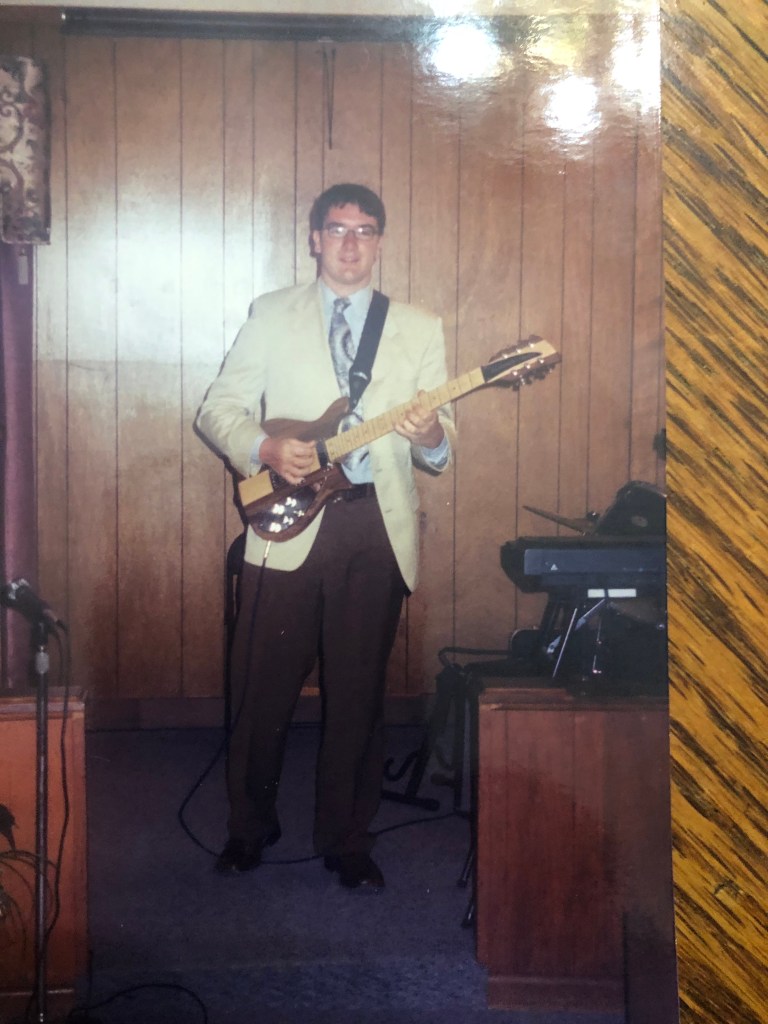
I got these hickory stripe tuxedo pants from Zach. I don’t know if I ever got cooler than that.
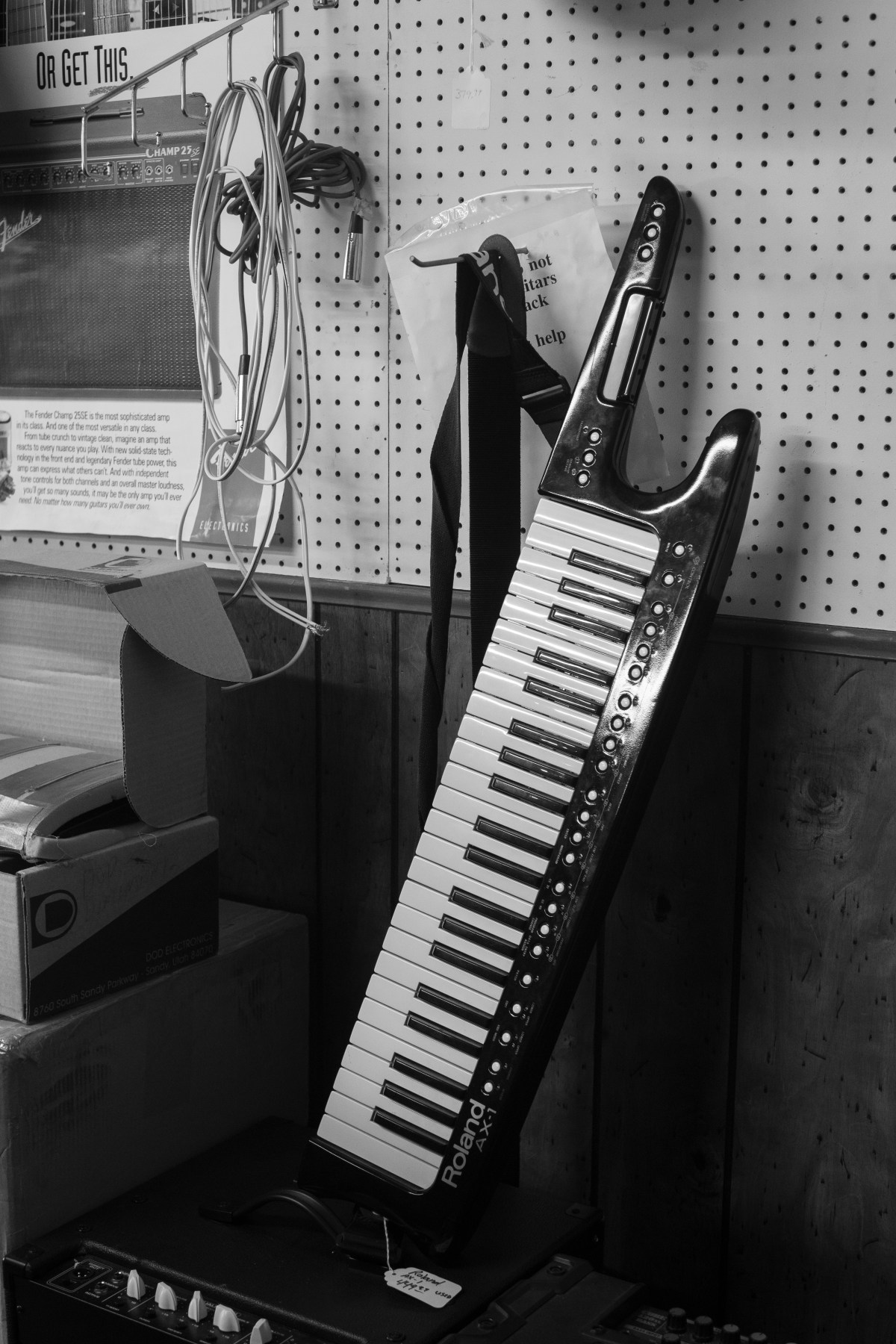
I’m less worried about my clothes and more interested in that guitar that I might’ve should’ve kept. Alas, it didn’t sound near as good as it looked. I suppose there is a lesson to be drawn from that.

Fashion is so fickle. When I was a teenager I probably spent far too much money on dress clothes. Trying to be fashionable, or cool. Some of those clothes are cool again, but probably won’t be for long. I will see teenagers this week at PEAK wearing stuff similar to what I wore 25 years ago.

My sartorial ideals have always been too lofty for my meager salary.

It took me a long-a very long-time to figure out exactly what kind of church clothes (or any clothes for that matter) that I wanted to wear. But Today, I feel that I am closest to my real essence when I am wearing a suit and tie. Ultimately, I think I accidentally took less cues from my peers and current fashion trends and more from history while establishing my wardrobe standards. And it happened by seeing old photographs not necessarily related to fashion from say 1962 or 1937 of a men in suits and realizing I would wear that today. When you take this classic approach, you are making a statement: I’m going to wear this and be confident and comfortable no matter what is trendy. This means that you may or may not be in style as the years pass. But what you will be, is established. And possible timeless. And we need more established people.

Well, I have to go pack.

My Favorite Things: Peaches

When was the last time you had a good peach? The kind that you bite into and the juice runs down your chin but you don’t even care?

When was the last time you had a good peach? The kind that you bite into and the juice runs down your chin but you don’t even care? A good peach ought to give a little when you touch it. You know it’ll be juicy if it leaves a thumb imprint. Sarah brought home some peaches from the store. Georgia Juicy the bag said. And they were. I ate five peaches one morning. I don’t know if peaches are my favorite fruit but they are in the top 25. I like to have to wipe my elbows when I get done eating a peach. The next week she went to a different store and brought home some peaches with the bag that said Fuzzies. I wouldn’t say the fuzz on a peach is the most appetizing or marketable feature. I do eat the skin. I know some people don’t like that, but it doesn’t bother me. I do like to rinse peaches before I eat them just to slick that fuzz down a little. It’s sort of like combing your hair before you go to church: it’s still the same old hair, but it just looks a little nicer when a bit wet.

Do peaches really need marketing?

I’m sort of glad that peaches are seasonal. Would they be as special if you could get them every day? Even when they are in season you might not get a great batch of them.

Peaches are the kind of food that don’t just taste good as an ingredient: A peach is good all by itself. But if I had to pick my favorite peach concoctions it be in these. Peach ice cream. Peach cobbler. Fried peach pie. I would like some homemade peach ice cream straight out of the container when it is still the consistency of a thick milkshake. Where you can use a spoon because you are mannerly, but really you can just drink it.

I hope y’all get some peaches soon.

The Cows Are Out

I saw these calves out of the fence this morning.

I saw these calves out of the fence this morning. And I just felt like I needed to tell someone. It seemed like the responsible thing to do. So I’m tell you since I don’t know who owns these cows. In fact, I don’t even know anybody that lives on the road where I saw them. I didn’t grow up in this town.

I imagine that whoever owns the cows will take care of the situation. Promptly. It might be a nuisance to have to stop what they are in the middle of doing and go try to round up loose calves. But this is probably not their first rodeo. And they’ll probably get the cows back in the fence and mend the fence right away.

This wasn’t the last time I caught these two yearlings out of the fence.

Things like that get taken care of quickly on the farm. I doubt there will be a meeting with all of the department heads to see whether it is a real problem or not and who will take responsibility. Or follow up departmental meetings to see who will be assigned to an interdepartmental special task force team. And no third meeting with the reluctantly volunteered staff to develop a plan of action. I bet just one man and a sack of feed took care of this issue.

Not all problems are this simple. Yet I am afraid that we often make a more complicated solution for problems that are even less important than cows being out.