Dementia

“Mr. Zane, that little old lady back there doesn’t even know her name. All she does is mumble, but she just sang I Saw The Light along with you.”

I have been blessed with a unique opportunity to sing at the nursing home as a part of my job. I have lost count of how many nursing homes I have visited. One of the most interesting and moving experiences I have had so far is singing in the memory care units. The memory care units I have visited have been in assisted living centers, not nursing homes, and are for residents who are dealing with memory loss due to Alzheimers or dementia. These units are usually locked down so the residents won’t wonder off and get lost. As I am being escorted through the halls, the workers always try to mentally prepare me for what I might expect as they punch in secret codes that take us deep into heart of the building. They don’t realize that that kind of stuff doesn’t bother me. I’ve probably been to more nursing homes than they have, and even preached at the Methodist church. I always keep my eyes closed while I’m singing anyway.

I’m not a licensed music therapist, but I have seen the power of music first hand. When the director of the unit walks up bawling after a concert and says things like, I’ve never seen that man talk before after the man just talked to me for three minutes. Or There is a little old lady back there that doesn’t even know her name. All she does is mumble, but she just sang I Saw The Light along with you. This kind of thing happens often. I cannot tell you what these people are diagnosed with, but I can tell you that there is a moment when the light comes on in their eyes. And it is a moving experience.

I often leave from these brief concerts thinking about those people, locked up in a wing of some multimillion dollar facility. Each person represents a heart wrenching story of children coming to grips with a parent whose mental state has deteriorated to an unrecognizable point. When did the children notice? Did their parent, who once possessed a sharp intellect and a profound pool of wisdom become foggy in their memory and erratic in judgment? Was there a sudden change in personality from a caring and compassionate nurturer to a mean and selfish miser, or was the change gradual? At what point did a brother call a sister and say, I think something is going on with Dad? And I wonder about perhaps the hardest conversation of all, Dad, we’re concerned about you, I think we need to get you some help.

I imagine a lot of that depends on the state of the relationship between children and parents. Disfunction, strained relationships, and estrangement is the sad reality for many families, and would make an already extremely difficult situation nearly impossible to navigate.

I have talked to quite a few people who have had this experience with a parent. They tell me that looking back they could remember odd changes in behavior from years before that now made sense. They talk about the parent leaving long before the body expired. And the sense of relief after their parents’ death, accompanied by a slight sense of guilt for being relieved. They also speak of the relief of knowing that the unkind words spoken to them were the disease and not the parent.

These are all the things I think about when I tune up my guitar in a memory care unit. I look for that light to come on. I try to sing a wide variety of hymns and gospel songs in hopes that one of them will resonate with a lingering memory behind a set of blank eyes. I also am painfully aware that I may not be able to reach someone if they have no memories of any of these spiritual songs. Or maybe the music has already died and there is no recalling them.

I sing anyway. I never know who is listening.

Broken

It may not work, but I am going to do my best to fix it.

“This guitar is broken!” I said in exasperation to the young man I was helping move across town.

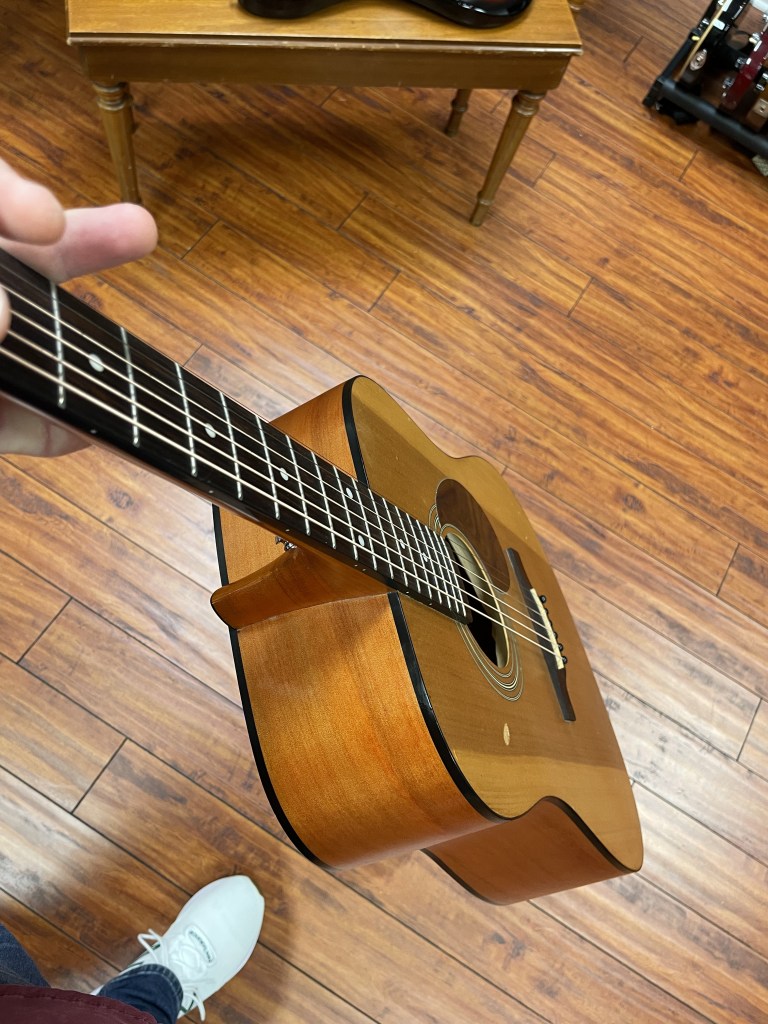
“You can have it.” He said, looking nonchalantly at the tired old instrument with a large crack in the heel of the neck. I laid it in the back of my truck like a wounded soldier amongst the mirrors and pictures wrapped in moving blankets. This guitar had been neglected if not abused. I winced as I thought back to things that I had not cared for properly as a child.

I took the guitar home and surgically removed the dirty strings and cleaned it thoroughly. Under the light of my work bench I could see that the crack wasn’t all the way through, but still substantial enough to make the guitar unplayable. I felt like the doctor when they say things like, It may not work, but I am going to do my best to fix it.

I inserted wood glue into the crack with a needle and syringe and clamped the body and neck down to the work bench to hold tension on the crack. This will only hurt for a little bit. Then I turned out the lights and didn’t look at it for three days. When I finally came back to it I could still see a black line where I probably didn’t clean the crack sufficiently, but the joint felt solid. Now I just needed some strings. Before I took the time to take a trip to the Guitar Dungeon, I happened to be at a friend’s house as he was changing his guitar strings. I noticed that he had an interesting string removal ritual. I usually clip my old strings-which have been played to death, black with grime and riddled with divots and dents- with a pair of wire cutters, and then to avoid a finger injury from the sharp string end under tension, I unwrap the bit still attached to the tuning post with a pair of pliers. He was taking his time and unwinding the string gently from the tuning post, so the entire string was still intact. Then he carefully placed each string in a neat little line, as if he too could still feel the life pulsing in those sparkly bits of metal, just waiting to be touched so they could burst forth singing. It works out nicely because the strings could be reused if you break one of the new ones. He did poke his finger with a sharp string end and there was a bit of bleeding. As he took the last string off he tied the whole bundle in a single knot. That’s when I asked him if I could have them. And he obliged. I have a hard time throwing some things away. Or seeing things thrown away. And those strings had been watching me like a puppy at the pound.

The next day I put the used strings on the old broken guitar and gave each another chance at life. I decided to leave the guitar tuned down a whole step, because I wasn’t sure if it could handle the tension of standard tuning. I held my breath as I got the last string tuned, then I cautiously inspected the crack. It was still solid. I played an F chord-not the first choice of most guitar players. And not the easiest chord to play in standard tuning. But we weren’t in standard tuning, and the F chord seemed so natural now and it rang out beautifully, deep and rich.

I have wondered what to do with this instrument brought back from the gates of death. I can’t in good conscience sell it. Because it was a gift, and also because I feel like I need to stay close to it in case in needs further repair. And maybe no one would want to pay for a broken instrument. This instrument has already served its time in the heavy hands of a careless owner. It now needs the gentle touch of a seasoned musician. Someone who has lived enough to know what pain feels like. I feel like I want to keep this resurrected instrument where I can see it every day and be reminded of the many second chances that I have been given. I want to be able to pick it up and make sweet music with something that came so near being cast off.

A bruised reed shall he not break, and the smoking flax shall he not quench: he shall bring forth judgment unto truth. Isaiah 42:3