Classical Music

There is a feeling that comes to me in the fall when the light is shining through the window just so, kind of sideways in the morning after all the kids are off to school. There must be a window where I can see the rest of the world, busy about their work. And there must be classical music creating a little bubble of peace.

Classical music to me is not sitting in a stuffy hall in your uncomfortable church clothes watching a bunch of musicians in their uncomfortable church clothes play music that everyone pretends to like. To me classical music is anesthesia for a job that I don’t enjoy very much. Sometimes I listen to classical music and I am in a concert hall, watching musicians play, but most of the time, the music is just the soundtrack to my imagination.

It works without a window too. I used to listen classical music seriously when I had a job cutting grass. It became a great escape for me. I had these radio headphones that allowed the music to take me far away from the tedious and laborious tasks of weed-eating. And when I finally got a job in the air conditioning, I would listen to classical music from the comfort of my desk as I watched the hustle and bustle of traffic just outside my window. That is the feeling that I am trying so hard to describe to you. It is as if I am looking at the rest of the world in a little glass terrarium, the music allows me to be an outside observer.

I was introduced to classical music when Mom bought our first CD player and a few CDs. The one I remember was a collection of classical music favorites. I listened to that album a lot in my bedroom. And if I hear one of those pieces today, like Schubert’s unfinished symphony, I am transported back to my little bedroom with my octagonal window.

Maybe it was because of the record player that listening to music became a ritual for me. I needed help from an adult with the record player. And once the record started, I would be left alone to be tended by the music. I just had to listen to the whole thing, there was no turning back. So I think that sense of commitment carried over to CDs. Anytime I got a new CD, I would sit down and listen to the whole thing front to back without stopping. I still think this is the best way to listen to music.

For all my love for classical music, I have only ever been to one concert. It was when I was a teenager. We went to a beautiful concert hall somewhere in Birmingham to see-and hear-the Alabama Symphony Orchestra play Variations on Haydn. At the beginning of the concert, the conductor gave a speech to the audience. And for some reason, the first chair violin was chatting with his neighbor. The conductor turned around to say something to him out of the microphone. When the conductor turned back to the audience, the first chair violin shook his bow at the conductor. That has always stood out to me. Was there bad blood between these two? Jealousy? Was this simply a joke? Who can know? I remember liking the music though and just staring at the orchestra. I could’ve watched it all night. My Uncle Tony elbowed me to point out a man who had fallen asleep. I guess it would be good music for sleeping.

I have been listening to a lot of classical music lately because the weather is just asking for it. And perhaps maybe because I like to daydream.

Phrasing

Maybe he meant, Young man you don’t understand how good you really got it.

Do you remember when you were in high school and the whole English class had to take turns reading Shakespeare’s Macbeth out loud? Our teacher assigned a different cast for each scene so we could all get a chance to experience public speaking anxiety. You never knew when it was your turn; you just waited in agony; your only consolation was how bad your classmates were doing. Everyone was saying the right words, but hardly anyone was really confident in their understanding of the text, despite any confidence they pretended to have in pronunciation. They were simply words without meaning: noise. It would’ve been painful to endure if we weren’t so clueless. I have a feeling that some of us thought we were doing a good job, but I don’t think anyone in my class went on to pursue an acting career. As bad as it was, I still enjoy hearing people read out loud.

I can hear us now just droning on…

Macbeth: If we should fail?

Lady Macbeth: -We fail?

But screw your courage to the sticking place

And we’ll not fail.

Now think for a minute of the old man you used to see at the grocery store—it helps if you had a job at a little grocery store while you were in high school—who had worked as a mechanic for 50 years and had to drop out of middle school to help out on the farm. He couldn’t pass an English class if his life depended on it, but it didn’t really matter; even with atrocious grammar and a vocabulary half consisting of words that could not be found in the dictionary, he could still create a sentence that would stay with you for 20 years because he knew exactly what he was talking about.

“How you doing today Mr. Wallace?”

“I’m doing fine, and you?”

“Pretty good.”

“Pretty good hard to beat.”

Pretty good hard to beat has been incorporated into my language. It may seem just like words on paper-or a screen-but it was the way he said it that let you know there was a lot more meaning that went into that sentence. Maybe he meant, Young man you don’t understand how good you really got it. I think about that old man whenever I chance to use this phrase. Whatever he may have intended, it certainly resonated with me.

That is what we call in music phrasing. Phrasing is how a musician puts a sequence of notes together into a musical thought, and how they interpret written music. It is the reason that Blues musicians could limit their musical vocabulary to the 5 note pentatonic scale and make people cry. It is why folk music can be so simple in its form, but still able to make us recall memories of places we’ve never been and times in which we never lived. And the same reason that beginner musicians sound like beginner musicians: their phrasing is off somehow. They may be playing the right notes-even reading the right notes from a master composer-but still unable to convey the real meaning of what the composer was trying to say.

The blues is feeling good about feeling bad.

Phrasing is more than having a nice voice, or tone. But I imagine that won’t hurt, but I’m not convinced it helps all the time either. It doesn’t matter how nice your voice is if you don’t have anything to say. Or if you are only going to regurgitate words that came from someone else’s heart.

It took me a while to really appreciate Shakespeare, and the closest I have come to understanding it was to see a play performed by actors who understood it at least better than me. I took Sarah to Blackfriars Theatre in Staunton, VA to see a All’s Well That Ends Well and Two Gentlemen of Verona. It was a far cry from bending over the text book following along as your buddy in class-who had never read a book for pleasure in his life and barely had a grasp on 21st century American English-stumble through his assigned lines without the faintest idea of the plot. Those Blackfriars performances have stuck with me and I would like to go back again some day.

Phrasing isn’t any one thing, but a host of subtle things like tone, dynamics, timing, space, and feel. These are all musical terms that could each have their own textbook and university course. So whether speaking or playing and instrument, how do you learn to phrase well? For a start, I think it is important to know what you want to say. For a musician, the most important part of phrasing is to get emotionally involved with the music. I think the best way to do that is to pay attention to the lyrics. And that means you need to understand the lyrics. People can tell when you don’t know what you are talking about. You don’t have to master the language of music-or the English language for that matter- to say something that will connect with a listener, but you do need to master your vocabulary, no matter its size. You don’t want to sound like someone who picked a random $40 word out of a dictionary and tried to force it into a $15 vocabulary. It will stick out like a Ferrari in a trailer park. If you want to build your vocabulary you need to read good stories-and listen to good music. A well written novel has the power to increase your emotional intelligence. Good readers understand empathy.

Even a fool, when he holdeth his peace, is counted wise: and he that shutteth his lips is esteemed a man of understanding. Proverbs 17:28

If you want your words to carry weight, don’t waste them.

Clapping: Your First Lesson in Rhythm

I have a little nephew and all he knows how to do is fill up diapers and clap.

O clap your hands, all ye people; shout unto God with the voice of triumph. Psalm 47:1

Did you grow up around live music? If so you probably clapped along, and probably never had to be taught how to clap. Its one of the first things you ever did. I have a little nephew and all he knows how to do is fill up diapers and clap. Its just in us naturally and most of us never even think about it.

Every once in a while I get to lead worship and I like to sing old songs. You know; country songs. Duple meter hillbilly gospel music. You can call me nostalgic and you’ll probably be right, but I also once had a kid rap at Youth Camp. You can’t please all of the people all of the time. Anyway, whenever I lead one of the these old upbeat gospel songs out of the hymnal there is usually one or two people that clap opposite of everyone else. And it makes it hard on me. Here I am, not really a singer but giving it all I got trying not to blow an artery while singing in the rafters, hoping to remember to give signs to the poor praise singers who are not hillbillies, and somebody is clapping off beat.

“Bluegrass is based upon a complex rhythm scheme called the boom-chuck boom-chuck. We kindly ask that you do not clap on the boom, only on the chuck.” -David Crowder

I feel like this man Crowder is speaking from the frustration of leading a song with a group of audience members who do not agree on where the clap feels right. And that is what I am here to talk about: How do you feel time?

Sincerely, I do not expect every audience member to be a musician and I wouldn’t discourage anyone from clapping in praise, whether they are in time with the music or not. This subject is interesting to me because time/feel is one of the things that makes music unique.

The “Boom-Chuck” rhythm that Mr. Crowder is referencing is the down beat (boom) and the back beat (chuck). In a bluegrass band the boom would be the stand up bass, and the chuck the mandolin. This eventually manifested itself in the drum kit with the kick drum playing the boom and the snare drum playing the chuck. So when Chuck Berry sang “Its got a back beat you can’t lose it” in Rock and Roll Music he was talking about the snare providing the back beat.

I was shown as a child, by a host of witnesses now passed on, to clap on the back beat. I didn’t grow up with a drum kit in church, which is where I did all my clapping to music. The clapping congregation were the timekeepers in my little church. I am sure I would’ve gotten in trouble from Mom for purposefully clapping on the down beat at church. And honestly, I have to bite the inside of my lip and furrow my brows like I am doing long division just to be able to clap “wrong”. Not because I can’t bring myself to do it, but because it is unnatural to me. But that is the musical tradition and environment that I was raised in.

When I got to Gateway College of Evangelism and joined the choir I was surprised to learn that even some of those blonde-headed, blue-eyed, midwestern yankees with funny German last names were just learning for the very first time in choir practice that you clapped with the snare drum in Gospel music. I thought man these people are backwards. Looking back though, Polka and Bluegrass musical traditions feel time very differently and emphasize different beats. And you might get odd looks for clapping on the back beat at Polka or Klezmer concerts. (I may be wrong about that, I have never been to either, but a lot of Polka is in 2/4 and puts strong emphasis on the downbeat. Klezmer music often has more elaborate clapping schemes compared to the simple backbeat.)

My Uncle Melvin believes that all this rhythm stuff we are talking about is made up, especially the part where you can count. I thought he was joking but after I talked to him about it I think he is being genuine. Maybe he represents a large swath of people who have no idea what I am writing about. I kind of doubt it though. I believe that many of you, especially if you grew up in a church that encouraged clapping, or around live music in general, will have a natural desire to move or clap when you feel a song. It is how you feel that song that is fascinating to me.

I made this video to demonstrate this topic. I said something in it that I want to set straight.

“There’s nothing worse than trying to lead worship with a group of people that are not in agreement on where to clap.”

That is not true. No one clapping is far worse. Clapping is an act of praise. Fortunately we are not being graded by The Almighty on how good our rhythm is. It doesn’t even have to be rhythmic. He’s happy with noise.

Make a joyful noise unto the Lord, all the earth: make a loud noise, and rejoice, and sing praise. Psalm 98:4

Radio Kid

I’m not out to defend parents who allow the iPad or the Television to “babysit” their children. I’m here to talk to you about the radio.

You hear the term iPad kids these days. Or children who learned how to operate iPads before they learned to speak. Consequently, they develop an addiction to this device. It doesn’t seem to be a term of endearment, but rather a derogatory term. These iPad kids don’t have a clue about how the real word is. I remember hearing the same kind of language when I was a kid but attached to Television. All these kids know how to do is watch TV. When I was a kid we were out riding bikes and throwing rocks at trains. I suppose every generation in many ways thinks that the following generation doesn’t have sense enough to “pour pee out of a boot” as my Dad used to say. And out of convenience perhaps we humans site the most recently adopted technology as the cause for a child’s …well a child’s natural childish behavior. I’m not out to defend parents who allow the iPad or the Television to “babysit” their children. I’m here to talk to you about the radio.

I was a radio kid amongst a bunch of television kids. We didn’t have a TV in our home. In the 90s this was unique. I’m not even sure if TV is still a relevant medium for entertainment, so it may no longer be strange to not have a TV today. But we did have a radio, and I liked to listen to it.

The AM/FM receiver, turn-table, and tape deck were all one and the same for me. The noise came out of the same source: The Radio.

Records

I think my earliest memory of recorded music was from the record player. We had a record of The Drifters singing Charlie Brown. I remember listening to that a lot. And dancing in the living room. We also had a Justin Wilson record I guarantee. Gram had a lot more records than we did. My favorite was the Disney Robin Hood record. It skipped on Friar Tuck saying No, but there’s somebody who will be very disappointed if you don’t come, don’t come, don’t come, don’t come… Gram would have to come and fix the needle so we could get on with the story.

I don’t remember many more records in particular that I had such a strong attachment to-excepting that there was a lot of country music. The old stuff like Hank Williams and Jim Reeves. I remember the audible artifacts of that old vinyl. The pleasant white noise and the occasional crackle and pop of the needle bouncing over debris. It is still a pleasant noise to me.

Tapes

Someone always had to load a record for me, but I was able to figure out the tape deck by myself. I listened to a lot of preaching tapes on the radio. One of my favorites was a Bro. Mahuron preaching at Alabama Camp Meeting. I kind of feel like that lightning bug that got caught in the ceiling fan. I am delighted to be here. He also told a story about playing baseball with Fred Blosser. He was a big ole boy, he had to hit a home run to get a base hit. I would request this preaching tape-especially on car rides-not for the theological substance of the sermon, but for these humorous preliminary remarks and sermon illustrations. Then I would settle in for a pleasant nap.

I got a Johnny Horton tape for Christmas when I was about seven years old. They probably bought it just for The Battle of New Orleans, but I ended up liking Whispering Pines, Comanche, and Sink The Bismarck just as much. It really took me a long time to realize that there were other genres of music besides country. I am slowly coming to terms with how much of my musical foundation is this early post-war country music. I still appreciate the storytelling aspect of real country music. And maybe that is why the guitar has always had a stronger pull on me than the piano.

Mom bought me a Merle Haggard tape at Food World one time. This is what I hear when someone plays a Telecaster. This was electric country. With electric bass that faked an airplane on Fighting Side of Me. Hearing these musicians create sound effects with their instruments made a lasting impression on me and shaped the way I interpret music.

AM Radio

Dad listened to a lot of AM radio in the truck. Mainly Sports Radio 690 WJOX-Birmingham! Skip Carey would call the Braves broadcast on this channel. It’s a high pop-fly foul into the stands, and a fan from Del Rio, Texas makes the catch! We’d listen to those games while we were in the hayfield with the truck windows down and the radio up. That’s when The Braves were going to the World Series in the 90s. There was also a radio show with two former basketball coaches-one from Auburn, one from Alabama-called Sonny and Wimp. Wimp and Sonny, one thinks he’s smart, one thinks he’s funny, They used to be coaches they used to have clout, do they really know what they’re talking about? And another show with a man named Herb Winches that Dad listened to pretty regular. It was all sports so I really wasn’t paying attention. I did get a kick out of the commercials though. The original Budweiser frogs and lizards were funny to me. The Real Men of Genius Bud Light commercials were also funny. It made alcohol seem like something you can laugh about. What a dangerous idea.

Dad used to say, “Boy you know that must have had some fun making this commercial!” One of his favorites was the Southern LINC cellular telephone commercials. Earl, a fictitious Southern LINC customer, told how Southern LINC had allowed him to expanded his business.

Thanks to you I’m branching out…Just the thought of it makes me shivery, Earl’s Septic Tank Repair, and Flower Delivery.

There was also a jewelry store somewhere in Birmingham that had a commercial where lovesick men would call in and ask for advice from a motherly character named Deadre. Talk to Deadre Darlin’. I still laugh about that. It was so funny that my cousin Kim named her dog Deadre. Gram run over that dog while backing out of the driveway. She heard it yell, then accidentally run over it again as she pulled back into the driveway. Poor Deadre.

Talk Radio was the forefather to PodCasts. The appeal of Talk Radio, at least for me, was that it was live. And they would take callers. Just ordinary people could call in and talk on the radio. This is the kind of entertainment that cannot be scripted. Even if you don’t like sports, you’d probably appreciate the drunk people who called in on the radio. Herb Winches took a drunk caller once who started out talking about some relevant sports topic and he got overwhelmed and just started saying You know, you good at what you do Herb. Dad laughed about this for months.

AM Radio had a distinct sound to me, and because of this I found it hard to listen to music on AM Radio. I now realize that there is less information coming through on AM than FM, so some frequencies are missing in the music. This is probably why audiophiles are willing to spend $50,000 on hi-fi stereo systems to listen to their record collections. So I never experimented much with AM Radio outside of listening to it with Dad.

FM Radio

I did experiment with FM Radio a lot. One of the first radio stations I remember hearing was Oldies 106.9. At that time they were playing everything from Elvis and Roy Orbison, to Motown and British Invasion. I remember hearing Love Me Do by The Beatles and being mesmerized by the harmonica sound. Dad told me the story of Delbert McClinton teaching John Lennon to play the harmonica. I didn’t realize that this was the music of rebellion in the 1960s. To me it was just like they were marketing it on the radio Feel Good Music.

We also listened to the Christian station out of Birmingham, 93.7 WDJC. Specifically The Dixie Gospel Caravan. Which was the evening Southern Gospel program. I used to love the song, I’ve Got a Feeling Everything’s Gonna Be Alright. This program was mainly Southern Gospel quartet music. And I imagined the bass singer as a face in the wall singing. That can’t be a real person. I also imagined the high tenor as tall and thin. I had a hard time telling the different quartet groups apart because the sound was so similar to me. And that is one of the reasons that I still don’t relish quartet music. Maybe I reached my quota of quartet music by the age of 9. Who knows?

I must confess, aside from The Dixie Gospel Caravan, I listened to the Oldies and Classic Country stations a lot more than I did the daytime contemporary offerings from WDJC. So there is a large gap in my Christian music canon. This is sometimes embarrassing to me when someone-usually a minister-wants me to remember-or even worse play-a Christian song from the 1980s which I have never heard. Or they ask me about a particular Southern Gospel Quartet. Did you used to listen to The Anointed Spoonbill Singers? No, Brother. I listened to The Beatles, The Rolling Stones, Sam Cooke, and Marvin Gaye though. I ain’t saying it’s right, I’m just saying it’s the truth.

When I started learning guitar I would sit by the radio and try to play along with the Classic Rock station. For hours. The radio taught me how to play guitar. I still prefer to try to work out a song guitar in hand while I listen before I resort to the sheet music.

Public Radio

At some point during my teenage years I was introduced to Public Radio. It fueled my curiosity about classical music and introduced me to opera. For years I listened to NPR’s World of Opera while I was cutting the church grass every Saturday. Public radio also had some cool shows on Saturday’s too. Car Talk, What a classic show. I still shift my manual transmission truck into reverse when I park because of Car Talk. I also enjoyed A Prairie Home Companion with Garrison Keillor. Which was a variety show sort in the style of Jack Benny or Phil Harris. Keillor’s show served up a healthy dose of Americana music. Which is to say a thick soup of gospel, bluegrass, country, blues, and swing. And it was live.

One of the strangest shows I remember was Hearts of Space, an electronic-new-age-ambient-music program. It featured artists like Klaus Schulze and focused heavily on synthesizers. My Mom didn’t like that show. Even though I didn’t fully understand it, I liked it. I didn’t know how those sounds were being created and I just accepted that it was with computers. I have learned a lot about synthesizers since first hearing Hearts of Space.

When I lived in Virginia I discovered The Big Broadcast with Ed Walker. This was my introduction to the golden age of radio shows from the 1930s-1950s. Ed was blind, and he made me wonder how much those old radio shows must have meant to someone who couldn’t see. I listened to that show until he died. I still listen to vintage radio shows on the Old Time Radio app with Wesley, but it isn’t the same without Ed introducing them.

Today

I suppose that you could find everything today on an iPad that I found on the radio, if you look in the right place. That’s just the thing though: the iPad is a very visual medium. While kids may still be listening, they are doing a lot of looking. And who can say what they are looking at? Radio and Television were pretty rigid in their programming. There was a time when you had to be good to be on the Radio. You may have just had to be good looking to be on Television. But now, anyone with a pulse can start a YouTube channel. And they don’t have to worry about getting dropped by a sponsor or advertisers because many people don’t make one red cent on YouTube but still churn out mindless videos of just about anything you can imagine. I think about this sort of thing when I see a child glued to an iPad. Time will tell how these children will turn out. I think they’ll be a lot like the Television kids. Which I don’t know if I have done a great job communicating with for most of my life.

I can’t remember the last time I turned on FM radio. I grew weary of the commercials long ago. And many of my favorite show hosts are now passed on. The Radio changed on me. But I still listen to something every day. In that sense I will always be a Radio Kid.


Broken

It may not work, but I am going to do my best to fix it.

“This guitar is broken!” I said in exasperation to the young man I was helping move across town.

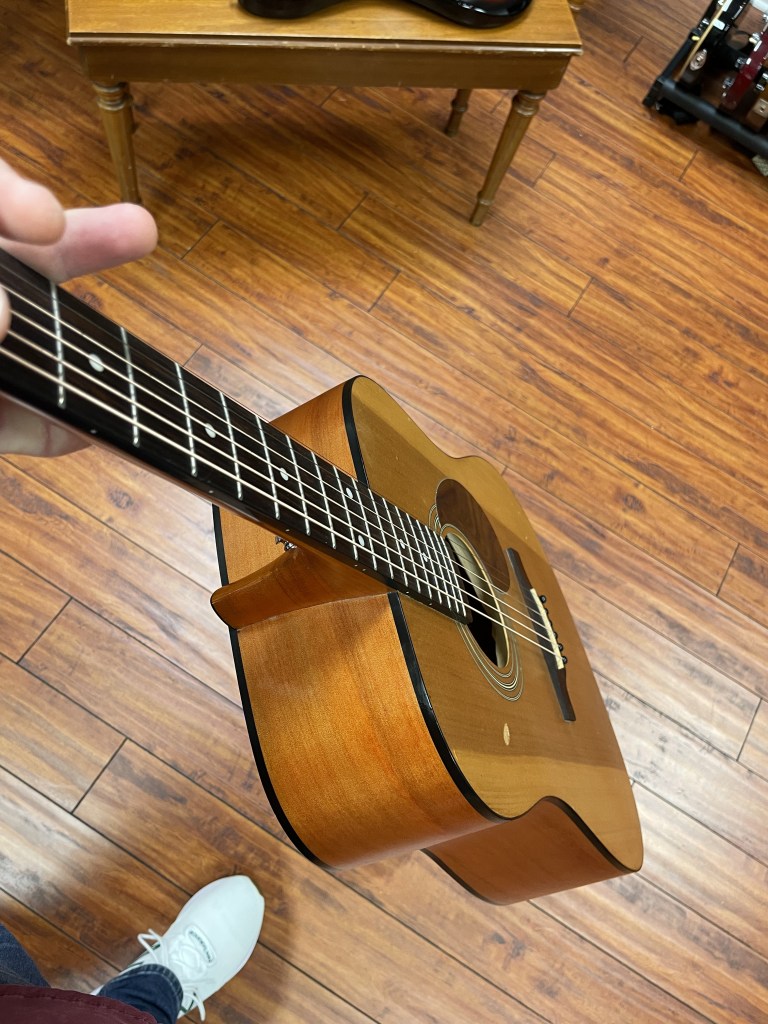
“You can have it.” He said, looking nonchalantly at the tired old instrument with a large crack in the heel of the neck. I laid it in the back of my truck like a wounded soldier amongst the mirrors and pictures wrapped in moving blankets. This guitar had been neglected if not abused. I winced as I thought back to things that I had not cared for properly as a child.

I took the guitar home and surgically removed the dirty strings and cleaned it thoroughly. Under the light of my work bench I could see that the crack wasn’t all the way through, but still substantial enough to make the guitar unplayable. I felt like the doctor when they say things like, It may not work, but I am going to do my best to fix it.

I inserted wood glue into the crack with a needle and syringe and clamped the body and neck down to the work bench to hold tension on the crack. This will only hurt for a little bit. Then I turned out the lights and didn’t look at it for three days. When I finally came back to it I could still see a black line where I probably didn’t clean the crack sufficiently, but the joint felt solid. Now I just needed some strings. Before I took the time to take a trip to the Guitar Dungeon, I happened to be at a friend’s house as he was changing his guitar strings. I noticed that he had an interesting string removal ritual. I usually clip my old strings-which have been played to death, black with grime and riddled with divots and dents- with a pair of wire cutters, and then to avoid a finger injury from the sharp string end under tension, I unwrap the bit still attached to the tuning post with a pair of pliers. He was taking his time and unwinding the string gently from the tuning post, so the entire string was still intact. Then he carefully placed each string in a neat little line, as if he too could still feel the life pulsing in those sparkly bits of metal, just waiting to be touched so they could burst forth singing. It works out nicely because the strings could be reused if you break one of the new ones. He did poke his finger with a sharp string end and there was a bit of bleeding. As he took the last string off he tied the whole bundle in a single knot. That’s when I asked him if I could have them. And he obliged. I have a hard time throwing some things away. Or seeing things thrown away. And those strings had been watching me like a puppy at the pound.

The next day I put the used strings on the old broken guitar and gave each another chance at life. I decided to leave the guitar tuned down a whole step, because I wasn’t sure if it could handle the tension of standard tuning. I held my breath as I got the last string tuned, then I cautiously inspected the crack. It was still solid. I played an F chord-not the first choice of most guitar players. And not the easiest chord to play in standard tuning. But we weren’t in standard tuning, and the F chord seemed so natural now and it rang out beautifully, deep and rich.

I have wondered what to do with this instrument brought back from the gates of death. I can’t in good conscience sell it. Because it was a gift, and also because I feel like I need to stay close to it in case in needs further repair. And maybe no one would want to pay for a broken instrument. This instrument has already served its time in the heavy hands of a careless owner. It now needs the gentle touch of a seasoned musician. Someone who has lived enough to know what pain feels like. I feel like I want to keep this resurrected instrument where I can see it every day and be reminded of the many second chances that I have been given. I want to be able to pick it up and make sweet music with something that came so near being cast off.

A bruised reed shall he not break, and the smoking flax shall he not quench: he shall bring forth judgment unto truth. Isaiah 42:3

Enduring Country Music

I grew up listening to a lot of country music, not because it was my first choice, but because my brother was an autocratic DJ. Although there are a few country songs and even country artists that I enjoy, for the most part, I endure country music. I endure it because I have been constantly subjected to it over the years. Being subjected to any type of music breeds a disdain for it. At my current job I am subjected to not just country, but modern country music, a term as oxymoronic as honest politician or men’s lotion. I could endure the modern country station with a little more patience, but I haven’t heard a single Merle Haggard song, not one!

What makes Country music enduring is tradition. These modern country lyrics are shallow. The content is overtly sexual, objectify women, and smacks of immorality, rebellion, arrogance, ignorance, and alcohol. I miss the days when country music lyrics were about Jesus. And America. And being rebellious, and cheating on your wife, and alcohol, and racism, and…well the music was better anyway.

Country music has always been most popular with working class Americans because the lyrics were so very relatable and emotional. Country musicians were bards who entertained in the local beer joints, singing to men and women who were often stuck in a socioeconomic situation with no hope of a way up or out. These songs gave them escape and release. These songs were ballads which told stories which connected with the very real struggles that working Americans were living out in their daily lives. It also appealed to their aspirations, traditions, and desires. Country Music gave a voice to many Americans.

With todays changing society, much of the culture of the American working class is rapidly becoming outdated, and in some cases taboo. People don’t farm like they did in post depression and World War II generations. There is a massive urban and suburban migration, and many dying small towns. It’s not as socially acceptable or politically correct to sing lyrics like, “Be proud you a rebel cause the South’s gonna do it again.” Today’s country musicians are aware of this and so a new image of the country musician is being forced upon one of the most loyal fanbases in the music industry. There has been a shift from singing about real social and economic issues heard in songs like, Working Man’s Blues, and Sixteen Tons, to shallower generic lyrics about girls, trucks, and having a bad attitude. In essence, modern country has long since abandoned the Southern culture and is trying to appeal to a wider audience, hence the hip hop influence and rapping. Of course there is still love to sing about, but the newer country songs push the limits of vulgarity that were set by rock and roll bands of the 70’s and 80’s.

It’s often the case that great oppression brings great hope. Although I am daily oppressed (and depressed) by modern country music, now more than ever I feel like I may have what it takes to be a professional songwriter. I think there’s probably good money to be made by writing a few tunes and letting one of these modern country guys record one of my songs. Since many establishments insist on playing modern country music, I think I could retire early. I’d like to share a few lyrics in the style of modern country that I’ve been sitting on for a while.

I got a Ford truck I painted primer gray

I’m going to go fishing when I get off work today

Little girl you ought to come with me

Maybe we can drink a little whiskey

I might look just like all these other country guys

But I’m different let me tell you why

(right here there needs to be a musical cut, then the band comes in full with chorus)

I’m a real country boy

I love Jesus, but sometimes I cuss

I ain’t into drama, don’t like to fuss

I play guitar, but I listen to rap

Got a fake accent…

Never mind. I’m fixing to go listen to some choir music.


Vanity

Mr. Lowe was the sole music teacher at my elementary school. I think he may have been involved with the music at his local church, but as I did not attend his local church this claim cannot be substantiated. I can tell you with certainty that he was bald. He kept what straight brown hair that remained on the sides and back of his hair neatly combed. I often thought that his hair had a distinct rounded puff like quality to it. I’m told he rode a motorcycle, but again, I never saw him on a motorcycle, or any other car for that matter, but I can imagine very easily that he did ride a motorcycle. He had a very resonant baritone voice and always taught setting down, which in later years I learned is not the best way to sing.

Mr. Lowe’s music class was held in a single wide trailer on the western side of the school. You had to walk outside, in a single file line with your mouth closed while you held your thumb behind your back, in order to reach the classroom. By the time all of us had filed into the trailer, the cool air had rushed out of the room, and we sat for the next hour or so listening to the window unit air conditioner work overtime as Mr. Lowe rambled about cows eating grass and good boys finding.

Music was taught in an odd fashion in elementary school. All of us, more or less, showed up on our first day at Kindergarten with at least good conversational English. For the next five years we were taught vocabulary, grammar, and composition. But with music, we were thrust almost immediately into music theory before we had any experience on a musical instrument. If we excelled in theory, we might then be encouraged to take up an instrument.

I enjoyed music time. Mr. Lowe introduced us to all of the least practical instruments for playing the type of music that I was exposed to at home and at church. He showed us maracas, sand blocks, guiros, and my personal favorite, the bells. I vaguely remember a piano, but no guitars. He would sometimes let us “play” these instruments. I don’t think any of us were very proficient at these odd instruments.

Mr. Lowe taught us the Peanut Butter Song.

First you take the peanuts and you dig ’em

You dig’em dig’em dig’em

Pea-nuuut, pea-nut butter, and jelly…

Mr. Lowe introduced us to Jerry Lewis in the movie Cinderfella. Before we started the movie, Mr. Lowe to pains to make it very clear that Jerry Lewis was not a sissy. Being a sissy was about the worst thing that anyone could call you. Mr. Lowe’s preliminary speech didn’t convince me.

Mr. Lowe tried his best to teach us about sharps and flats, rhythm, melody and harmony, but like many of my teachers, he spent far too much of his time trying to get the attention of children who’s only desire was to do anything but learn.

In about the fourth or fifth grade, Mrs. McManus sat our class down for a speech before we were to go to music class. We all prepared for another, “Y’all better learn how to act or we’re putting you on silent lunch” orations. What followed caught us off guard.

“Students.” Mrs. McManus began in a grave manner.

“Today when you go to music class, Mr. Lowe is going to look different. He’ll have hair.”

She paused for a moment to see what our reaction would be. We were so taken off guard that not a word was spoken. She took advantage of the silence and proceeded.

“Mr. Lowe has decided to wear a toupee.” Here she went into detail about what a toupee was, our french not being what it should be. After she was convinced that we had been thoroughly educated on what a toupee was, how it staid on, why you would want to wear one, and what it was made of, she made it very clear that we were not to “Stare, ask questions, or even acknowledge that anything was different about Mr. Lowe.” Now this is a lot to ask a group of rowdy fourth and fifth graders, but aside from one or two well meaning compliments, we acquiesced to this strange demand from our pedagogue.

This absurd experience made a bigger impact on me than all of the musical knowledge that Mr. Lowe tried to impart. We had seen Mr. Lowe every week for five years and now he was going to be radically different and we weren’t allowed to talk about it. That’s the way with vanity: we spend a lot of effort trying be something that we’re not and hope that it comes off as normal.

The Tinker Suit

We stopped at Smith’s and got some of that orange peanut candy that tastes like rubber.

I was two years old when Brant Douglas Reynolds, my Mom’s dad, died of a heart attack on Thanksgiving Day in 1989. My memories of him are few and a little vague. I remember riding in the back of his 1968 Ford Ranger that rotted to the ground from neglect after his death. I remember him bringing me Oreo cookies. I remember going to the cow sale with him. We stopped at Smith’s and got some of that orange peanut candy that tastes like rubber. I remember going into his work shed and seeing all of his power tools.  I remember his blue tractor. And I remember being at his viewing after he died. “Dan Dan is asleep.” I said to Mom as she held me on her hip so that I could peer into his casket.

Years later as a teenager, I changed the strings on his 1972 Martin D-18. Gram had bought it new for him from Fretted Instruments with the income tax return that year. You’d have thought that you bought him a brand new pickup truck. I could tell that he cared for the guitar because he had looped the strings through the hole in the tuning peg twice before winding it, a step that I always skip because it takes longer and isn’t really necessary, but it looks nice. That extra step said something about the thoroughness of his personality, as I took those old strings off it was almost like he was talking to me. I think he’d be happy to know that I play guitar, but he’d be happier to know that I preach the same Gospel that he and the Apostle Peter preached.

I heard that he had a 1959 Les Paul in the 1960’s. The Holy Grail of guitars. He had to trade it for a car. I’d like to at least see a picture of that guitar. Perhaps it wasn’t a 1959, and it’s better to just remember it that way. I use this story to convince my wife to let me have multiple guitars, I hope it pays off one day.

I don’t know how well he played guitar, or sang. I  don’t remember. I vaguely remember him at church preaching and playing guitar. But you do a lot of sleeping at church when you’re two years old, so these memories are sort of dreamy. He was taken away early in my life and looking back I can see how his absence impacted me. I’m sure things would have been different if he were still alive today, I can’t say that they would be better. Or worse. But they’d be different. 

Rev. Roger Lewis, a close friend to “Tinker” as my grandfather was known, was traveling for Thanksgiving when he heard news of my Tinker’s death. He didn’t have a suit with him and felt terrible about going to the viewing in casual clothes. Til this day, he keeps a suit of dress clothes in his vehicle whenever he is going out of town overnight, just in case of an emergency. He calls it his Tinker Suit. I hope that it doesn’t get much use.

Nursing Homes

I was probably too young to go, but my parents were committed, so I went to everything.

I don’t remember whose idea it was to take small children to sing at the nursing home, probably some adult who did not take into consideration how terrifying elderly wheelchair bound people can be to a five year old child. I was probably too young to go, but my parents were committed, so I went to everything. The nursing home we chose was a dismal place. The residents looked completely defeated, the staff had a martial air about them and the whole facility gave you the feeling of complete hopelessness, more like a prison than a care facility. Perhaps the one we visited was simply outdated, but I’ve visited others as an adult and I get a similar feeling.

I was too young to read so I was only obligated to sing from memory. My brother Zach, and Corey Barber did not get off of the hook so easily, since they were capable of not only reading, but counting too, which enabled them to use the Sing Unto The Lord hymnal. Sis. Vivian, Corey’s grandmother sat at the piano with her back to us and called out the page numbers to the each hymn as she played. In our church, we hardly called a song by it’s name, but rather used it’s page number. “Please turn to page 315.” Page 315 was Jesus Hold My Hand. Page 94 was Amazing Grace. As Zach and Corey turned the right page, Sister Vivian would play  an intro on the piano, and by then we were ready to sing. I’m sure our mothers enjoyed it. I think the residents might have just enjoyed seeing some small children, even if they had trouble hearing us. I did not enjoy it. I wasn’t miserable, I just wanted to play.

It was during one of these fidgety moments, probably about the third song, that I decided to pinch Zach on the rear end. He whipped around mid chorus of I’ll Fly Away and gave me a mean look and probably would have hit me but everyone was watching. In the midst of all this the music and the singing never stopped. Mom came and grabbed me by the hand led me to the side of the makeshift auditorium. It was really more of a wheelchair parking lot. Barring this incident, the show kept right on going. As Mom focused on singing I wondered around on the fringe of a crowd.

As we were about to leave, Mom went up towards the front to do something, possibly sing and I was left alone in my seat. One of the residents, an elderly lady in a hospital bed, pointed to me with a crooked finger and said in a weak voice, “Come here to me little boy.” Rear end pinching aside, I was an obedient little boy and I went straight over to her and said, “Yes Ma’am.”

She took my hand and put it on the back of her neck and said, “Scratch here.”

I would like to pause here and give some advice. If you are ever in a strange place and an elderly lady in a hospital bed asks you to scratch her neck, don’t do it. It’s a trap.

No amount of preliminary lecture on my behavior could have prepared me for a situation like this. There I was, not even in Elementary School, in a nursing home, doing the very thing that my parents had spanked me for not doing, minding my elders. As I was scratching the lady’s neck, a nurse rushed over and took my hand away. “Don’t touch the patients.” She said firmly. I didn’t get a chance to explain myself as she led me to Mom.

I’m glad to report that during my subsequent visits to nursing homes over the past twenty five years I behaved myself much better, although a lot of time I still get that same dismal feeling. I will also add that unless you’re playing like Merle Travis or Chet Atkins, don’t bring your electric guitar to the nursing home.


Biblical Rock Band Names

I’ve composed a list of band names taken from the Bible.

I’ve composed a list of band names taken from the Bible.

  1. Wounded in the Stones
  2. Balaam’s Ass
  3. Kicking Against the Pricks
  4. Strange Fire
  5. The Fleshpots
  6. Pestilent Fellows of the Baser Sort
  7. The Whited Walls
  8. Jannes & Jambres
  9. The She Bears
  10. Dead Men’s Bones
  11. The Bloody Husbands
  12. Sons of Korah
  13. The Privy Members
  14. Wilderness of Sin
  15. The Lame Men
  16. Chaff
  17. Backsliding Heifer
  18. Gate of Sodom
  19. The 10 Plagues
  20. Hole in the Roof
  21. Golden Calf
  22. Pillar of Salt
  23. Forehead Bald
  24. The Italian Band
  25. Tombs of Gadara
  26. Noise of the Viols
  27. Hands Against Every Man
  28. Sepulchre Throat
  29. Plain of Ono
  30. Fire of Molech
  31. Sons of Belial
  32. The Peeping Wizards
  33. Ostrich Mother
  34. Dart in the Liver
  35. Golden Emerods
  36. Nehushtan
  37. High Places
  38. Riotous Eaters of Flesh
  39. Leave Us Alone!
  40. The Slow Bellies