Communication: Implicit & Explicit.

“I know we’re not supposed to bully people, but that works with me. I have been inspired to make life changes because someone talked rough to me. I hate it when people don’t tell me something plain. I feel like I’m being lied to if they afraid to say something because they think it may hurt my feelings. That doesn’t help.” This is what a young man told me recently. And I have been thinking about it a lot since then. Thinking deep.

He was being genuine in his desire for explicit understanding and straightforward verbal communication. Say exactly what you mean. Please don’t make me guess. Essentially, he told about some miscommunications that he had with someone with powerful influence in his life who it seemed prefers implicit communication. Although I am not sure that he realized that the person he was frustrated with was probably equally-if not more- frustrated with him. Instead the young man most likely entirely missed the implicit communication-the subtle nonverbal cues-and perceived the economic verbal communication as dishonesty. At the heart of this problem is a mismatch between high and low context communication.

Americans, in general, are low context communicators. We principally communicate with words. We like clear instructions and contracts. If you are an American you may be thinking well duh Zane, how else am I supposed to communicate?

Actions speak louder than words but not nearly as often.

Mark Twain

A high context communication culture like the Japanese, would depend heavily on implicit, nonverbal communication like body language, tone of voice, and especially silence in order to understand the message. High context communication cultures rely on a shared background of beliefs and principles-sort of reminds me of the church-and place a special importance on relationship in communication. The level of relationship they share with a person will have tremendous bearing on the level of communication. In contrast low context cultures are willing to enter into 30 year contracts with total strangers.

In my college courses, there was an emphasis on this being a cultural characteristic. Asian, Latin American, Mediterranean, and Middle-Eastern cultures tend to prefer high context communication. The whole reason that this was important to learn is because there is often profound misunderstanding in the business world between these cultures and low context communication cultures found in Europe and North America. Since this material was covered in more than one class it leads me to believe that this is a very real issue. Indeed it was manifested in my conversation with a frustrated young man.

I want to emphasize that this is true in general; and like any generalization or stereotype, there are exceptions. Low context communicators can be found in high context cultures and vice versa. As I was studying this material in college I found myself relating more to the high context than the low context communicators. Perhaps our young man would find himself in the low context camp.

What should we do about this problem of mismatched explicit and implicit communication?

Jesus spoke in parables to the multitude, but spoke plainly to his disciples. This means that the disciples heard both implicit and explicit communication from God.

Matthew 13 is a great example of this. I encourage you to read the whole chapter, then reread it in sections pausing to reflect after each section. Then reread the whole chapter. I want to focus on this one portion though that outlines the issue at hand.

Matthew 13:10-17 And the disciples came, and said unto him, Why speakest thou unto them in parables? He answered and said unto them, Because it is given unto you to know the mysteries of the kingdom of heaven, but to them it is not given. For whosoever hath, to him shall be given, and he shall have more abundance: but whosoever hath not, from him shall be taken away even that he hath. Therefore speak I to them in parables: because they seeing see not; and hearing they hear not, neither do they understand. And in them is fulfilled the prophecy of Esaias, which saith, By hearing ye shall hear, and shall not understand; and seeing ye shall see, and shall not perceive: For this people’s heart is waxed gross, and their ears are dull of hearing, and their eyes they have closed; lest at any time they should see with their eyes and hear with their ears, and should understand with their heart, and should be converted, and I should heal them. But blessed are your eyes, for they see: and your ears, for they hear. For verily I say unto you, That many prophets and righteous men have desired to see those things which ye see, and have not seen them; and to hear those things which ye hear, and have not heard them.

This section falls between the Parable of the sower and the explanation of the parable of the sower. It is Jesus’s answer to his disciple’s question Why don’t you just tell these people explicitly what you mean? Jesus essentially answers that he used parables to give these people the option of hearing, seeing, understanding, and being converted and healed.

Jesus did speak explicitly to his disciples in private. I find it interesting that he often gave correction via explicit communication.

Matthew 16:23 But he turned, and said unto Peter, Get thee behind me, Satan: thou art an offence unto me: for thou savourest not the things that be of God, but those that be of men.

Jesus openly and explicitly rebuked Peter. You have to really be a true disciple of someone for them to call you Satan and you not get offended.

John 14:9 Jesus saith unto him, Have I been so long time with you, and yet hast thou not known me, Philip? he that hath seen me hath seen the Father; and how sayest thou then, Show us the Father?

You can almost hear the frustration in Jesus’s explicit response to Phillip’s question. Phillip, how long have you been my disciple and you don’t know that I am the Mighty God, The everlasting Father, The Prince of Peace (Isaiah 9:6)…don’t remember that I and my father are one (John 10:30)?

I really believe that you have to want it to receive implicit communication.

Proverbs 1:1-6 The proverbs of Solomon the son of David, king of Israel; To know wisdom and instruction; to perceive the words of understanding; To receive the instruction of wisdom, justice, and judgment, and equity; To give subtilty to the simple, to the young man knowledge and discretion. A wise man will hear, and will increase learning; and a man of understanding shall attain unto wise counsels: To understand a proverb, and the interpretation; the words of the wise, and their dark sayings.

Subtilty and discretion will help you know the difference between dark sayings and deception.

In order to receive the instruction of wisdom, justice, and judgment, and equitysubtilty and discretion from the Book of Proverbs you are going to have to read it. And reread it. With open ears. Fast and slow. Pausing and reflecting. Meditating. And you’ll also have to practice what you’ve read.


Broken

It may not work, but I am going to do my best to fix it.

“This guitar is broken!” I said in exasperation to the young man I was helping move across town.

“You can have it.” He said, looking nonchalantly at the tired old instrument with a large crack in the heel of the neck. I laid it in the back of my truck like a wounded soldier amongst the mirrors and pictures wrapped in moving blankets. This guitar had been neglected if not abused. I winced as I thought back to things that I had not cared for properly as a child.

I took the guitar home and surgically removed the dirty strings and cleaned it thoroughly. Under the light of my work bench I could see that the crack wasn’t all the way through, but still substantial enough to make the guitar unplayable. I felt like the doctor when they say things like, It may not work, but I am going to do my best to fix it.

I inserted wood glue into the crack with a needle and syringe and clamped the body and neck down to the work bench to hold tension on the crack. This will only hurt for a little bit. Then I turned out the lights and didn’t look at it for three days. When I finally came back to it I could still see a black line where I probably didn’t clean the crack sufficiently, but the joint felt solid. Now I just needed some strings. Before I took the time to take a trip to the Guitar Dungeon, I happened to be at a friend’s house as he was changing his guitar strings. I noticed that he had an interesting string removal ritual. I usually clip my old strings-which have been played to death, black with grime and riddled with divots and dents- with a pair of wire cutters, and then to avoid a finger injury from the sharp string end under tension, I unwrap the bit still attached to the tuning post with a pair of pliers. He was taking his time and unwinding the string gently from the tuning post, so the entire string was still intact. Then he carefully placed each string in a neat little line, as if he too could still feel the life pulsing in those sparkly bits of metal, just waiting to be touched so they could burst forth singing. It works out nicely because the strings could be reused if you break one of the new ones. He did poke his finger with a sharp string end and there was a bit of bleeding. As he took the last string off he tied the whole bundle in a single knot. That’s when I asked him if I could have them. And he obliged. I have a hard time throwing some things away. Or seeing things thrown away. And those strings had been watching me like a puppy at the pound.

The next day I put the used strings on the old broken guitar and gave each another chance at life. I decided to leave the guitar tuned down a whole step, because I wasn’t sure if it could handle the tension of standard tuning. I held my breath as I got the last string tuned, then I cautiously inspected the crack. It was still solid. I played an F chord-not the first choice of most guitar players. And not the easiest chord to play in standard tuning. But we weren’t in standard tuning, and the F chord seemed so natural now and it rang out beautifully, deep and rich.

I have wondered what to do with this instrument brought back from the gates of death. I can’t in good conscience sell it. Because it was a gift, and also because I feel like I need to stay close to it in case in needs further repair. And maybe no one would want to pay for a broken instrument. This instrument has already served its time in the heavy hands of a careless owner. It now needs the gentle touch of a seasoned musician. Someone who has lived enough to know what pain feels like. I feel like I want to keep this resurrected instrument where I can see it every day and be reminded of the many second chances that I have been given. I want to be able to pick it up and make sweet music with something that came so near being cast off.

A bruised reed shall he not break, and the smoking flax shall he not quench: he shall bring forth judgment unto truth. Isaiah 42:3

Controlled Burn

I still get the itch to set the yard on fire.

“Is this a controlled burn?” The volunteer fireman asked my dad as he looked out across the kudzu patch with flames leaping halfway up the ancient pecan tree.

“Does it look like a controlled burn? Don’t drive on my new field lines!” My dad replied.

I still get the itch to set the yard on fire. It has been welling up in me since the last church men’s cookout we had. We have kind of given up on calling it a men’s campout since most of the men swore off camping after that year it rained all night. I guess not everyone is cut out for roughing it. So we have resigned to having a big fire at the church and eating until we can barely stay awake and then driving back home. Or staying up all night, but we have the option. This past year though something interesting happened that gave me the fire itch like I have never experienced.

We had just gotten the fire started good where all the folks on the highway in front of the church could start blowing the horn, wishing that they were a part of something so exciting, when all of the sudden here comes the volunteer fire department in one of their trucks, sirens a wailing. We watched him go by on the highway but were surprised when he pulled into the church parking lot. It was only one fireman. Now that I think back, I’m not sure he was a real fireman because he didn’t have a uniform. That would also explain his behavior that followed. He said something about receiving a call about an out of control fire and then that [REDACTED] proceeded to unroll a firehose and thoroughly dowse our campfire. I wanted to say a lot of things and do a few more, but I let Pastor do the talking because I didn’t feel like it was the best time to give the younger boys a vocabulary lesson. I’m not sure what pastor told him, but he didn’t listen.

Volunteer work; it just doesn’t pay.

So there we were; the men and the boys just sitting around the dripping firewood. Like we all just found out that Santa Claus ain’t real, and the person that told us had run over our dog and run off with our girlfriend. We were in a bad way. The only thing that really matters about the men’s cookout is the fire, and now we didn’t have one. You could see it on every face from the boys fresh out of diapers to the grey headed retirees: pure disappointment. We were downcast. Something had to be done.

I waited until I was pretty sure that the hasty volunteer had made it all the way back to the fire station before I said, “$10 to the boy that gets this fire started again.” You’d have thought I said $100,000,000 by the way those boys got after it. I wasn’t really concerned about the fireman coming back, but I wanted to waste his whole evening if he decided to. It took the eager boys about five minutes to get the fire rekindled, and just like that, morale was restored.

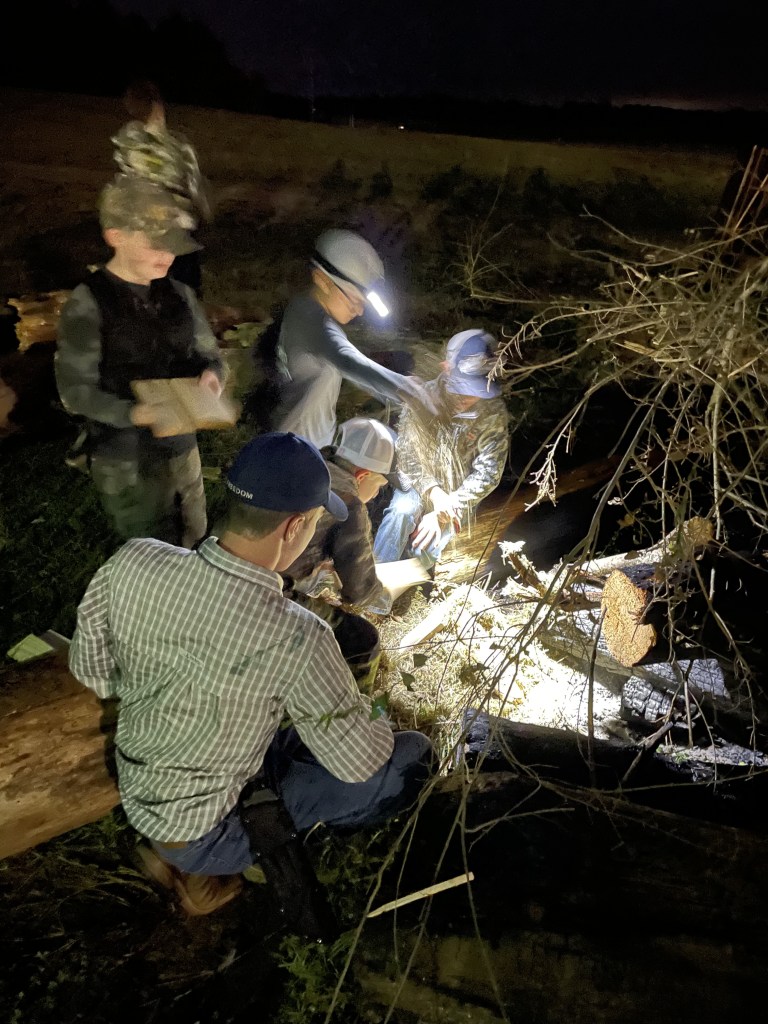
The boys getting the fire restarted.

I have been wanting to burn something bad since then. So I set the yard on fire this week. It was glorious. My dad would’ve enjoyed watching it slowly burn off the dead grass from last year. It was the perfect day to set the yard on fire.

There are not many things as satisfying to me as burning the yard.

When I told my friend that I was going to burn the yard he asked me, “How do you keep the fire from spreading?”

I didn’t really have a good answer for that. You can’t really control a fire. You can pretend like you are controlling it, and that may make you feel better, but I suppose if the fire wants to burn something then you can’t really stop it. Any time you set a fire, you are risking it burning a lot more than you had intended. In my case this week, it didn’t burn all of what I intended. I was less in control of the fire than the wind. But I still stood there coughing in the smoke with a shovel and brazen confidence.

The horseleach hath two daughters, crying, Give, give. There are three things that are never satisfied, yea, four things say not, It is enough: The grave; and the barren womb; the earth that is not filled with water; and the fire that saith not, It is enough. Proverbs 30:15-16

After I got the fire stopped where I felt was sufficient, one of my friends called me and said, “Man is everything ok? Looks like your yard caught on fire.”

I just told him it was a controlled burn.

Taking Notes

What does wisdom, understanding, and knowledge look like?

Sarah just got me a brand new notebook. It is a wonderful feeling to start a brand new notebook. Something about a fresh crisp and clean page makes me want to take my time and try to write neatly. I have always had poor handwriting-or penmanship as Col. Moore stated in his lament about trying to read my assignment-but on a good day I can still read what I have written, even if it was a long time ago. And when those sentences from the past are legible I often can remember what I was thinking when I wrote them. Which is the whole point of taking notes. For me anyway.

I never took notes in high school. I just listened and hoped for the best on test day. That still works pretty well if you only need to remember something until Friday, but it may fail you if you try to remember something twenty years later. Even so, I believe there is an art to active listening. Which is to say that I believe that you can practice to be a better listener. This is one of the reasons that I love audiobooks. But if I really don’t want to forget something I like to write it down. That doesn’t necessarily ensure that I won’t forget it, but this redundancy reinforces the chances of remembering. So I take a lot of notes. While listening of course. Especially to preaching.

I don’t recall bothering myself to even take note of a test date. I just showed up to class and took it day by day.

I haven’t always taken notes as an adult either. I made an attempt to start in college, but it was short lived. College and note-taking. I started in earnest about 12 years ago at Youth Camp. I noticed a fellow councilor writing away on a notepad during a day session. The man who was preaching was saying some pretty good stuff. So I found a pen and pad before the next service and I started taking notes too. After it had become a habit for a couple of years I found out that the person who I had seen taking notes at Youth Camp was simply trying to stay awake.

It took me a while to develop a note taking system. When I take notes I am subconsciously trying to answer these questions: Am I following the speaker’s notes? What is the speaker saying? What is the essence of this message? What am I thinking that the speaker is not saying? What is God saying? How does this apply to my life? What songs will go for altar?

Good luck reading this. It was my notes from a powerful sermon at Youth Camp by Ari Prado.

I still take notes every service. And I journal fairly regularly. I even write these articles as an exercise in manifesting ideas. I believe this is all only practice to be a more excellent communicator. It has helped me learn to put my thoughts into words and be confident when I have to speak in difficult situations. From time to time I browse through my my notebook, particularly when I just finished one. It is a moment to reflect that chapter in my life. I may highlight major life events in the index in the front and write a synopsis of that time period. It is also interesting to know what a younger man was thinking.

I am hesitant to say that taking notes has made me critical of what people say, especially across the pulpit, but it has given me an awareness of their authority of subject material and the amount of preparation they spent on their speech or sermon. The last thing I want to be remembered as is a sermon critic. At the same time preaching is a matter of eternal significance and should not be practiced nonchalantly. If study for preaching is only internet deep then the sermon will be shallow indeed. Words are all that we have, and words must carry weight.

In the past year I have begun to look at taking notes differently. Principally because of these two scriptures:

Proverbs 3:19 The Lord by wisdom hath founded the earth; by understanding hath he established the heavens. 20 By his knowledge the depths are broken up, and the clouds drop down the dew. 21 My son, let not them depart from thine eyes: keep sound wisdom and discretion: 22 So shall they be life unto thy soul, and grace to thy neck.

What does wisdom, understanding, and knowledge look like? How do I not let them depart from my eyes? I think it is safe to say that this means words. How powerful are words! It is my sincere intention to learn to recognize wisdom, understanding, and knowledge when spoken and to write them down.

Proverbs 4:20 My son, attend to my words; incline thine ear unto my sayings. 21 Let them not depart from thine eyes; keep the in the midst of thine heart. 22 For they are life unto those that find them, and health to all their flesh. 23 Keep thy heart with all diligence; for out of it are the issues of life.

What do words and sayings look like? I can still hear my Dad say things, and if I tell them to you then you will hear them too. Maybe even for a long time after they’ve been said. But this can’t just be oral. Somethings must be written down. This concept of letting the words and sayings not depart from my eyes has caused me not only to be more diligent in taking notes, but also in reading the Word of God.

And that, dear reader, is why I take notes.

Rich People Things

Rich people sometimes have the dog on the Christmas Card. That’s another one of the things that they have in common with rednecks.

What would you do if you were rich? I mean so rich that you could eat slow food anytime you wanted. If I were rich and famous I’d only drink ice cold Topo-Chico in glass bottles. I’d wear a brand new pair of socks to church every service. Rich people can do things like that. I’d probably get a gold tooth too. Not right in the front, but off to the side where you could still see it but only when I smiled. That’s so I could stay modest. I would smile a lot though. And have a pair of crocodile skin cowboy boots. I’d drive a big old Cadillac with a pair of longhorns on the front.

I sometimes struggle to know if people are rich or not. Not that it is really any of my business, but I wonder just the same. I often get rich people and rednecks confused. For instance rich people and rednecks both have lots of cars. But rich people will have a garage, and the rednecks just park their cars all over the yard. And the rich people cars all run.

I met some rich people that had a swimming pool in the ground with a fence and everything. That’s how I knew in my eight year old mind that they were rich. But rednecks sometimes have swimming pools too, but its usually in the front yard. Or in the backyard surrounded by all the cars with busted windows and engines that don’t start.

Some folks have got it all.

Rich people sometimes have the dog on the Christmas Card. That’s another one of the many things that they have in common with rednecks. The dog might have a different name though, like Beaumont, or Charlemagne. That’s a rich people dog name. Sassy is a redneck dog name. Also, rich people sometimes take their dog to the vet for no reason.

“The clothes make the man. Naked people have little or no influence on society.”

Mark Twain

Rich people and rednecks both like to go to the beach. When they don’t have a lot of clothes on its hard to tell them apart. I am neither rich nor a redneck so I don’t go to the beach that often. Which means I don’t have any tips for telling them apart at the beach. Wesley said that Rich people “Have a big ole tent, or something, and nice chairs. And a condo. At the beach.” He’s been to the beach a lot more than I have. I didn’t ask him about rednecks at the beach.

Some other ways to spot rich people is to go to the local airport. Not the big commercial airport at the closest big city, but the little rinky-dink municipal airport. The people who own airplanes are rich. Rednecks don’t typically have airplanes. I think I’d have me an airplane if I was rich. I’d paint teeth and eyeballs on the nose like they did back in WWII. I’d get a leather jacket and a big long white scarf for flying.

All the happiness in the world can’t buy you money.”

I would like to be rich, but I don’t really want to quit shopping at thrift stores. So I don’t really want to be filthy rich, just regular rich. If I came into money real sudden like, I think I would keep shopping at thrift stores so I could keep my cover since it is sometimes hard to tell rich people from rednecks anyway. Even if I was rich, people would see me at the thrift store and think, “He ain’t rich. He’s just another redneck.” It would also help me practice modesty. I wouldn’t smile when I went in there.

When I recall my biggest life decisions, money has not been the principle influence. For instance, having children is not necessarily a wise financial decision. But you don’t really worry about money when you decide to have a child. There is a stronger force than money at play. Moving without a job is not a wise financial decision. But money doesn’t get to make all of the decisions for me. This is probably why I am not a rich man. Money is not the only currency in life. I just read the book Creative Confidence by Tom and David Kelley and I really liked an illustration that the authors often use when making decisions. A see-saw, or balance, with a heart on one side and a dollar sign on the other. To paraphrase the author, the money is almost always easier to measure, the heart-the unquantifiable values, relationships, sense of calling, principles, and intuition- takes a little more time. The message is clear, money is not the only thing that should be considered when making decisions.

This blog for example; the motivation to write does not come from money. Or extrinsic motivation as I learned in college. There is another, stronger source of intrinsic motivation that compels me to write. It is the desire to connect on an unseen level with a reader. The urge to communicate an idea that will provoke deep personal insight in hopes that they can see themselves more clearly. There is the need of going out of one’s self that motivates me to write. This is not to say that I couldn’t be motivated by money to write. I have written on commission and gratefully cashed the check. But if I am honest with myself, I have never felt that any of my best efforts have come from being given an assignment. I have felt this way since a child in art class. I suppose that all creative people wrestle with the tension between creating what they want and getting paid to create what someone else wants. There is also the question of does anyone else want what I want to create? That can only be answered after the thing is created.

On my wedding day my father-in-law gave me some of the best advice I ever received about money. “Don’t ever fight about money.” At the time it was almost like saying, “Don’t fight about nothing.” This is a principle that my wife and I still share in our personal finances.

Money has always been a chore to me. I am getting better at doing chores the older I get. I have some friends that look at money differently than I do. And I am trying to learn from them. They can’t help but make money. Its fun to them. It is not a chore at all, but something that just comes natural. At the same time, they seemed to not be controlled by it. I have observed other people, extremely wealthy people-filthy rich people-be destitute when it comes to personal relationships. Billionaires who are vicious about money yet who are in poverty when it come to love. Cold blooded killers to quote a friend who has met more of them than me. When I take a closer look at their lives, it is pretty clear that these people do not have the same values as me.

Faith, and not money, is the currency of God’s economy.

II Timothy 6:6 But godliness with contentment is great gain. 7 For we brought nothing into this world, and it is certain we can carry nothing out. 8 And having food and raiment let us be therewith content. 9 But they that will be rich fall into temptation and a snare, and into many foolish and hurtful lusts, which drown men in destruction and perdition.

But they that will be rich. I am reminded of Rudyard Kipling’s The Man Who Would Be King. I won’t spoil it for you, but if you have read it then you know what I’m talking about. I’m also reminded of someone else that said I will be like the most High. What you commit your will to has profound consequences.

I am less concerned with being rich and more focused on doing something in life that matters. Furthermore, I think it is more important to God that what I do with my life matters. Fortunately God delights in blessing his children and this includes, but is not limited to, financial blessings. With this in mind, If I were regular rich I doubt I would drink more Topo-Chico than I do now. I would take care of quite a few church projects though.

Spanish

In 2020 I listened to the audiobook version of Don Quixote by Miguel Cervantes. I chose that book because it was included in my subscription to Audible and I didn’t have to use any of my precious credits. It turned out to be hilarious. I really appreciated how the 400 year old humor still made me laugh out loud today. It really made me think If the book was that funny in English, how funny was it in Spanish? It is because of this literary masterpiece and too many other books to name about the Spanish conquest of Mexico, pre-Columbian America, and Mesoamerican civilization that I decided to download the DuoLingo app and start learning Spanish. My Mom died that summer and I found studying Spanish a welcome distraction. And by Thanksgiving I became determined to make studying Spanish a part of my daily activity. That was over 1,000 days ago.

Some days I feel like I haven’t learned any Spanish at all. I am sure I would be further along if I was forced to speak in Spanish every day instead of doing the simple grammar exercises. I get the same feeling sometimes about guitar. To put things in perspective I flip the guitar over and try to play a few chords left handed and it makes me feel better about how far I have come. I have done this so much over the years that I am starting to get good playing left handed. With Spanish there are a couple of similar motivation reminders: I can understand spoken and written Spanish far better than I can speak it.

The other day I was at our church’s Fall Festival Fellowship standing around the grill with a bilingual brother and two Spanish speakers. We were eating grilled corn on the cob and they were jabbering away in Spanish. I wasn’t really paying attention to what they were saying until one of the Spanish speakers started talking about eating iguanas. It dawned on me that I was comprehending more or their Spanish conversation than I was not. “Iguana con leche de coco…es muy buena.”

La iguana es el pollo de los árboles

The most rewarding thing about learning Spanish has been being able to communicate with people who still only speak Spanish. Even though I still feel pretty vulnerable because I have to take my time forming my thoughts. There is something wonderfully exhilarating about communication.

Studying Spanish has also allowed me to see and hear English in a different perspective. Because of its silent letters, irregular verbs, and borrowed words from other languages, English is a difficult language to learn for a non-native speaker. You probably even know native speakers of English that still do not speak it well. Language, whether native or foreign, is a skill and must be honed. Studying Spanish has made me want to be a better English speaker.

A person’s vocabulary is a reflection of the books they have read.

There are some things in Spanish that just make sense. Like having punctuation at the beginning of a sentence, letters that only have one sound, accent marks that do not get ignored, and I almost hate to say it, adjectives after the noun instead of before.

I am a long way from writing in Spanish as well or as quickly as I can in English. But I still practice on my wife. When I think about writers like Joseph Conrad, who wrote in English, a language foreign to him, I am encouraged that some day I will be able to express myself in Spanish on such a level.

Dieting

“I’m going on a diet, starting tomorrow. By summer I’m going to have to introduce myself. I’ll be so skinny y’all won’t recognize me.”

Mom. Circa 1998.

My Mom was a serial dieter. My Dad was not. The first time she tried to make them go on a diet Dad would just swing by Nonna’s house and eat with them on the way home from work. When he got ready to go on home he’d say something like, “I guess I better go home. It’s time for my salad.” He gained weight on that diet.

Sometimes Mom would go grocery shopping after she got fired up about dieting and she’d buy a bunch of SlimFast shakes, and those chocolate devil’s food cake snacks. And then us kids would promptly eat all of her desserts in the next two days.

Have you ever noticed how many trendy diets there are? When I was just a lad the Low Fat Diet was popular. That one just sounds like it makes since. Then the Atkins Diet seemed to be the rage when I was a teenager. Later on there were a bunch of diets that I never really fully understood because I was not dieting at the time. Like the Paleo Diet, the Keto Diet, the Carnivore Diet, and the Tight Rope Diet. I just made that last one up. These diets are like a bunch of religions. Sooner or later you’ll run into someone that is spreading the good news of this diet-whether or not they have been changed by it. The funny thing is all of these diets have a “prophet” that did lose a bunch of weight and now you can too. The problem is only the people who are sold out enough to actually make the diet a lifestyle see any progress. The bottom line is any diet works not because you are eating all organic Vienna sausages, or gluten free cabbage steaks, but because you are burning more calories than you are consuming. I don’t care how you want to slice it, that is hard. It is also not fun.

I believe the main reason most of us don’t enjoy dieting-even though we know it works-is because it does not work fast. It’s that time of year though. A lot of us are thinking about dieting whether we are talking about it or not. If you are interested I’d like to share some weight loss tips that have worked for me in the past.

The most success I ever had losing weight was getting the stomach flu. It was the first or second Christmas that Sarah and I were married. She got it first and was having a horrible time. I wasn’t feeling great either. I told her that I didn’t think that she could hold it as well as I could. I would like to thank the Lord for allowing me to get back home-we lived 11 hours away at the time- before it really hit me. I think this method worked so well because I had no control over it. No seems like an insufficient word. At any rate, I lost 15 pounds in less that a week on the flu diet.

I also had pretty good success losing weight when I had my first kidney stone. It was so uncomfortable that I hardly had an appetite. On top of that, once I found out that it was a kidney stone I quit drinking all the sugary drinks and starting drinking about five gallons of water a day. When I finally got rid of the stone I had also gotten rid of some extra weight I had been carrying.

The most practical way to lose weight though is to get rid of your car and cycling everywhere like my neighbor does. It seems like he didn’t really have any input making the final decision about not driving so I don’t know if he is enjoying it. But he is skinny.

If you have kept on a diet this far into January I am proud of you. I want to warn you that Chick-Fil-A is probably going to be giving away free breakfast in February and that might shake your plans up a little bit. They do that on purpose. That’s why I’m waiting til after February to start dieting for real. By Summertime y’all ain’t going to recognize me.

Words Fitly Spoken

This year I read Reflections on the Revolution in France by Edmund Burke. I was initially intrigued by this work because I was on a French Revolution kick brought on by reading through A Tale of Two Cities yet again. What I found was I became far more interested in the writing style of the author than the subject material. This mastery of the English language is also what makes me, and countless others, Dickensian disciples. Mr. Burke writes a series of letters to a “French Friend.” Thankfully his friend could read English. As the title implies, these letters are his well thought out reflections on the French Revolution, an event that he watched unfold. The reflections were published and widely read during Mr. Burke’s lifetime. If you study political science today, you will become familiar with Edmond Burke as a political theorist. But I think he ought to be studied for his formal writing style.

How often have you had a conversation with someone and after it is over you find yourself wanting to edit what you said? It happens to me quite often. It is much easier for me to craft a clear response if I can write it. I am far more likely to choose appropriate words when given the luxury of reflection. With discipline and that most valuable resource time, I believe that anyone can put their deepest thoughts and feeling into written words. And people used to make this a habit in the form of diaries, journals, and letters to actual people.

Why do emails feel so stuffy and written letters seem so personal?

Although I keep a journal, and if you use your imagination I suppose you can call this blog-what an ugly word- and form of journalism, I cannot remember the last time I wrote someone a letter. For that I am a bit ashamed. At the same time I cannot remember the last time I received a letter. Most of our communication with friends today is done via text messages, FaceTime, and decreasingly for my generation, phone calls. All of these forms of communication lack the forethought and planning that a personal letter requires.

Even so, I believe that words fitly written are mere practice for words fitly spoken. As I said before, anyone can write if given time and inspiration, but it takes a truly gifted communicator to bring forth a fitly spoken word in real time. Words are powerful. Maybe this is why public speaking is a common fear.

A word fitly spoken is like apples of gold in pictures of silver. Proverbs 25:11

I am a long way away from where I want to be as an in person communicator. For that matter, I am a long way from where I want to be as a writer. But I am practicing. Thank you for allowing me to practice with you today.

The Spirit of Ignorance

Poverty has many roots, but the taproot is ignorance.

Lyndon B. Johnson

Ignorance simply means the lack of knowledge or information. If you pause to reflect on how many books are in your local library, or better yet how much information is on the internet (64+zetabytes) you can begin to see how much there is to know that you don’t know. You may become overwhelmed with how ignorant you are. Before you get caught up feeling bad about this it is important to understand that it takes people a lifetime of study to become masters in a single field. That is why we call a particular branch of knowledge a discipline. A microbiologist may be an expert on cyanobacteria but have virtually no understanding of group theory, the Battle of Tours, or even how an internal combustion engine works. Even the immortal Sherlock Holmes baffled Dr. Watson with his ignorance of heliocentric motion because it was outside of his desired field of study. It is safe to say that we are all ignorant of many things, and that is perfectly acceptable in most cases. You’ll probably be fine if you do not understand game theory, statistics, or the psychoacoustics. But If you do take some time to study these topics I believe that your life will be enriched by this knowledge. That is the wonderful thing about learning, it is the only way to deliver you from ignorance.

Through wisdom is an house builded; and by understanding it is established: And by knowledge shall the chambers be filled with all precious and pleasant riches. Proverbs 24:2-4

To reject knowledge or instruction in our ignorant state is a dangerous folly, and to prefer ignorance over understanding is the root of the Spirit of Ignorance. I grew up in a small community where most of the people were working class. I didn’t know many people that had gone to college, I’m sure they were there, but I just didn’t know them. There was an extremely gifted young man a few grades ahead of me that was simultaneously revered and ridiculed by his peers for his remarkable intelligence. On one hand they were proud to know someone who was so smart, on the other hand he was unable to get them to embrace learning for themselves and in that regard they failed to understand him and considered him a freak of nature rather than an a disciplined independent learner. He graduated with high honors and went on to study at a prestigious university and never came back. This is what happens in small communities, all the smart kids end up moving away. Sociologists call this phenomenon Brain Drain and after a few generations it takes a tremendous toll on rural areas. What is left is a perfect breeding ground for the Spirit of Ignorance.

My people are destroyed for lack of knowledge: because thou hast rejected knowledge, I will also reject thee… Hosea 4:6

Ignorance can be deeply rooted, but often manifests itself as pride. People may feel personally attacked when their ignorance is confronted. No one enjoys being told that they are doing something wrong, or they don’t know what they are talking about, especially if they have been doing it for a long time.

Sometimes when people say they have done something for 20 years what they really mean is they have have repeated one year’s experience 20 times.

Dr. Nathaniel Wilson

This is one of the principle ways that the Spirit of Ignorance can be defeated: unlearning what you thought was true. When someone’s understanding is built upon fallacy, or false preconceptions, these must be confronted before any real learning can happen. I am reminded of Galileo’s conflict with the Catholic church over heliocentric motion. The Catholic church was in predicament because it was confronted with evidence contrary to its doctrine on heavenly bodies. The Catholic church failed in its response to Galileo and rather chose willful ignorance. Furthermore it waited over 400 years to fumble an opportunity at an apology.

“Experience keeps a dear school, but fools will learn in no other, and scarce in that.”

Poor Richard’s Almanack, Benjamin Franklin

There is a strong possibility that I will face a new concept, or a better way, that may challenge what I have always done or thought. I cannot afford to be hard-headed, or stiff-necked to borrow a Bible term when in these opportunities. Neither can I ignore them. Ignorance contains the root word ignore. To ignore something takes a conscious decision. This is the essence of the Spirit of Ignorance: ignoring truth.

It was important to the Apostle Paul that we would not be ignorant on certain topics or doctrine. I would not have you ignorant… There are a few people in my life that when I hear them talk, teach, or preach I get a strong sense that they too alongside of Paul are at war against the Spirit of Ignorance. And they make me want to join in the fight.

Loss of a Coworker

Getting to know people who are not like me has always been one of my favorite aspects of working with the public and attending public school.

Coworkers are people that you may not have anything in common with the except that you both work at the same place. So you end up building a special relationship with someone that you ordinarily would not have made friends with. Getting to know people who are not like me has always been one of my favorite aspects of working with the public and attending public school.

Losing a coworker is a strange feeling. I remember Dad losing a coworker to cancer when I was just a lad. I think his name was Ed White. Dad had visited him a few times while he was in the hospital. I remember how he would tell Mom how the visits went. I don’t have anyone to verify this-they are all dead-but I am fairly certain that Ed White paid the hospital bill when my sister was born. Mom and Dad went to the funeral without us kids. We didn’t know all of the details but we could tell by Dad’s countenance that it was not a time to be rowdy at the house.

“Paul passed away this morning.”

I got this text a couple of weeks ago from my boss at my former State job. I only saw him once or twice a month for the years that I worked there. But I talked to him on the phone quite often. He was one of our field officers and spent most of his time covering a large part of east Alabama. It was always a welcome diversion whenever one of these officers dropped into to see the people like me who hardly left the office. Those officers all had the best stories.

He carried a cane. He would walk by and smack that cane on my desktop and say things like:

“You’re fired.”

“You’re working too hard, take a break.”

He was good at saying nice things in an abrasive tone of voice. He was also a very giving person. My first week or so at work he made me a wooden stand with my name. I still have it in my new office. It means a little more to me now. One day he brought me a bunch of metal straws. At first I thought, what in the world am I going to do with these? But they have been in constant use since I brought them home to the kids. Recently I have gained a deeper appreciation for these straws since I have slipped into the habit of drinking milkshakes nearly everyday.

Paul had served in more than one branch of the military and was a veteran of Iraqi Freedom. This may be where he picked up the cane. After he retired from the military he landed the gig with the State and that’s where I met him. He retired in the last year or so because his health. He had been fighting cancer. God I hate cancer. Paul was indeed a character. He made me want to be a better gift giver.

The first coworker that I ever lost was named Chavelo. Although I think that was his nickname. His real name was Isabel. I had never heard a man named Isabel, but I was so much older then, I’m younger than that now. He was from El Salvador and he introduced me to papusas. He would share them for breakfast. We were working for a man up in our church who owned a commercial lawn care business. We all went to church together. I was the truck driver and chief weed-eater operater, Cecil-another Alabamian-and Chavelo drove the big mowers. Neither one of them spoke proper English. And now that I think of it, I don’t think they even tried to talk to each other, they just each talked to me.

Chavelo told me that he had worked on a dairy farm in El Salvador.

“Tha macheen dat meelk da cow. It bad por da cow chitty. We meelk by hand.” He made a squeezing motion. I’m not sure what I was supposed to do with this information, but it has brought me a lot of joy over the years.

As we drove from job to job, Cecil would point out houses that he had sanded the floors in. The two would interrupt each other to talk to me. It was so entertaining.

“You see that bank right there Brother Zane?” Cecil asked one day.

“Yes.” I said, not fully paying attention as I navigated the truck and trailer through the streets that had been designed for horses and carriages.

“Somebody robbed that bank with a banana!”

“What?” I asked incredulously, now fully paying attention.

“It was a chocolate covered banana.” Cecil replied. I’m not sure of the veracity of this story, but I know for certain that Cecil believed it. I really hope it is true because I want to believe it too.

That’s what it was like working with these two. They were both old enough to be my grandad. I did a lot of laughing back then. That’s what the best coworkers do, they make you laugh.

Chavelo was sick one week for a few days, and when he returned I noticed that his eyes were yellow. After a month I began to noticed that his upper belly was protruding. He was not an overweight man by any means and this protrusion turned out to be bloating from liver cancer. I noticed the same symptom in Paul a while back. Chavelo went down hill pretty quick. I went to see him a few times while he was on his deathbed to pray for him.

“It’s no good Brother Zane.” He burst into tears one day. I cried too.

When he died they asked me to speak at the funeral. That was the first time I had ever spoken at a funeral and also the first time that I had ever spoken with a translator. I said something along these lines.

Chavelo and I had a language barrier, but not a communication block. We couldn’t always understand each other’s words, but we understood each other’s thoughts. Love transcends language. Chavelo was always sharing and we were always laughing. That connection was worth more than words could explain.

I sometimes think of Chavelo when I get discouraged while trying to learn Spanish. Chavelo helped me understand that speaking English is not the only sign of intelligence.

Eventually I got a job with Parks & Recreation and left the mowing industry. I was sitting at my desk one day and I got a phone call on my personal phone. I didn’t recognize the number so I didn’t answer. It is one of the biggest regrets I have. Pastor Dillon was out of the country so that’s probably why they called me. When I finally checked the message I was gutted.

“Cecil has had an mowing accident and he didn’t make it. Please call us.” It was from one of Cecil’s family members.

When they described the hill that he had been mowing when his mower flipped over on him I knew exactly where they were talking about. It was steep and tall. I never liked mowing on it myself.

Two things changed in me after Cecil died. I still answer the phone even if I don’t recognize the number. This does mean that I talk to a lot of people in Kolkuta, India, but I don’t mind. I also don’t play around with zero-turn mowers and I don’t feel bad telling people, “Hey man, you need a roll-bar on that thing.”

When I got the text about Paul it brought back a lot of memories for me. God and Death are no respecters of persons. I don’t know if this has helped anyone, but it has helped me.