Dog Walker

I went for a walk at my brother’s house while visiting him for Thanksgiving. I picked up a stick out of a brush pile on the side of the road. It just feels right to walk with a stick. And the last time I went on this walk a dog bit me. I would not describe myself as a dog person. No sooner had I picked up the stick a dog came running towards me. I was ready for it. But when I saw the dog cower down and still continue to crawl to me, like a servant bowing before a king, I lowered my scepter. I mean my stick. Still a bit unsure I decided to just tell the dog to go home and continue on my walk. The dog did not go home, but trotted along side of me. I concluded that if a dog was going to be this agreeable I would welcome a companion on this walk. After all, the thing hadn’t even barked.

The first time a car slowed down to pass me I didn’t even think about the dog. It was not my dog, why should I care if the thing was run over and killed?

So on we walked, the dog darting back and forth across the road, wandering into yards, and occasionally glancing over at me. Once it stopped and growled a low growl at a house sitting close to the road. I couldn’t see what he was growling at, but I took a good look at the house in case the dog was trying to communicate some important information to me.

The next car that came along I felt that I should return the favor and keep the dog out of the road. I don’t remember cars slowing down that much for just a person walking on the side of the road.

I made it all the way to the highway and I was about to turn back. I felt it was my responsibility to tell the dog it was time to go back home. He kept right on following me as I headed back the way we came.

About halfway back a group of three little white and black dogs came running and barking at us. Growling and snapping at Rover. We’d come this far together I felt I needed to call him something. I raised my stick and broke up the little ruckus.

The dog followed me all the way home today. And I hope we can do this again tomorrow.

The Spirit of Ignorance

Poverty has many roots, but the taproot is ignorance.

Lyndon B. Johnson

Ignorance simply means the lack of knowledge or information. If you pause to reflect on how many books are in your local library, or better yet how much information is on the internet (64+zetabytes) you can begin to see how much there is to know that you don’t know. You may become overwhelmed with how ignorant you are. Before you get caught up feeling bad about this it is important to understand that it takes people a lifetime of study to become masters in a single field. That is why we call a particular branch of knowledge a discipline. A microbiologist may be an expert on cyanobacteria but have virtually no understanding of group theory, the Battle of Tours, or even how an internal combustion engine works. Even the immortal Sherlock Holmes baffled Dr. Watson with his ignorance of heliocentric motion because it was outside of his desired field of study. It is safe to say that we are all ignorant of many things, and that is perfectly acceptable in most cases. You’ll probably be fine if you do not understand game theory, statistics, or the psychoacoustics. But If you do take some time to study these topics I believe that your life will be enriched by this knowledge. That is the wonderful thing about learning, it is the only way to deliver you from ignorance.

Through wisdom is an house builded; and by understanding it is established: And by knowledge shall the chambers be filled with all precious and pleasant riches. Proverbs 24:2-4

To reject knowledge or instruction in our ignorant state is a dangerous folly, and to prefer ignorance over understanding is the root of the Spirit of Ignorance. I grew up in a small community where most of the people were working class. I didn’t know many people that had gone to college, I’m sure they were there, but I just didn’t know them. There was an extremely gifted young man a few grades ahead of me that was simultaneously revered and ridiculed by his peers for his remarkable intelligence. On one hand they were proud to know someone who was so smart, on the other hand he was unable to get them to embrace learning for themselves and in that regard they failed to understand him and considered him a freak of nature rather than an a disciplined independent learner. He graduated with high honors and went on to study at a prestigious university and never came back. This is what happens in small communities, all the smart kids end up moving away. Sociologists call this phenomenon Brain Drain and after a few generations it takes a tremendous toll on rural areas. What is left is a perfect breeding ground for the Spirit of Ignorance.

My people are destroyed for lack of knowledge: because thou hast rejected knowledge, I will also reject thee… Hosea 4:6

Ignorance can be deeply rooted, but often manifests itself as pride. People may feel personally attacked when their ignorance is confronted. No one enjoys being told that they are doing something wrong, or they don’t know what they are talking about, especially if they have been doing it for a long time.

Sometimes when people say they have done something for 20 years what they really mean is they have have repeated one year’s experience 20 times.

Dr. Nathaniel Wilson

This is one of the principle ways that the Spirit of Ignorance can be defeated: unlearning what you thought was true. When someone’s understanding is built upon fallacy, or false preconceptions, these must be confronted before any real learning can happen. I am reminded of Galileo’s conflict with the Catholic church over heliocentric motion. The Catholic church was in predicament because it was confronted with evidence contrary to its doctrine on heavenly bodies. The Catholic church failed in its response to Galileo and rather chose willful ignorance. Furthermore it waited over 400 years to fumble an opportunity at an apology.

“Experience keeps a dear school, but fools will learn in no other, and scarce in that.”

Poor Richard’s Almanack, Benjamin Franklin

There is a strong possibility that I will face a new concept, or a better way, that may challenge what I have always done or thought. I cannot afford to be hard-headed, or stiff-necked to borrow a Bible term when in these opportunities. Neither can I ignore them. Ignorance contains the root word ignore. To ignore something takes a conscious decision. This is the essence of the Spirit of Ignorance: ignoring truth.

It was important to the Apostle Paul that we would not be ignorant on certain topics or doctrine. I would not have you ignorant… There are a few people in my life that when I hear them talk, teach, or preach I get a strong sense that they too alongside of Paul are at war against the Spirit of Ignorance. And they make me want to join in the fight.

Downhill Uphill

“He went downhill fast.” That’s the kind of thing we say when someone gets terminally ill and doesn’t recover. It is a difficult thing to watch people go downhill. This is one of the reasons that I dread visiting nursing homes.

I was thinking about this phrase this morning as I was going down a steep hill on my bicycle. It really doesn’t take much effort at all to go downhill. Everyone can go fast downhill. You just keep it in the road, if that is the course that is set before you. But it takes real work to go uphill. And to go uphill fast demands an extraordinary amount of energy.

Do you ever get caught in this situation? You are riding shotgun and the driver answers the phone and the phone call plays through the vehicles sound system. You become an involuntary, nonspeaking party to the phone call. It is not that you are intruding by listening, but you would be intruding by talking. You go through something similar in real life watching people make decisions. I guess that is some how wrapped up in minding your own business. Anyway, It is hard for me to not pay attention to a conversation. By the way, do you ever quit listening to someone that is talking to you because you overhear a more interesting conversation off to the side? That is something that I struggle with. I won’t go into the finer details of what the conversation was about but this line stood out to me.

Things are going well but its all uphill.

I guess that means that they are putting in the effort. It sure sounded like it. And that is the point I am trying to make: making progress is really just a gentler way of saying that you are doing a lot of hard work and it is paying off. And you know, work is fun to watch. Especially if someone else is doing it.

I remember when we added an education wing to the church in Winchester. Cecil and I met every morning just down the hill from the church before we started our mowing rounds. I was not the early riser that I am today and Cecil always beat me to work. I’d pull in and start getting the truck and mowers in order before I almost had to drag him away from the construction site. He would be up there talking to the workers, pointing at things, telling them God knows what. Checking on that construction site really made him grin. Old men and little boys can watch bulldozers all day. I think we all like to watch work because it is inspiring.

I catch myself doing it now. Man they didn’t waste any time getting that house built! (Is this how you talk to yourself?) Progress is exciting. My community is patiently waiting for our Chick Fil A to be rebuilt. We are all emotionally invested in the progress of that building. We celebrate at each milestone. They got the sign on the wall!

When you are actually working on the construction site, or really any kind of project it can be difficult to appreciate your progress because you are constantly seeing it. Watching children grow up is a similar phenomenon. You hardly notice it when you see them every day, but the folks that just see them at Thanksgiving are shocked by their growth. If you are working on something that matters, it is good to remind yourself every once that your labor is not in vain.

Galatian 6:9 And let us not be weary in well doing: for in due season we shall reap, if we faint not.

Out of Tune

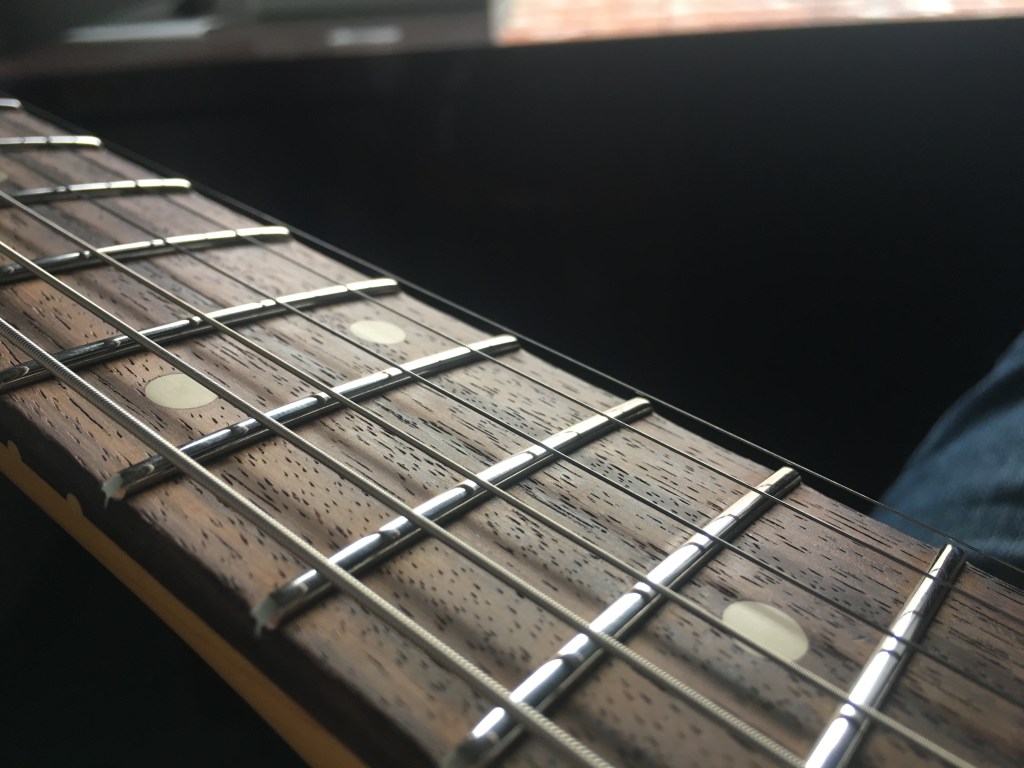
Have you ever wondered why guitars have frets and violins do not? I didn’t think so. I guess I better tell you what a fret is now. A fret is a thin strip of metal that runs perpendicular to the strings on a guitar. In theory it makes it easier to play a correct note. On a fretless instrument you have to rely in your ear and not a fret to play the correct note.

I do not own a violin but I spent a little time with one in my first round of college. I kept asking the wrong questions. Where is C? I should have asked, What does C sound like? I have come a long way since then on guitar. And I am beginning to understand why the concert music world did not respect the guitar until players like Andreas Segovia and Julian Bream paved the way for classical guitar in the twentieth century. I suppose I might as well tell you now that the guitar is out of tune. Or you could say it is equally in and out of tune. And this has bothered me for years.

I discovered this issue as a young player when I realized that guitars need regular maintenance. You need to tune a guitar’s open strings every time you play, but occasionally you have to check the guitars intonation. That means you make sure that the guitar is in tune at the 12th fret octave as well as the open string. If it is flat at the octave you can adjust the guitar’s bridge to make the string shorter and therefore sharpen the pitch. You lengthen the string to flatten it if the pitch is sharp at the octave. But there is a mathematical problem with tuning that is highlighted on fretted instruments: you can either have the octaves in tune, or the Fifths in tune, but not both. (Fifths are the fifth degree of the major scale and are the foundation of western music.) I did not have this information all of those years ago, I just noticed that I could never get the tuning perfect. And I thought there was something wrong with my instrument. It turns out it was not my guitar, but the whole tuning system in general. The piano suffers from the same problem.

I am tuning an octave on this old piano by ear. When you play two frequencies that do not match, say 400 hertz and 445 hertz, you can hear the difference of 5 hertz as a thumping sound called beats. You should be able to hear the beats disappear as the octave is brought in tune.

There have been a number of attempts made to deal with this issue over the past thousand or so years. Various temperaments, or tuning systems have been developed to to mitigate the Pythagorean Comma, or tuning gap. Apparently Pythagorus- yes that Pythagorus from your geometry class- wrestled with this issue.

Now that we have the tuning system worked out people only want to write four chord pop songs.

Enter the guitar around 500 years ago. I’d like to think that a prototypical guitar player invented the guitar. He was probably aware of the tuning issues, and thought, What if I just put these frets on the neck, make everything straight, and hope for the best? Guitar players are infamous for not being able to read music. Maybe he put frets on the fingerboard because he was tired of guessing where to put his fingers. Maybe he didn’t want to memorize notes but was happy to play patterns. At any rate guitars have been using equal temperament tuning since the renaissance and pianos waited to adopt it until right after the Boer Wars. And I think that’s why the guitar didn’t start gaining notoriety until the 1930s. Equal temperament tuning compromises the fifths in each key so the instrument can play fairly in tune across all the keys. This is why I have never been able to tune my guitar to my idealists standards. That brings me a small amount of psychological pain. But I have fallen in love with the guitar and I believe we can work our differences out.

Imagine now if this tuning phenomenon did not plague musicians and instrument makers. What if we could have the octaves and the fifths in tune? I don’t think that music would be what it is today. Part of the beauty of music is figuring out what works and what doesn’t. If everything was perfect there would be no dissonance, and how could we write music about pain and suffering without dissonance? J.S. Bach wrote his masterpiece The Well Tempered Clavier on an imperfect instrument. He wrote a piece of music in every key for the Harpsichord or Clavichord. These are stringed keyboard instruments that predated the piano. The genius of these pieces are the notes that he avoids because the well tempered tuning system still had some major dissonance issues. This piece is still studied today by aspiring pianists.

Think about this: more than likely, all of the piano music that you have ever heard in your whole life has not been in tune.

I suppose every good story needs a moral. Life is not always perfect. It can be frustrating to find the perfect balance because there may be no perfect balance. You just have to do the best that you can do with what you have. And often that ends up being the most beautiful thing anyway.

Loss of a Coworker

Getting to know people who are not like me has always been one of my favorite aspects of working with the public and attending public school.

Coworkers are people that you may not have anything in common with the except that you both work at the same place. So you end up building a special relationship with someone that you ordinarily would not have made friends with. Getting to know people who are not like me has always been one of my favorite aspects of working with the public and attending public school.

Losing a coworker is a strange feeling. I remember Dad losing a coworker to cancer when I was just a lad. I think his name was Ed White. Dad had visited him a few times while he was in the hospital. I remember how he would tell Mom how the visits went. I don’t have anyone to verify this-they are all dead-but I am fairly certain that Ed White paid the hospital bill when my sister was born. Mom and Dad went to the funeral without us kids. We didn’t know all of the details but we could tell by Dad’s countenance that it was not a time to be rowdy at the house.

“Paul passed away this morning.”

I got this text a couple of weeks ago from my boss at my former State job. I only saw him once or twice a month for the years that I worked there. But I talked to him on the phone quite often. He was one of our field officers and spent most of his time covering a large part of east Alabama. It was always a welcome diversion whenever one of these officers dropped into to see the people like me who hardly left the office. Those officers all had the best stories.

He carried a cane. He would walk by and smack that cane on my desktop and say things like:

“You’re fired.”

“You’re working too hard, take a break.”

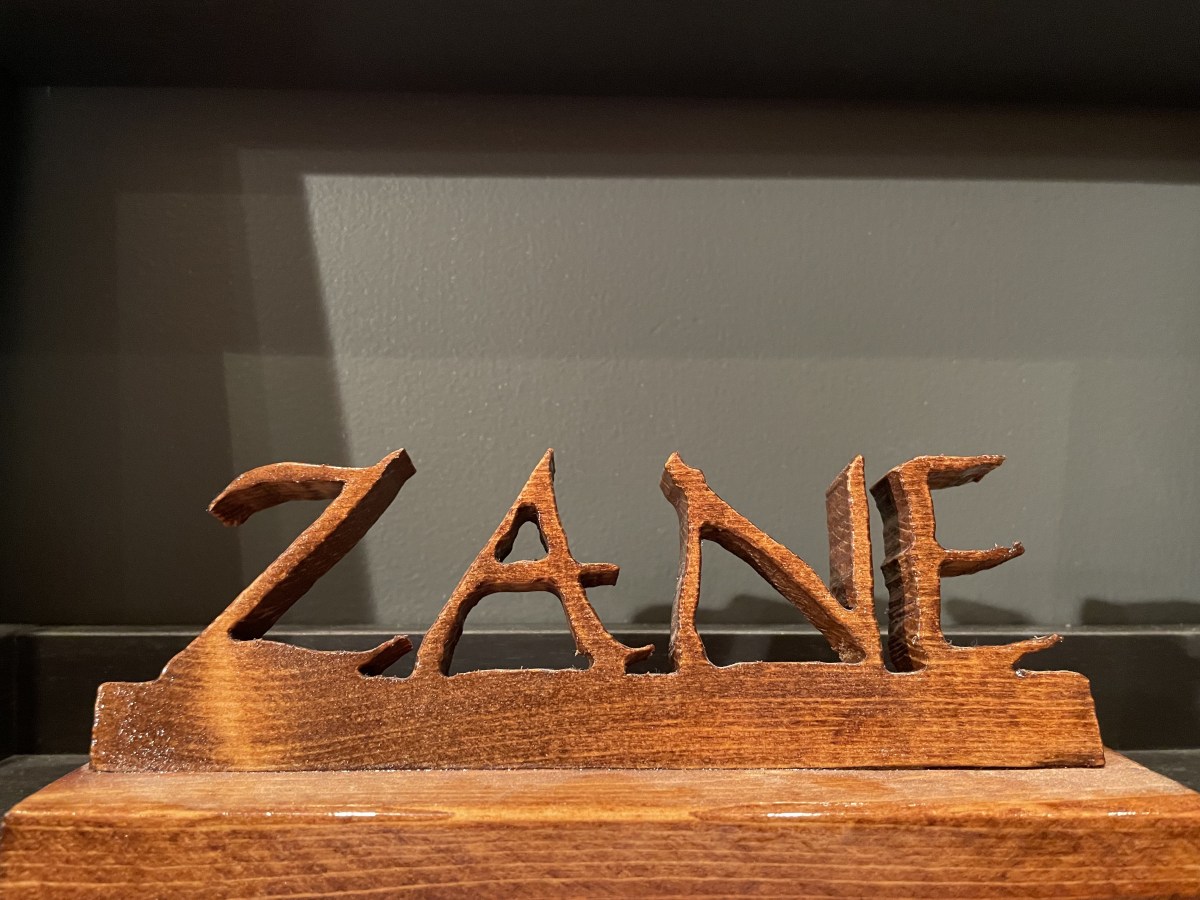
He was good at saying nice things in an abrasive tone of voice. He was also a very giving person. My first week or so at work he made me a wooden stand with my name. I still have it in my new office. It means a little more to me now. One day he brought me a bunch of metal straws. At first I thought, what in the world am I going to do with these? But they have been in constant use since I brought them home to the kids. Recently I have gained a deeper appreciation for these straws since I have slipped into the habit of drinking milkshakes nearly everyday.

Paul had served in more than one branch of the military and was a veteran of Iraqi Freedom. This may be where he picked up the cane. After he retired from the military he landed the gig with the State and that’s where I met him. He retired in the last year or so because his health. He had been fighting cancer. God I hate cancer. Paul was indeed a character. He made me want to be a better gift giver.

The first coworker that I ever lost was named Chavelo. Although I think that was his nickname. His real name was Isabel. I had never heard a man named Isabel, but I was so much older then, I’m younger than that now. He was from El Salvador and he introduced me to papusas. He would share them for breakfast. We were working for a man up in our church who owned a commercial lawn care business. We all went to church together. I was the truck driver and chief weed-eater operater, Cecil-another Alabamian-and Chavelo drove the big mowers. Neither one of them spoke proper English. And now that I think of it, I don’t think they even tried to talk to each other, they just each talked to me.

Chavelo told me that he had worked on a dairy farm in El Salvador.

“Tha macheen dat meelk da cow. It bad por da cow chitty. We meelk by hand.” He made a squeezing motion. I’m not sure what I was supposed to do with this information, but it has brought me a lot of joy over the years.

As we drove from job to job, Cecil would point out houses that he had sanded the floors in. The two would interrupt each other to talk to me. It was so entertaining.

“You see that bank right there Brother Zane?” Cecil asked one day.

“Yes.” I said, not fully paying attention as I navigated the truck and trailer through the streets that had been designed for horses and carriages.

“Somebody robbed that bank with a banana!”

“What?” I asked incredulously, now fully paying attention.

“It was a chocolate covered banana.” Cecil replied. I’m not sure of the veracity of this story, but I know for certain that Cecil believed it. I really hope it is true because I want to believe it too.

That’s what it was like working with these two. They were both old enough to be my grandad. I did a lot of laughing back then. That’s what the best coworkers do, they make you laugh.

Chavelo was sick one week for a few days, and when he returned I noticed that his eyes were yellow. After a month I began to noticed that his upper belly was protruding. He was not an overweight man by any means and this protrusion turned out to be bloating from liver cancer. I noticed the same symptom in Paul a while back. Chavelo went down hill pretty quick. I went to see him a few times while he was on his deathbed to pray for him.

“It’s no good Brother Zane.” He burst into tears one day. I cried too.

When he died they asked me to speak at the funeral. That was the first time I had ever spoken at a funeral and also the first time that I had ever spoken with a translator. I said something along these lines.

Chavelo and I had a language barrier, but not a communication block. We couldn’t always understand each other’s words, but we understood each other’s thoughts. Love transcends language. Chavelo was always sharing and we were always laughing. That connection was worth more than words could explain.

I sometimes think of Chavelo when I get discouraged while trying to learn Spanish. Chavelo helped me understand that speaking English is not the only sign of intelligence.

Eventually I got a job with Parks & Recreation and left the mowing industry. I was sitting at my desk one day and I got a phone call on my personal phone. I didn’t recognize the number so I didn’t answer. It is one of the biggest regrets I have. Pastor Dillon was out of the country so that’s probably why they called me. When I finally checked the message I was gutted.

“Cecil has had an mowing accident and he didn’t make it. Please call us.” It was from one of Cecil’s family members.

When they described the hill that he had been mowing when his mower flipped over on him I knew exactly where they were talking about. It was steep and tall. I never liked mowing on it myself.

Two things changed in me after Cecil died. I still answer the phone even if I don’t recognize the number. This does mean that I talk to a lot of people in Kolkuta, India, but I don’t mind. I also don’t play around with zero-turn mowers and I don’t feel bad telling people, “Hey man, you need a roll-bar on that thing.”

When I got the text about Paul it brought back a lot of memories for me. God and Death are no respecters of persons. I don’t know if this has helped anyone, but it has helped me.

Compliments

Are you better at giving or receiving compliments?

I imagine that most people like to have nice things said about them. Especially the Words of Affirmation people. I never remember exactly what my love language is because I never finished reading that book. There wasn’t enough plot for me. However, I have always enjoyed complimenting people. Although my sister-in-law, sister, and even my wife sometimes tell me that I am not very good at it. They say things like, I never know if you are being nice or making fun of me.

Compliments are like bubble gum, its ok to chew on them for a while, just don’t swallow them.

For instance a generic compliment to one of them might sound something like this, “I like that dress.” That is boring, and easily forgotten. To give a good compliment you have to imagine that your 3rd grade teacher is grading you on your effort. “I like that dress” is at best average. It lacks creativity and inspiration. Now try something like, “That dress reminds me of some curtains I saw at a museum exhibit about Japanese textiles.” See how that is more memorable? Some thought went into that. But even my best efforts get responses like Zane, no woman wants to hear that her clothes look like curtains.

Death and life are in the power of the tongue: and they that love it shall eat the fruit thereof.

Proverbs 18:21

Maybe I am not very good at giving compliments but I really do try because I believe in the power of words. I believe that words can be a source of inspiration. I believe that words can set a person’s mind in the right direction. This is why I feel compelled to write. But maintaining a blog in the era of the reel to sometimes feels like a lost cause. I must admit that I occasionally wonder if my energy is being wasted. And it is difficult to find inspiration to write when you are questioning whether what you are doing matters.

And then I’ll meet a real live person who has read my blog and they will compliment me on my writing and it inspires me so much that I stay up until 2:45am writing run on sentences because I am drawing inspiration from the power of their words.

Let me back up a little bit. I know that people read my blog because the website tells me these kinds of things. But it uses numbers and I have always thought that numbers were so impersonal. So meeting a reader in person gives me a clearer context for the numbers.

Whenever someone approaches me to tell me that they read my blog I feel incredibly vulnerable. I usually write in isolation so to me it feels like I am merely putting thoughts into words as a mental exercise. Some of the essays that have reached the most people were really not intended for entertainment but were my way of grieving. Many of the things I have written are simply thoughts that will not leave me alone and I only get peace when I release them to the outside world. There is something cathartic about reaching into the infinite and grabbing hold of something and wrestling it into the finite so that others can view it.

I also feel that since no one saw me write it that no one knows that I wrote it. I take refuge in this assumed anonymity. Furthermore, because I feel like that what I write already exists in a perfect form in the infinite, I can only take a small amount of responsibility for making it finite. These personal psychological constructs give me a false sense that no one really reads anything I write.

Whenever you read someones work you get an insight into their mind. In a sense you become familiar with the deepest part of that person. As the reader you also enjoy a sense of real anonymity in relation to the author. This is why I always feel vulnerable when I meet with someone who is a fan of my work because I feel like they can read my mind, but I cannot read theirs. But I can see it in their eyes if they really have read. Maybe they cried with me. Maybe they have the same questions that I do. Maybe they too used to go swimming in the creek with the town drunk when they were kids.

It happened to me last night as I was walking out of the conference center here in Pigeon Forge, TN. They took me by surprise.

“Brother Wells I read your blog and I love your style of writing.”

Whenever something like this happens I just say “Thank you!” But I try to say it in italics because I really mean it and I am otherwise speechless. I always think of something nice to say or questions that I should have asked hours later.

Then they said, “I feel like I know you.” This may be one of the highest compliments I have received on my writing. Complimenting someone involves a going out of yourself in much the same way that writing does. Saying something has the power of putting your thoughts into words and transferring them into someone else’s mind. And you may never know how much your words may help someone.

The Art of Listening

Whether or not you are a musician, how good of a listener are you?

I have worked with a lot of musicians over the years. Most of them have been church musicians that learned to play by ear. This does not always mean that they cannot read sheet music, or lack a strong understanding of music theory. It usually simply means that they do not sight read traditional musical notation in real time. I only know a few people that can sight read sheet music. And they are fantastic musicians. The rest of us have to study traditional sheet music in order to play it.

There is no shame in being a musician who plays by ear. There are even a lot of advantages. For instance when someone has a good enough ear they can listen to a song once and be able to play it. This is also our greatest handicap; many times we need to have heard a song before we can play it. The danger comes when we think that we are good enough to stop listening.

Many master musicians have spent years practicing ear training. Remember when you were learning your multiplication tables or when you were first introduced to Algebra? You may have struggled to even understand the concepts and the thought of being able to do these complicated formulas in your head seemed out of reach. But after practice you can probably now do simple math and even Algebra mentally and it feels natural. This is also true for music. For most ordinary humans it takes practice to be able to identify intervals, find your vocal part, or pick out a melody or chord progression. But ear training immerses you into the language of music and after a while things start to make perfect sense.

“Listen!”

This is what my Dad would say from behind a book whenever one of us kids was making too much noise. We would quieten down and strain as if we could hear. Hear what? I never know exactly what we were listening for. Was he about to say something? If we tried hard enough could we hear the book he was reading playing out in his head? It took me a long time to realize that he was simply telling us to be quiet. I catch myself telling my kids the same thing these days.

Whether or not you are a musician, how good of a listener are you? Listening is so much more than a musical skill. At the very least listening is half of communication. Listening is a vital ingredient in healthy relationships. It becomes even more important when we understand that faith comes by hearing.

So then faith cometh by hearing, and hearing by the word of God.

Romans 10:17

Whenever I take those learning style tests I always score high on a preference for auditory learning. I believe this is accurate. I really enjoy listening to audiobooks. I can recall things better when I give my undivided attention to auditory information. I think that is what makes someone a good listener, the ability to give their undivided attention.

How do you listen to music? Do you like it in the background or full blast?

When I was a teenager listening to music was a ritual. Digital music off of the internet via Napster and Limewire was in full swing, but I always felt the computer speakers sounded weak. I preferred to buy my music in compact disc form from the music section at Wal-Mart. I would bring the unopened CD home, carefully peel the cellophane and stickers off, and insert the disc into my three CD player stereo. I would listen to the whole album straight through in one sitting without any repeats or skips. Doing nothing but listening with my undivided attention. I still think this is the best way to listen to music.

I have a hard time listening to background music. I would rather listen to background silence than barely audible mosquito music. I am drawn to focus on the music and when it is too quiet any disruption seems amplified.

All of this has me thinking about things that inhibit being a good listener.

I tend to get distracted by noise. I have a hard time going to restaurants if the music is too loud, or if there are a bunch of TVs playing different programs. It is very difficult for me to have a conversation while there is music playing. The worst thing is when there are two songs playing at one time. I sometimes wonder if that makes me a bad listener. Perhaps it means I am susceptible to distractions. To some extent I do not have control over external noise.

I can control internal noise. Have you ever been listening to someone talk only to realize that you have no idea what they are talking about because you were thinking about something else? We call this spacing out, or zoning out. If used properly, the ability tune everything out and focus your attention on your thoughts is a valuable skill. But an inability to control your thoughts can also make you a poor listener. It becomes a matter of will. Will you listen to what this person is saying or will you let your mind wonder?

Your attitude is largely controlled by your will and is another internal factor that can an inhibit and an enhance listening. Imagine the worst political figure that you can. If you are like me, you will have a hard time listening to that person say anything. There is an internal block that keeps us from being open to people that we do not trust. Have you ever noticed in political debates that people are always interrupting one another? There is not a lot of listening going on. What we have here is a failure to communicate. There are many deep issues in this example, but a lot hinges on being unwilling to listen.

As musicians, if we really claim to play by ear, then we should understand the importance of listening. We must constantly practice active listening. We must listen to the song to learn what to play. We must listen to the music director for instruction. We must listen to the other musicians in order to play together and not simply at the same time, like two political candidates arguing over one another. This also applies to relationships.

He that hath an ear, let him hear what the Spirit saith unto the churches.

Revelation 2:29;3:6;3:13,22

I read something interesting this week in This Is Your Brain On Music by Daniel Levitin. Pitch, loudness, and sound in general are purely psychological phenomena. All of these perceptions are just how our brain interprets air pressure. You literally cannot hear without an ear. This has really been heavy on my mind.

I hope that we can all be better listeners.

How To Go To College As An Adult

I can’t slay your college giant, but I can tell you how I killed mine.

I started my higher education career at Gateway College of Evangelism back in 2005. Fresh out of high school. But I left at the end of the semester to go work in youth ministry in Virginia. I did that for 12 years. I have no regrets. But I have always felt like college was a big ugly giant following me around every day. I knew that if I didn’t square up with him and whip him then he would never leave me alone.

Maybe that’s how you feel. If so, I can’t slay your college giant. But I can tell you how I killed mine: Slowly.

Zane, you’re too smart to not go to college.

Pastor Jeremy Wilbanks. (And a bunch of other people)

Make a Decision

This is where you confront college. I am going to engage in mortal combat with this giant. I am not going to give up until I kill him. And when I am done I am going to hang him on the wall in my office.

Have a Plan

You don’t just pick a fight with a giant without having some kind of plan. You need to know what you are going to study. You need a plan for when you will study. You need to know how much time you can allot for study so you don’t overwhelm yourself.

“College is really just a lot of reading.”

Non-traditional student. That is the label that college puts on you when you work a full-time job, are raising a family, and have many commitments outside of work. A traditional student has little or no responsibilities and is able to tackle college full-time straight out of high school. While non-traditional students do have more work and family responsibilities, they are not bound by traditional expectations. I guess I have always been a non-traditional student since I went year-round k-12. I also did a stint at Wilson University where you could only take one class at a time, but at your own pace. So if you wanted to complete a course in a month you had the freedom to do it. You could even test out of some subjects. This confused the tar out of my employer when I took advantage of their tuition reimbursement program.

There is a freedom in being able to make your own attack plan. I found that I was able to take two classes per semester and one each summer. It was a war of attrition.

College is expensive. You need to have a plan for paying for college. I have several friends that are still harrowed by student loan debt. For years I avoided going to college because I felt that it was irresponsible to accumulate debt. And I still feel that way. But it turns out if you are broke enough there is a strong chance that you can get a Pell Grant. And If you are persistent in applying, you could very well be granted a scholarship. I received a scholarship for Business Administration because I wrote an essay. Which makes me wonder how I earned a C in English Composition II.

Stay Motivated

And let us not be weary in well doing: for in due season we shall reap, if we faint not. Galatians 6:9

One of the biggest motivators for me was a promise that I made to my Dad.

“I’m going to go back to college Dad.” This was one of the last things I told Dad while he was still lucid. He died a few days later. That was in 2018. It is 2023 now and I have finally graduated with a Associate in Science, Business Administration degree. Magna cum laude. This degree would only take a traditional student a couple of years at the most to complete. But I was and will always be a non-traditional student.

I really wish I could tell my Dad about this. But he is gone so I am telling you. I did something that no other Wells that I know has ever done. Something that not many of them even had the chance to do. My great-grandfather was simply uneducated. Pop (my grandfather) had to drop out of middle school to help make ends meet, but he valued education. So when my father graduated high school it was monumental for the Wells family. I strongly believe that Pop could have excelled as a mechanical engineer had he been able to continue his studies. There was hardly any machine that he couldn’t fix. He was also quick with mental math. I feel the same way about Dad. He had a brilliant mind. He could recall things he read decades before. He also had the remarkable ability to put abstract concepts into language that simple people could understand. Without a doubt, my father would have excelled in academia. But we can do nothing for the dead, and must address the living.

The other motivating factor for me to finish college was my children. I want my children to know that education is not something to fear. I do not want them to be destroyed for a lack of knowledge. I want them to know that hard things can be done, and they can be done with excellence.

There is a good chance that I will resume formal study again in the future. But currently I am sizing up a different giant.

Irregular Hours

Even when things were not busy in the office, we pretend they are and look busy.

For the better part of 15 years I have worked the rigid hours prescribed by HR departments of the County and State governments that employed me. 40 hour weeks. 1 hour lunch breaks. 15 minute breaks. Even when things were not busy in the office, we pretend they are and look busy. This is one of the reasons why I started writing. I had to fake being busy. Looking back, my supervisors were pretending to be busy by being concerned that I looked busy. Nobody really verbalizes this phenomenon at work, but everyone understands it.

At my most recent State job, we decided that we would try out four ten hour shifts. The idea was we were too busy answering phone calls during business hours to get any work done. So if we could have a few hours each day to work without the phone ringing we could get the work done. And have an extra day off.

After I made it through the allotted trial period, and consequently the busiest season of the year, I realized that the four ten hour shift was too taxing on my energy when I included my one hour commute and trying to do some important things every day. So I decided to switch back to five eight hour shifts.

I was talking to my coworker about how glad I was to switch back. The conversation went something like this.

“I am glad that I switched back to five eights. leaving the house at 5am and getting home at 6pm was wearing me out. But I might switch back next busy season.”

“They probably won’t let you.”

“Why not?”

“Because that would be too much like making your own schedule and they don’t want that.”

This conversation rattled me. For years I had wanted a job with regular predictable hours and now I had one. I had hated showing up to work to check the schedule and seeing that some boneheaded manager had me working on a church night. Or worse, being sent home because they were cutting hours. Now here I was working like a borrowed mule for three months out of the year, never seeing an end to the work. Then for nine months doing 15 hours of work per week and pretending to look busy for the other 25 hours. I wondered how productive I could be if I in fact did make my own schedule.

It was not long after this that I left that job. No hard feelings. No bitterness. No parting shots. But this conversation helped me make the decision to leave. When I was offered a new job one of the most attractive aspects was that I would indeed make my own schedule. So now I work irregular hours. And it is one of the best things that has ever happened to me.

I never could make any money. I was always too busy working.

Perry Wells

Open For Business

There aren’t many things that I have done that have been more fulfilling than teaching music.

My parents bought me my first guitar. I kind of forced them into it by signing up for guitar class at school. I didn’t learn a whole lot about playing guitar in that class, but I got a refresher on music theory. Eventually a proper flat-picker wandering into our church and showed me how to read tabs and chord diagrams, the major scale, how to play Bluegrass rhythm in G, and one Tony Rice lick before he told me, “I can’t show you anything else. If you really want to learn you will.”

In one sense, being told it is time to sink or swim really motivated me to learn. Conversely, I still had so much to learn and I had to learn it the hard way. Not having a teacher forced me to be a scholar. Learning how to learn on your own is what teachers really mean when they say you need to study. I have been studying guitar for over twenty years. As the physicians say, I am a practicing musician.

Learning to play guitar did wonders for my self confidence as a teenager. As an adult it still amazes me that I can play. This skill has also opened significant doors in my life.

Earlier this year the Lord delivered me from my one hour commute to work. The first things I did was start teaching guitar lessons again. There aren’t many things that I have done that have been more fulfilling than teaching music.

Get something in your life that God can bless.

Pastor Jeremy Wilbanks

Pastor has been saying that a lot lately to the church. It is one of the reasons that I wanted to start teaching again. I also feel like I need to put some of things I have learned while studying business in college into practice. Most significantly, I feel a responsibility to help musicians avoid having to learn the hard way. And God is blessing it.

Here are the answers to some of the frequent questions I get asked about learning guitar.

Should I start out on acoustic or electric? Choose the one that you want to play. You won’t be motivated to practice the acoustic if you really want to play electric.

What age do they need to be to learn? The youngest that I have successfully taught was seven. As long as they can pay attention and have enough hand strength to fret a note I can work with them.

Am I too old to learn? You are never too old to learn.

So if you or anyone you know is interested in learning guitar or bass guitar please send them my way.

zanewells@yahoo.com