On Learning of the Death of Charlie Kirk

I was reminded of the scripture where the angels heralded the birth of Jesus Christ.

 And suddenly there was with the angel a multitude of the heavenly host praising God, and saying, Glory to God in the highest, and on earth peace, good will toward men. Luke 2:13-14

No one else in history received an angelic concert like this at birth, because no one else had ever brought peace and good will. After all these years, there was peace on earth and good will toward men. Only because the Prince of Peace came to earth was there ever a chance of peace. It was a manifestation of God’s good will towards us: the Word made flesh. Without Jesus there is no peace and there is no good will. Alas, we rejected peace and good will, and we crucified the Lord of Glory.

And here we are today, with the same hate and venom we had then spewing out of our mouths and onto each other and everything around us. No peace. No good will. We think we know what we’re mad about, but we only know what we’d like to be mad about. Deep down in the essence of our being we know what it really is, but we don’t like to talk about it.


Because that, when they knew God, they glorified him not as God, neither were thankful; but became vain in their imaginations, and their foolish heart was darkened. Romans 1:21

We can get mad-not just mad, but cutthroat vicious-about politics and try to make the issue conservative against liberal, but that is not the issue, so no political solution will ever work. We can get parade marching angry about gun rights, but that isn’t the issue either. We can push the limits on free speech, arguing ourselves into circles and corners high on hate, but the issue isn’t about free speech. We can get fist-fighting furious about racism and social inequality; trying to blame the world’s problems on white people, or rich people, or rich white people like they are trying to teach me in college. But if there were never any white people, the issue would remain. These are all just saplings growing out of an ancient root: Sin.

I have not studied world religions because I think there is another way, I am persuaded that Jesus is the way, but I have studied them because I am interested in humanity. Understanding someone’s religious beliefs will help you understand the way that person thinks. Outside of what we can call Abrahamic religions, there is no religion with a doctrine of sinning against a deity. Hinduism, a broad, amorphous, non-codified religion is practiced in many different ways and has a concept of not following your dharma or personal destiny, but this is not sin against God. Buddhism and Jainism, both offshoots of Hinduism also do not preach sin. Many Eastern religions involve ancestor worship, and while one can bring shame upon themselves and their families, there is nothing about Sin.

We don’t like to be told that something we are doing is something that displeases God. We don’t even like to be told that there is a God. As Paul wrote in Romans 1, we do not like to retain God in our knowledge. It is no wonder when the Apostles preached repentance that they were often stoned to death. Sin is still the issue. Many of us like our sin, and we want everyone else to like it too.

Because of Sin, we live in a broken world. But thank God, where there is sin, there is so much more Grace.

…But where sin abounded, grace did much more abound… Romans 5:20

Neighbor, How Big is Your World?

I grew up in a small town, but for most of my adult life I’ve lived and worked in suburban areas. Having experienced both, I now live in the tension of wanting the business of a city and the quietness of the country. I imagine you could draw lines and each side could argue until Kingdom Come-I’m not trying to do that today- but I am going to endeavor to expose some aspects of human nature common to every one of us, but I tend to notice more in rural areas. Perhaps because it is hard to be anonymous in a small town where character and actions seem to be magnified. This is not an indictment of small town life, nor an endorsement of city life, but an honest attempt at addressing selfishness.

We have a couple of interesting words for selfish thinking: egocentrism-that is, the world revolves around me, and ethnocentrism-the world revolves around people like me. In a small town, it is easy to forget-or never even realize-that there is a world, indeed a much bigger world, beyond the city limits, or property lines. No matter how big the town, a small world is the breeding ground for self-centered thinking.

More people live in the city of Delhi, India than in the whole state of Texas.

I heard a lot about worldview in college. It was good for me, a country boy from central Alabama to learn things like American football is not even in the top 10 most popular sports in the world. That not everyone is an American. It challenged my worldview when I made friends with people who grew up in foreign places like Canada, Mexico, Thailand, Jamaica, South Africa, and California.

Jesus addresses egocentrism and ethnocentrism in the parable of the Good Samaritan. When we ask Who is my neighbor? We are asking, How big does my world really have to be?

Luke 10:25 And, behold, a certain lawyer stood up, and tempted him, saying, Master, what shall I do to inherit eternal life?

26 He said unto him, What is written in the law? how readest thou?

27 And he answering said, Thou shalt love the Lord thy God with all thy heart, and with all thy soul, and with all thy strength, and with all thy mind; and thy neighbour as thyself.

28 And he said unto him, Thou hast answered right: this do, and thou shalt live.

29 But he, willing to justify himself, said unto Jesus, And who is my neighbour?

More can be said of the story of the Good Samaritan than I am capable of writing. It is the story of humanity and I implore you to read it. The fall of man has left us in a cruel world, half dead, without help, until an outsider came along and saved us. Jesus did not have to show us mercy, but that is what neighbors do.

Luke 10:36 Which now of these three, thinkest thou, was neighbour unto him that fell among the thieves?

37 And he said, He that shewed mercy on him. Then said Jesus unto him, Go, and do thou likewise.

When I was a little boy I thought that my only neighbors were Rob and Karen, my next door neighbors. But there was a man in our church that challenged that mindset in the manner that he greeted people: “Howdy neighbor.” I remember my Dad preaching a message about this using the above text. I think about this whenever I read this portion of scripture. With a child’s understanding I began to realize every human on the planet is my neighbor.

This kind of broader thinking is often limited by human constructs that manifest as national pride, political ideologies, regional traditions, and even things as simple as sports team preference. It is hard for many people to break out of these constructs and see other people as humans, much less neighbors.

How we view and treat other people is linked to eternal life.

It is a question that we will be unable to avoid in the judgement: How big was your world?

Matthew 25:34 Then shall the King say unto them on his right hand, Come, ye blessed of my Father, inherit the kingdom prepared for you from the foundation of the world:

35 For I was an hungred, and ye gave me meat: I was thirsty, and ye gave me drink: I was a stranger, and ye took me in:

36 Naked, and ye clothed me: I was sick, and ye visited me: I was in prison, and ye came unto me.

37 Then shall the righteous answer him, saying, Lord, when saw we thee an hungred, and fed thee? or thirsty, and gave thee drink?

38 When saw we thee a stranger, and took thee in? or naked, and clothed thee?

39 Or when saw we thee sick, or in prison, and came unto thee?

40 And the King shall answer and say unto them, Verily I say unto you, Inasmuch as ye have done it unto one of the least of these my brethren, ye have done it unto me.

All Quiet on Pew Number Five

There was a wedding at church on Saturday.

There was a wedding at church on Saturday. The kind without all the fuss of rehearsal dinners. Or rehearsals. Or the hassle of getting a hotel room. No frivolity, just a simple wedding like I remembered when I was a kid, with cake and punch in the church foyer. I really like these kind of weddings.

As my family sat in the pew on the Bride’s side waiting for the wedding to start, I noticed that it was uncommonly quiet for our church. Even the children were whispering. At least some of them. You can almost hear what your neighbors are thinking when it is that quiet. But that is what the Bride wanted, no filler music that didn’t mean anything. Just one song to walk in with.

Silence makes some people uncomfortable. And uncomfortable people make the rest of us uncomfortable. But I like quiet places. A lot more than I like canned mosquito music that nobody asked to listen to, or TV noise. I like to be able to hear the ticking of my watch. I like to hear the birds singing outside. Most of all I like being able to hear myself think.

“Quiet as a church? If had a car that sounded like my church, I wouldn’t drive it out of the driveway.”

-Tom Trimble

As I sat there on the pew, hardly daring to whisper, I thought about how much racket I normally make at church. I have blown three speakers while playing guitar at church. Now I’m not proud of that, because it was expensive, but probably some of the loudest moments in my life were at church. But there we were, sitting on the pew trying not breath too heavily so as not to disturb the quiet. It was so peaceful. I think I’ll slip up there again soon when no one is there and just listen to the silence.

Some Thoughts on Truth

Resisting the truth is what keeps many conflicts alive.

While I was working my way through college I noticed a phenomenon that happened with alarming frequency. Things that I had been taught in high school as fact were now being challenged and subjected to heavy source criticism.

Post-truth: relating to or denoting circumstances in which objective facts are less influential in shaping public opinion than appeals to emotion and personal belief.

It was the Oxford Dictionaries word of the year in 2016.

“Never have human societies known so much…but agreed so little about what they collectively know.”

Dan Kahan, psychology and law professor

It is safe to say that we live in a post-truth society. What does this mean for the Church? As Christians we are people who are very concerned with truth and how we view truth is a matter of grave importance. This is in no way an exhaustive work, but a mere peering into mirrored surface of the profound pool of truth.

Truth can be known.

Jesus said in John 8:31 “…And ye shall know the truth, and the truth shall make you free.”

You cannot know a lie. Neither do lies bring freedom. You can only believe a lie.

But truth is knowable. It is stable foundation that can built upon. When everything is falling apart in your life you can cling to something that you know is true.

You can know this today: There is a God who loves you.

Truth must be purchased.

While there is some truth that can be immediately transmitted into our knowledge, truth must be purchased; sought out. You have to get it for yourself, not just because some body told you.

Buy the truth, and sell it not; also wisdom, and instruction, and understanding. Proverbs 23:23

In order to be purchased, truth must be valued. You will not purchase something that you do not think is valuable. Lies can also be purchased. What people value determines the market. Truth is precious. It is rare. Lies have no value. Unfortunately, many unsuspecting-or rather undiscerning-people have been sold so many lies at immense costs.

What you value matters to God. The highest level of value is love. If you do not love truth, God will hide it from you.

II Thessalonians 2:8-12 And then shall that Wicked be revealed, whom the Lord shall consume with the spirit of his mouth, and shall destroy with the brightness of his coming: Even him, whose coming is after the working of Satan with all power and signs and lying wonders, And with all deceivableness of unrighteousness in them that perish; because they received not the love of the truth, that they might be saved. And for this cause God shall send them strong delusion, that they should believe a lie: That they all might be damned who believed not the truth, but had pleasure in unrighteousness.

Truth Demands a Response.

Response to truth is reflected in behavior. When truth is resisted corrupt behavior is manifested.

II Timothy 3:1 This know also, that in the last days perilous times shall come. For men shall be lovers of their own selves, covetous, boasters, proud, blasphemers, disobedient to parents, unthankful, unholy, without natural affection, trucebreakers, false accusers, incontinent, fierce, despisers of those that are good, traitors, heady, highminded, lovers of pleasures more than lovers of God; Having a form of godliness, but denying the power thereof: from such turn away. For of this sort are they which creep into houses, and lead captive silly women laden with sins, led away with divers lusts, Ever learning, and never able to come to the knowledge of the truth. Now as Jannes and Jambres withstood Moses, so do these also resist the truth: men of corrupt minds, reprobate concerning the faith.

Truth will always be resisted, and as time draws near to the end, it will be resisted more. People will always try to hide the truth, and it will be reflected in their fruit.

Truth is Liberating.

John 8:31 “…And ye shall know the truth, and the truth shall make you free.”

With truth comes a freedom that nothing else can bring. Hiding the truth breeds fear. There is nothing to fear when you can tell the truth.

If you tell the truth, you won’t have to worry about someone else telling it.

Hard Questions

“Will the Lord cast off for ever? and will he be favourable no more? Is his mercy clean gone for ever? doth his promise fail for evermore? Hath God forgotten to be gracious? hath he in anger shut up his tender mercies? Selah.”
‭‭Psalm‬ ‭77‬:‭7‬-‭9‬ ‭

David has some of the most pointed and direct questions in the Bible.

“Will the Lord cast off for ever? and will he be favourable no more? Is his mercy clean gone for ever? doth his promise fail for evermore? Hath God forgotten to be gracious? hath he in anger shut up his tender mercies? Selah.”
‭‭Psalm‬ ‭77‬:‭7‬-‭9‬ ‭

“How long, Lord? wilt thou hide thyself for ever? shall thy wrath burn like fire? Remember how short my time is: wherefore hast thou made all men in vain? What man is he that liveth, and shall not see death? shall he deliver his soul from the hand of the grave? Selah. Lord, where are thy former lovingkindnesses, which thou swarest unto David in thy truth?”
‭‭Psalm‬ ‭89‬:‭46‬-‭49‬ ‭

I’m glad those questions are in the Bible. It is comforting to see such relatable humanity in a character like David. It is human to question things. It is how God created us. David isn’t the only one with questions in the Bible.

Job had some hard questions. Legitimate questions. Questions about pain, justice, equity, and integrity. The Disciples of Jesus had questions. Questions about roles in the Kingdom, when Jesus was returning, and why they failed to cast out demons. Nicodemus had questions. Questions about who Jesus really was. Paul had questions. Questions about why God wouldn’t take away the thorn in his flesh. And Zane has questions. And maybe you have questions.

“God can handle your questions.

-Joel Booker

Sometimes I look at the calendar and I see holidays that I don’t understand. Or holidays that I understand and don’t observe. I’m not sure if it is on your calendar, but October is Pastor Appreciation month. I learned about this as an adult. I don’t recall observing this when I was a kid. I probably missed a lot as a kid though. I observe Pastor Appreciation but I don’t limit it to the month of October.

A pastor, we read in the English dictionary, is a minister in charge of a Christian church or congregation. I like Webster’s definition better, a spiritual overseer. The Bible likens pastors to shepherds and the people of God as sheep. In my childlike mind I understood that my pastor was the man who preached to me. He was The Preacher. There are many today that feel like preaching is irrelevant, and to use a Bible word foolish, but God still thinks that preaching is pretty important.

For after that in the wisdom of God the world by wisdom know not God, it pleased God by the foolishness of preaching to save them that believe. I Corinthians 1:21

“At some point, whether you want to admit it now or not, you are going to need a preacher, if only to put you in the ground.”

-Perry Wells

The words of the Preacher, the son of David, King in Jerusalem. Ecclesiastes 1:1

Solomon was a preacher. A wise preacher. Solomon gives us three of the five books of the Bible that are considered wisdom literature: Song of Solomon, Proverbs, and Ecclesiastes. In these books he gives us sound doctrine in how to conduct our relationships with our spouse, our fellow man, and pleasure. Solomon, to quote my father, was “Something else.”

Anyone can give you an answer, not everyone can give you wisdom.

And when the queen of Sheba heard of the fame of Solomon concerning the name of the Lord, she came to prove him with hard questions…And Solomon told her all her questions: there was not any thing hid from the king, which he told her not. I Kings 10:1-3

The Queen of Sheba came to test Solomon with questions. Hard questions. Let’s just see how brilliant this guy is. I’ve asked some questions like that before too. Sometimes you have to ask a few of those test questions just to make sure you’re not smarter that the person you are asking. Maybe the Queen also began that way. I can see her sashaying up to Solomon with a list of riddles and sharp hypothetical questions that she already knew the answer to, trying to catch him in a trap, and one after one Solomon answers her questions without any loss of composure. Maybe her attitude then shifted from snarky to the sincere and she began to ask questions about things that she really didn’t have a handle on but was too embarrassed to ask. After all, when you’re the Queen, you’re supposed to have all the answers.

I still have a lot of questions that I don’t feel comfortable asking just anyone. I believe that Pastors are a gift from God for the perfecting of the saints. I have come to appreciate my pastor so much more than simply his irreplaceable role as the The Preacher. At this season in my life my pastor has been someone who I can ask hard questions. Which leads me to this question: If you can’t ask your pastor hard questions is he really your pastor?

My Pastor, Rev. Zachary B. Wells.

Taking Notes

What does wisdom, understanding, and knowledge look like?

Sarah just got me a brand new notebook. It is a wonderful feeling to start a brand new notebook. Something about a fresh crisp and clean page makes me want to take my time and try to write neatly. I have always had poor handwriting-or penmanship as Col. Moore stated in his lament about trying to read my assignment-but on a good day I can still read what I have written, even if it was a long time ago. And when those sentences from the past are legible I often can remember what I was thinking when I wrote them. Which is the whole point of taking notes. For me anyway.

I never took notes in high school. I just listened and hoped for the best on test day. That still works pretty well if you only need to remember something until Friday, but it may fail you if you try to remember something twenty years later. Even so, I believe there is an art to active listening. Which is to say that I believe that you can practice to be a better listener. This is one of the reasons that I love audiobooks. But if I really don’t want to forget something I like to write it down. That doesn’t necessarily ensure that I won’t forget it, but this redundancy reinforces the chances of remembering. So I take a lot of notes. While listening of course. Especially to preaching.

I don’t recall bothering myself to even take note of a test date. I just showed up to class and took it day by day.

I haven’t always taken notes as an adult either. I made an attempt to start in college, but it was short lived. College and note-taking. I started in earnest about 12 years ago at Youth Camp. I noticed a fellow councilor writing away on a notepad during a day session. The man who was preaching was saying some pretty good stuff. So I found a pen and pad before the next service and I started taking notes too. After it had become a habit for a couple of years I found out that the person who I had seen taking notes at Youth Camp was simply trying to stay awake.

It took me a while to develop a note taking system. When I take notes I am subconsciously trying to answer these questions: Am I following the speaker’s notes? What is the speaker saying? What is the essence of this message? What am I thinking that the speaker is not saying? What is God saying? How does this apply to my life? What songs will go for altar?

Good luck reading this. It was my notes from a powerful sermon at Youth Camp by Ari Prado.

I still take notes every service. And I journal fairly regularly. I even write these articles as an exercise in manifesting ideas. I believe this is all only practice to be a more excellent communicator. It has helped me learn to put my thoughts into words and be confident when I have to speak in difficult situations. From time to time I browse through my my notebook, particularly when I just finished one. It is a moment to reflect that chapter in my life. I may highlight major life events in the index in the front and write a synopsis of that time period. It is also interesting to know what a younger man was thinking.

I am hesitant to say that taking notes has made me critical of what people say, especially across the pulpit, but it has given me an awareness of their authority of subject material and the amount of preparation they spent on their speech or sermon. The last thing I want to be remembered as is a sermon critic. At the same time preaching is a matter of eternal significance and should not be practiced nonchalantly. If study for preaching is only internet deep then the sermon will be shallow indeed. Words are all that we have, and words must carry weight.

In the past year I have begun to look at taking notes differently. Principally because of these two scriptures:

Proverbs 3:19 The Lord by wisdom hath founded the earth; by understanding hath he established the heavens. 20 By his knowledge the depths are broken up, and the clouds drop down the dew. 21 My son, let not them depart from thine eyes: keep sound wisdom and discretion: 22 So shall they be life unto thy soul, and grace to thy neck.

What does wisdom, understanding, and knowledge look like? How do I not let them depart from my eyes? I think it is safe to say that this means words. How powerful are words! It is my sincere intention to learn to recognize wisdom, understanding, and knowledge when spoken and to write them down.

Proverbs 4:20 My son, attend to my words; incline thine ear unto my sayings. 21 Let them not depart from thine eyes; keep the in the midst of thine heart. 22 For they are life unto those that find them, and health to all their flesh. 23 Keep thy heart with all diligence; for out of it are the issues of life.

What do words and sayings look like? I can still hear my Dad say things, and if I tell them to you then you will hear them too. Maybe even for a long time after they’ve been said. But this can’t just be oral. Somethings must be written down. This concept of letting the words and sayings not depart from my eyes has caused me not only to be more diligent in taking notes, but also in reading the Word of God.

And that, dear reader, is why I take notes.

Apostolic Youth Ministry

The Bible does not contain a youth ministry model separate from adults, children, or elders.

Sarah and I drove from Alabama to Virginia this last weekend to attend the funeral of a man who had been a young person while we were leading youth ministry. Being there and seeing the teenagers-now grown people with families-whom we spent nearly every Friday night of our 20s with brought back a flood of memories. I love those people. And I still recognize a familiar connection that is not easily built with people.

In light of eternity, I am reminded that not everything we can involve ourselves with has equal importance. Not all activities or pursuits weigh the same. There are weighty things like righteousness, temperance, and the judgment to come, that make people uncomfortable to talk about. So they pursue, and try to find purpose in the frivolous and trivial. There is a grave danger in binding your life up in superficial things that have no eternal significance. Coming through The Valley of the Shadow of Death has also caused me to reflect on the eternal weight of glory that was being stored up in youth ministry. There are some things that we do that are far more important than other things. I wholeheartedly believe that Youth ministry is one of the important things that I have ever done.

And as he reasoned of righteousness, temperance, and judgment to come, Felix trembled, and answered, Go thy way for this time; when I have a convenient season, I will call for thee. Acts 24:25

In the name of personal development, I have read some superfluous and shallow books on the topic of Youth Ministry.

While there are many books about Youth Ministry, there are not many books about Apostolic Youth Ministry. As an Apostolic Christian, I believe in the Oneness of God, and have obeyed the commandment of the Apostle Peter-the man with the keys to the Kingdom- in Acts 2:38. This distinction-and many others-set Apostolic believers apart from mainstream Christendom. So when a non-Apostolic attempts to write a book on Youth Ministry it fails to address foundational concepts of Apostolic Christianity. To be clear, I make no claims to being an expert in Youth Ministry. Indeed I have made many mistakes. But I did serve for 12 years as a Youth Pastor and for a while now I have felt the gravity of the need to write about Youth Ministry from an Apostolic perspective. So today is a start at the very least.

The Bible does not contain a youth ministry model separate from adults, children, or elders. There are instructions at times to these demographics, but no formula for a church service that is unique to a specific age group. This is something that was largely ignored in the many youth ministry seminars, clinics, and training sessions that I attended in pursuit of excellence. Something else that was never at the forefront of these training was an emphasis on preaching in Youth Ministry. In fact there was often a strong emphasis on teaching in place of preaching. I think this is a mistake. Without doubt it is possible to build something without anointed preaching, but it will not be an Apostolic Youth Ministry.

I stood in front of that casket this past weekend and relived those Friday night youth services from days gone by. It was not the shoestring budget that we operated on, nor whatever trendy teaching series that was in circulation, or any hip stage design that came to mind-all these things are fleeting. It was preaching and the response to preaching that made the difference. At its essence, Apostolic Youth Ministry must contain prayer, and preaching. And not just any prayer and preaching, but the kind of prayer that shakes the house, and the kind of preaching that turns the world upside down.


For after that in the wisdom of God the world by wisdom knew not God, it pleased God by the foolishness of preaching to save them that believe.            I Corinthians 1:21

I wrestled with a man nearly all night when I learned that I would be saying something at the funeral. Not because I didn’t know what I would say-God had already told me- but because of how important words are, and how not all moments are created equal. I did not get rest until I had prayed and written this out:

Think not that I am come to send peace on earth: I came not to send peace, but a sword.
Matthew 10:34

Preaching is an offensive action. Its about the most offensive thing that you can endure.
There is no more offensive word than repent. The Word of God is a sharp sword that goes for the jugular. But God chose preaching to save them which believe
.

The law and the prophets were until John: since that time the kingdom of God is preached, and every man presseth into it.
Luke 16:16

Matthew records this same passage in this manner:

And from the days of John the Baptist until now the kingdom of heaven suffereth violence, and the violent take it by force.
Matthew 11:12

There is something combative about the Kingdom of God.

When I think of Brandon I first see a skinny little middle school aged boy sweaty from playing basketball before Youth Service on a Friday night. And there was preaching. And I see Brandon now as a teenager at Youth Camp not as sweaty anymore because he is trying to impress Makayla. And there was preaching. I see Brandon every Sunday morning, every Sunday night, and every Wednesday night with his crooked glasses. And There was preaching. And I see Brandon now as a young man of God in his office praying, and listening to preaching.

The preached Word of God speaks to us in our essence, or our full potential in the Spirit world. This is why the angel of the Lord spoke to a cowering Gideon threshing wheat by the wine press as a Mighty Man of Valor.

I watched Brandon look into the mirror of the preached Word of God and see Brandon, the man of God that could be.

Brandon heard the Word preached, mixed it with faith, and pressed his way violently into the Kingdom of God. And as his youth pastor, I watched him wrestle with heavenly potential. I could cheer him on, but it was his fight alone.

And Jacob was left alone; and there wrestled a man with him until the breaking of the day.
Genesis 32:24

I can see Brandon in those altars, alone, without his parents, wrestling with God; the Brandon who Was wrestling with the Brandon Who Could Be.

And I see him grab ahold of God and not let go. I see him wrestle some things to the ground. And I see him walk away, limping, and victorious.

At last I see him by faith, leaning on the top of his staff and worshipping as he died.

Brandon…you are the kind of person that I want to be: a man who died In the Faith.

I never really think about who may read whatever you want to call what I write, until I meet them in person and they tell me. If you are in Youth Ministry today I want to speak directly to you. Have a nice stage. But Preach the Word. Have great music and cool lights. Don’t try to give a TED Talk, Preach the Word.

I charge thee therefore before God, and the Lord Jesus Christ, who shall judge the quick and the dead at his appearing and his kingdom; Preach the word; be instant in season, out of season; reprove, rebuke, exhort with all long suffering and doctrine. For the time will come when they will not endure sound doctrine; but after their own lusts shall they heap to themselves teachers, having itching ears; And they shall turn away their ears from the truth, and shall be turned unto fables. II Timothy 4:1-4

Portrait of a Southern Gentleman, or Things I Learned From My Dad

I was brushing my teeth this week, and while I generally do it every day, I can’t remember which day, so, I was brushing my teeth this week. I look in the mirror while I’m brushing my teeth. I was taken off guard to see that my forearms have grown considerably since I’ve been working in a more strenuous environment. For a moment, I thought that I was looking at my Dad’s arms.

I think my earliest memories of my father is of him splitting wood in the back yard. His forearms swelling as they gripped the maul. I was watching from my upturned five gallon bucket chair. Now I see him open the chicken pen and feed the chickens. Now I am standing on the back porch watching Dad wade through the flooded back yard in the pelting rain with a chicken under each arm. I watch a chicken snake as long as a fishing pole swim between his legs. I remember him killing the snake with a hoe. I remember him loading a rusty wood stove with the wood that he split. I remember riding around in his red Mazda. Mostly, I remember him coming home from work just about every day. Because my Dad is a faithful man.

Proverbs 20:6 Most men will proclaim every one his own goodness: but a faithful man who can find?

My Dad did not teach me how to be faithful, he showed me. He has been faithful to his wife. He showed me the importance of loving your wife.

“In 1936c King Edward VIII of England abdicated the throne to marry a woman from the United States. He would rather marry that woman than be the king of England. I don’t know what it’s like to be the King of England, but I do know what it’s like to love a woman.” -Perry Wells at the dedication of Wesley Wells.

My Dad has been faithful to his family. He loves his kids. He has shown me how to love my children. How to speak kind and lovingly. Dad never talks to babies like babies, he talks to them like they’re grown people. I think that may be why children love him so much.
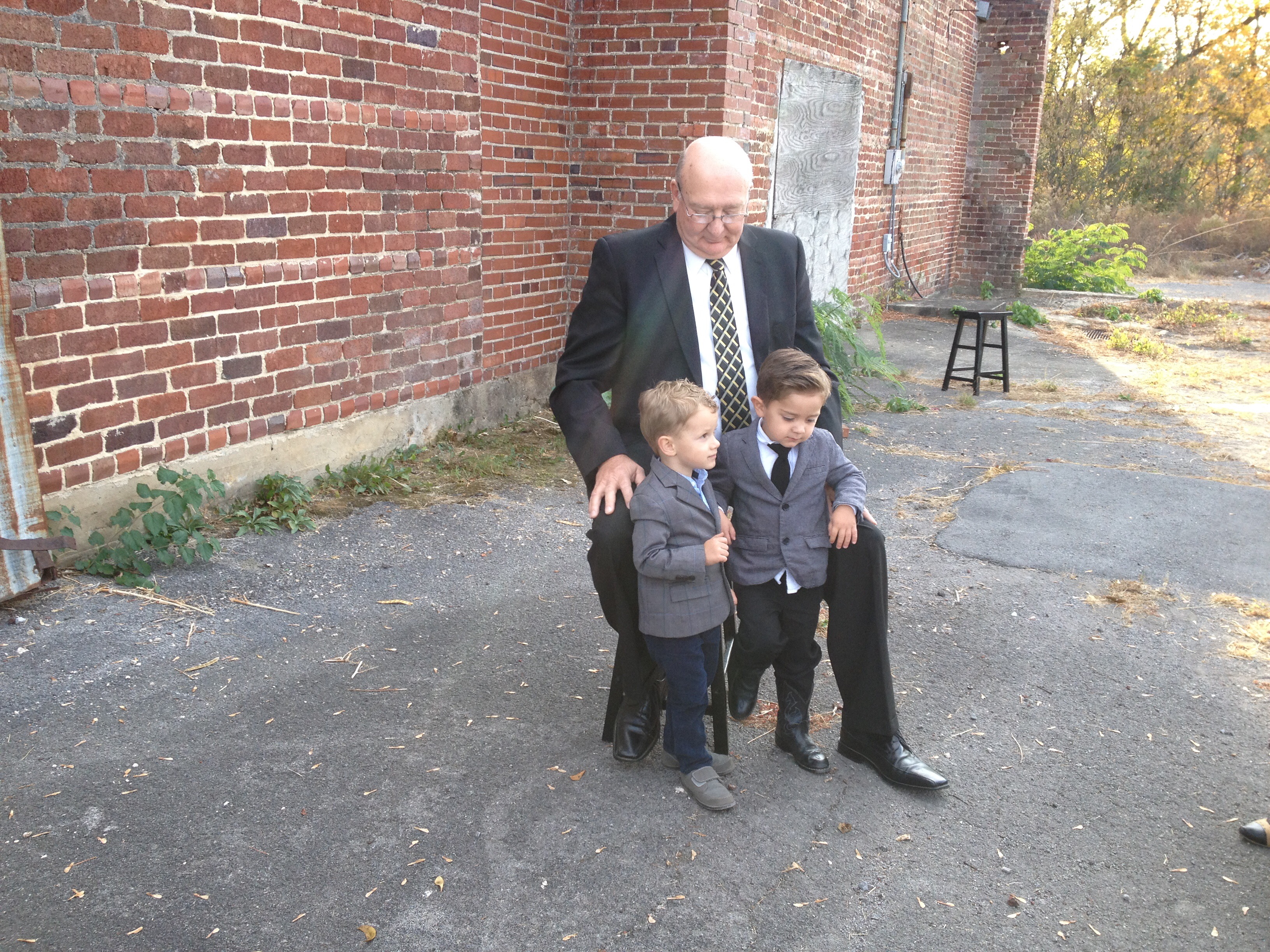
Dad went to work every day because he was faithful to his family and to his job. He only took vacation time to take us to camp meeting, and Alabama Revival Conference, and Men’s Retreat, and Youth Explosion and Back to School Rally. Dad’s family was his top priority and the best thing he could do for us was to take us to church.

My Dad has been faithful to his God. We missed about two Sunday services in my life to go the family reunion at Uncle Freddy’s place on the river. There was never any question of whether we were going to church. Even when times were strange. Not to say it couldn’t have happened, but I never once remember thinking that my Dad might backslide. Dad didn’t just attend church, he lived it at home.

Dad would have been an excellent candidate for college, but he did not have the opportunity. He started working in a foundry right out of High School. And so he worked all of my life, getting promotions as I grew older. I remember Dad buying a set of World Book Encyclopedias from a door to door salesman. I read through them about twice. A year. For the next thirteen years. Dad gave me a hunger for learning and an appetite for literature. Dad values learning in a way that I hardly saw in the public education system. He is a voracious reader, and because of this, there is hardly a topic that he isn’t at the very least conversationally knowledgeable.

Which brings us to conversations. I’ve never met someone that Dad couldn’t have a conversation with. My Father can talk to anyone about anything. Whenever Dad found out that Pastor Dillon was considering me for a Youth Pastor position in Winchester, Virginia, Dad called him up and talked to him like they had known each other for years and as if Pastor Dillon had been expecting the call. Dad has always been my biggest salesman. Perhaps you’re reading this blog because he forced you to read about a town drunk. Thanks for reading. And thank you Dad for being my biggest fan.

My Dad is a music lover. He would drive us boys around in the truck and we’d listen to Motown and British Invasion on the oldies station. He loved to sing along with the radio.

I love to hear him sing at church too. My favorite selection from his repertoire is House Of Gold. I can’t imagine any voice but his singing…

Some people cheat, they steal and lie
For gold and what it can buy
But don’t they know that on the judgement day
Gold and Silver will melt away?

What good is gold and silver too
If your heart’s Not pure and true?
Oh sinner heed me when I say
That gold and silver will melt away

I’d rather be in a deep dark grave
And know that my poor soul was saved
Than to live in this world in a house of gold
And deny my God, and doom my soul

After he realized that I didn’t like hunting or fishing, and after I played the broom for two years, Dad bought me my first guitar. It was a sacrifice at the time, but Dad sent me to Mars Music and I picked out the Squier Strat Pack, “Rock N’ Roll in a box, everything you need is right here.” The salesman said. Dad also paid for my lessons with Marky Vincent. I still play that guitar everyday. I keep it out so it’s easily accessible, I think about my Dad every time I play it. Sometimes I play his favorite requests and imagine him listening in, bobbing his head and singing along, even though he is so far away. House of the Rising Sun, My Girl, Every Breath You Take.

Dad showed me how to tell a story. That’s why you, dear reader, have made it this far reading an essay that you will not be graded on. Dad knows how to captivate your attention and get you genuinely interested in a story. He sometimes leaves you hanging on the edge of your seat wondering what comes next while he shakes his head and rocks back and forth laughing so hard that he cries and loses his breath. Dad knows how to flavor a story with colloquialisms, short sayings that are stories in themselves, sometimes bizarre but still relatable. Growing up I thought everyone’s dad was as good of a communicator as my dad. The older I got the more I realized that Dad is a naturally gifted bard. Here are a selection of my favorite of his colloquialisms.

“Dangerous as doo-dooing in a well.”
“Heavy as a widow’s heart.”
“Goofy as an eight day clock.”
“Wild as a team of goats.”
“Ugly as pootin’ in church.”
“Mean as a snake.”

It was September 11th, 2017. I was vacuuming the church in the altar area, listening to Dragnet on my headphones when I got a call from Mom. She was crying. “I got some bad news. Dad has cancer.”

Cancer. I’d heard of it. A terrible disease that happens to other people and their family members. Cancer takes on a new meaning when it happens to you or someone you love.

Dad’s response was, “If God heals me, I’m going to live for God. If He doesn’t heal me, I’m going to live for God.”

It’s been a rough few months. A hard time. I’ve cried a lot. I’ve prayed a lot. There are a lot of things I don’t understand. I don’t know why my Dad got cancer. I don’t know why the first doctor missed it nearly a year ago. I don’t know why we found out so late. I don’t know why the medicine doesn’t seem to be working. I don’t know why God hasn’t healed him. I don’t know why…but this I do know:

Romans 8:28 And we know that all things work together for good to them that love God, to them who are the called according to his purpose.”

For the duration of my adult life, I’ve called my dad just about every day. He was there to give council. He was there to comfort when we had a miscarriage. He was there when the money was tight. I’ve been able to share a lot with my dad over the years. Every time I hit a major milestone in my life he would rejoice with me, then he’d quote this scripture:

III John 1:4 “I have no greater joy than to hear that my children walk in truth.”

It’s not an easy thing to think about passing from this life into eternity. Recent events in my life have caused me to reassess my priorities. When I weigh what it is important in the light of eternity it is sobering to think that what most men are breaking their back and neglecting family to obtain does not even make the list of important things. But I don’t want to be like most men, I want to be a faithful man.

Thank you Dad.
Thank you for showing me how to walk in truth.
Thank you for being a man’s man.
Thank you for whipping me when I smarted off to you.
Thank you for being faithful to Mom. Thank you for loving her and honoring your vows. Thank you for sticking together through hard times, through hellish times.
Thank you for being faithful to God. I know that you loved the book of Job, but I didn’t think that you were going to have to relate to it on this level. Thank you for not charging God foolishly.
Thank you for taking out a second mortgage to send me to Bible college. Thank you for raising me to follow the will of God even though it broke your heart when I moved eleven hours away to pursue God’s will.
Thank you for living what you believed.
Thank you for making me get a haircut.
Thank you for buying me my first guitar.
Thank you for buying me my second guitar.
Thank you for giving me my first vehicle, the purple Tacoma.
Thank you for teaching me how to drive a manual transmission.
Thank you for giving me my second vehicle just in time for college. The old Plymouth Grand Voyager.
Thank you for paying for all the times that I went over my minutes talking to my future wife.
Thank you for showing me how to be a man.
Thank you for teaching me how to work.
Thank you for listening to me flesh out all the sermons I preached over the years.
Thank you for loving me.
Thank you for being a faithful man.