Out of Tune

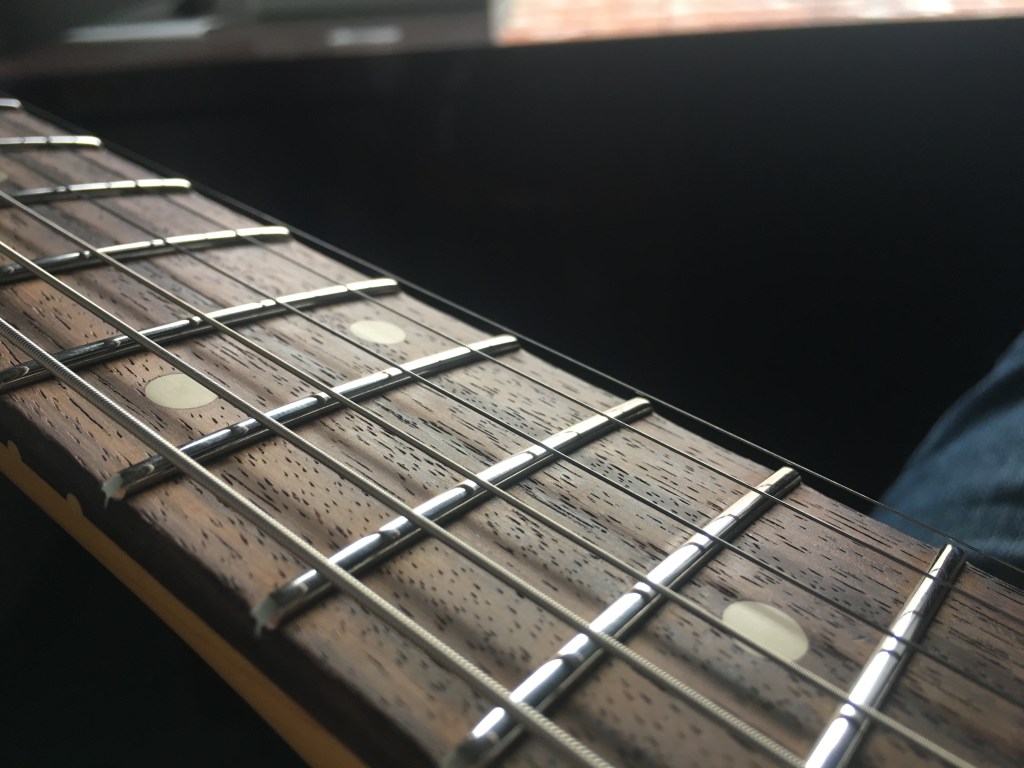
Have you ever wondered why guitars have frets and violins do not? I didn’t think so. I guess I better tell you what a fret is now. A fret is a thin strip of metal that runs perpendicular to the strings on a guitar. In theory it makes it easier to play a correct note. On a fretless instrument you have to rely in your ear and not a fret to play the correct note.
I do not own a violin but I spent a little time with one in my first round of college. I kept asking the wrong questions. Where is C? I should have asked, What does C sound like? I have come a long way since then on guitar. And I am beginning to understand why the concert music world did not respect the guitar until players like Andreas Segovia and Julian Bream paved the way for classical guitar in the twentieth century. I suppose I might as well tell you now that the guitar is out of tune. Or you could say it is equally in and out of tune. And this has bothered me for years.

I discovered this issue as a young player when I realized that guitars need regular maintenance. You need to tune a guitar’s open strings every time you play, but occasionally you have to check the guitars intonation. That means you make sure that the guitar is in tune at the 12th fret octave as well as the open string. If it is flat at the octave you can adjust the guitar’s bridge to make the string shorter and therefore sharpen the pitch. You lengthen the string to flatten it if the pitch is sharp at the octave. But there is a mathematical problem with tuning that is highlighted on fretted instruments: you can either have the octaves in tune, or the Fifths in tune, but not both. (Fifths are the fifth degree of the major scale and are the foundation of western music.) I did not have this information all of those years ago, I just noticed that I could never get the tuning perfect. And I thought there was something wrong with my instrument. It turns out it was not my guitar, but the whole tuning system in general. The piano suffers from the same problem.

I am tuning an octave on this old piano by ear. When you play two frequencies that do not match, say 400 hertz and 445 hertz, you can hear the difference of 5 hertz as a thumping sound called beats. You should be able to hear the beats disappear as the octave is brought in tune.

There have been a number of attempts made to deal with this issue over the past thousand or so years. Various temperaments, or tuning systems have been developed to to mitigate the Pythagorean Comma, or tuning gap. Apparently Pythagorus- yes that Pythagorus from your geometry class- wrestled with this issue.

Now that we have the tuning system worked out people only want to write four chord pop songs.

Enter the guitar around 500 years ago. I’d like to think that a prototypical guitar player invented the guitar. He was probably aware of the tuning issues, and thought, What if I just put these frets on the neck, make everything straight, and hope for the best? Guitar players are infamous for not being able to read music. Maybe he put frets on the fingerboard because he was tired of guessing where to put his fingers. Maybe he didn’t want to memorize notes but was happy to play patterns. At any rate guitars have been using equal temperament tuning since the renaissance and pianos waited to adopt it until right after the Boer Wars. And I think that’s why the guitar didn’t start gaining notoriety until the 1930s. Equal temperament tuning compromises the fifths in each key so the instrument can play fairly in tune across all the keys. This is why I have never been able to tune my guitar to my idealists standards. That brings me a small amount of psychological pain. But I have fallen in love with the guitar and I believe we can work our differences out.

Imagine now if this tuning phenomenon did not plague musicians and instrument makers. What if we could have the octaves and the fifths in tune? I don’t think that music would be what it is today. Part of the beauty of music is figuring out what works and what doesn’t. If everything was perfect there would be no dissonance, and how could we write music about pain and suffering without dissonance? J.S. Bach wrote his masterpiece The Well Tempered Clavier on an imperfect instrument. He wrote a piece of music in every key for the Harpsichord or Clavichord. These are stringed keyboard instruments that predated the piano. The genius of these pieces are the notes that he avoids because the well tempered tuning system still had some major dissonance issues. This piece is still studied today by aspiring pianists.

Think about this: more than likely, all of the piano music that you have ever heard in your whole life has not been in tune.

I suppose every good story needs a moral. Life is not always perfect. It can be frustrating to find the perfect balance because there may be no perfect balance. You just have to do the best that you can do with what you have. And often that ends up being the most beautiful thing anyway.

The Art of Listening

Whether or not you are a musician, how good of a listener are you?

I have worked with a lot of musicians over the years. Most of them have been church musicians that learned to play by ear. This does not always mean that they cannot read sheet music, or lack a strong understanding of music theory. It usually simply means that they do not sight read traditional musical notation in real time. I only know a few people that can sight read sheet music. And they are fantastic musicians. The rest of us have to study traditional sheet music in order to play it.

There is no shame in being a musician who plays by ear. There are even a lot of advantages. For instance when someone has a good enough ear they can listen to a song once and be able to play it. This is also our greatest handicap; many times we need to have heard a song before we can play it. The danger comes when we think that we are good enough to stop listening.

Many master musicians have spent years practicing ear training. Remember when you were learning your multiplication tables or when you were first introduced to Algebra? You may have struggled to even understand the concepts and the thought of being able to do these complicated formulas in your head seemed out of reach. But after practice you can probably now do simple math and even Algebra mentally and it feels natural. This is also true for music. For most ordinary humans it takes practice to be able to identify intervals, find your vocal part, or pick out a melody or chord progression. But ear training immerses you into the language of music and after a while things start to make perfect sense.

“Listen!”

This is what my Dad would say from behind a book whenever one of us kids was making too much noise. We would quieten down and strain as if we could hear. Hear what? I never know exactly what we were listening for. Was he about to say something? If we tried hard enough could we hear the book he was reading playing out in his head? It took me a long time to realize that he was simply telling us to be quiet. I catch myself telling my kids the same thing these days.

Whether or not you are a musician, how good of a listener are you? Listening is so much more than a musical skill. At the very least listening is half of communication. Listening is a vital ingredient in healthy relationships. It becomes even more important when we understand that faith comes by hearing.

So then faith cometh by hearing, and hearing by the word of God.

Romans 10:17

Whenever I take those learning style tests I always score high on a preference for auditory learning. I believe this is accurate. I really enjoy listening to audiobooks. I can recall things better when I give my undivided attention to auditory information. I think that is what makes someone a good listener, the ability to give their undivided attention.

How do you listen to music? Do you like it in the background or full blast?

When I was a teenager listening to music was a ritual. Digital music off of the internet via Napster and Limewire was in full swing, but I always felt the computer speakers sounded weak. I preferred to buy my music in compact disc form from the music section at Wal-Mart. I would bring the unopened CD home, carefully peel the cellophane and stickers off, and insert the disc into my three CD player stereo. I would listen to the whole album straight through in one sitting without any repeats or skips. Doing nothing but listening with my undivided attention. I still think this is the best way to listen to music.

I have a hard time listening to background music. I would rather listen to background silence than barely audible mosquito music. I am drawn to focus on the music and when it is too quiet any disruption seems amplified.

All of this has me thinking about things that inhibit being a good listener.

I tend to get distracted by noise. I have a hard time going to restaurants if the music is too loud, or if there are a bunch of TVs playing different programs. It is very difficult for me to have a conversation while there is music playing. The worst thing is when there are two songs playing at one time. I sometimes wonder if that makes me a bad listener. Perhaps it means I am susceptible to distractions. To some extent I do not have control over external noise.

I can control internal noise. Have you ever been listening to someone talk only to realize that you have no idea what they are talking about because you were thinking about something else? We call this spacing out, or zoning out. If used properly, the ability tune everything out and focus your attention on your thoughts is a valuable skill. But an inability to control your thoughts can also make you a poor listener. It becomes a matter of will. Will you listen to what this person is saying or will you let your mind wonder?

Your attitude is largely controlled by your will and is another internal factor that can an inhibit and an enhance listening. Imagine the worst political figure that you can. If you are like me, you will have a hard time listening to that person say anything. There is an internal block that keeps us from being open to people that we do not trust. Have you ever noticed in political debates that people are always interrupting one another? There is not a lot of listening going on. What we have here is a failure to communicate. There are many deep issues in this example, but a lot hinges on being unwilling to listen.

As musicians, if we really claim to play by ear, then we should understand the importance of listening. We must constantly practice active listening. We must listen to the song to learn what to play. We must listen to the music director for instruction. We must listen to the other musicians in order to play together and not simply at the same time, like two political candidates arguing over one another. This also applies to relationships.

He that hath an ear, let him hear what the Spirit saith unto the churches.

Revelation 2:29;3:6;3:13,22

I read something interesting this week in This Is Your Brain On Music by Daniel Levitin. Pitch, loudness, and sound in general are purely psychological phenomena. All of these perceptions are just how our brain interprets air pressure. You literally cannot hear without an ear. This has really been heavy on my mind.

I hope that we can all be better listeners.

Open For Business

There aren’t many things that I have done that have been more fulfilling than teaching music.

My parents bought me my first guitar. I kind of forced them into it by signing up for guitar class at school. I didn’t learn a whole lot about playing guitar in that class, but I got a refresher on music theory. Eventually a proper flat-picker wandering into our church and showed me how to read tabs and chord diagrams, the major scale, how to play Bluegrass rhythm in G, and one Tony Rice lick before he told me, “I can’t show you anything else. If you really want to learn you will.”

In one sense, being told it is time to sink or swim really motivated me to learn. Conversely, I still had so much to learn and I had to learn it the hard way. Not having a teacher forced me to be a scholar. Learning how to learn on your own is what teachers really mean when they say you need to study. I have been studying guitar for over twenty years. As the physicians say, I am a practicing musician.

Learning to play guitar did wonders for my self confidence as a teenager. As an adult it still amazes me that I can play. This skill has also opened significant doors in my life.

Earlier this year the Lord delivered me from my one hour commute to work. The first things I did was start teaching guitar lessons again. There aren’t many things that I have done that have been more fulfilling than teaching music.

Get something in your life that God can bless.

Pastor Jeremy Wilbanks

Pastor has been saying that a lot lately to the church. It is one of the reasons that I wanted to start teaching again. I also feel like I need to put some of things I have learned while studying business in college into practice. Most significantly, I feel a responsibility to help musicians avoid having to learn the hard way. And God is blessing it.

Here are the answers to some of the frequent questions I get asked about learning guitar.

Should I start out on acoustic or electric? Choose the one that you want to play. You won’t be motivated to practice the acoustic if you really want to play electric.

What age do they need to be to learn? The youngest that I have successfully taught was seven. As long as they can pay attention and have enough hand strength to fret a note I can work with them.

Am I too old to learn? You are never too old to learn.

So if you or anyone you know is interested in learning guitar or bass guitar please send them my way.

zanewells@yahoo.com

Left Behind: Musician Thoughts

What a person prefers about music depends largely on the memories associated with that music, and how broad their musical tastes were while this theoretical window was open.

I was listening to a song this morning on the way in to work. It was Christian Pop and I liked it. It wasn’t the sort of song that I would think to play at church, but it was uplifting nonetheless. Quite often Christian popular music takes its cues from secular pop. The phenomenon of secular-or profane-musical influence on church music has been going on for at least a thousand years. I noticed that the influences on the song I heard this morning sounded a little dated. I checked the release date on the song, and low and behold the song was twenty years old. Two decades. No wonder the influences sounded dated.

There is a theory that each generation thinks that their music was the best. I believe that each person has a window in which their musical tastes are established. What a person prefers about music depends largely on the memories associated with that music, and how broad their musical tastes were while this theoretical window was open. It takes effort to broaden that window and learn to appreciate music that doesn’t fit an individual’s concept of what sounds good. Especially as we get older.

I have seen this theory proved in the two decades that I have been fortunate to play music at church. I have met musicians willing to quit church before they were willing to learn a new type of music. Do you recall about twenty years ago when churches were splitting over traditional versus contemporary music? If you are yet a teenager and cannot recall, I am here to tell you that the Christian pop music that sounds so dated now was powerful enough to split churches.

When you are young it is easy to point your finger at an older generation for not being willing to learn anything new-including music. I have watched older musicians who struggled to keep up with new trends in church music (electric guitars, drums, click tracks, drum loops, synths, etc.): some overcame, some did not. I have also witnessed those who downright refused to learn anything new. It made me realize that staying relevant-this word has been blunted by Christendom- as a seasoned musician will take more than a moderate amount of effort.

On the other hand, seasoned musicians do have the advantage of being able to recognize the influences on modern music. And not all influences are good. Seasoned musicians also have developed a voice on their instrument that usually only comes with years of hard work. Also a seasoned musician’s repertoire is one of their most valuable assets. Having a large catalog of songs goes a long way in picking the right song for the moment. For all that, there is a fear of being left behind as a musician. So what does a musician need to do in order to not be left behind?

I would say the principle thing is to stay in love with music. I have many friends that no longer play an instrument. They will tell you a lot of reasons why they stopped playing, but the underlying cause is that they do not love it anymore. It is hard to play with musicians whose heart is not involved.

I Chronicles 25:6 All these were under the hands of their father for song in the house of the Lord, with cymbals, psalteries, and harps, for the service of the house of God, according to the king's order to Asaph, Jeduthun, and Heman.

7 So the number of them, with their brethren that were instructed in the songs of the Lord, even all that were cunning, was two hundred fourscore and eight.

8 And they cast lots, ward against ward, as well the small as the great, the teacher as the scholar.

I think the pinnacle for a musician is to be chosen for the service in the House of God. In David’s Tabernacle musicians were chosen by lot. Chronicles categorizes them as small or great (young and old), and teachers or scholars (students). I believe that this is still the model for God’s ideal music team. Young and old, teacher and students.

In order for a church’s music team to be healthy there must be a relationship between teachers and students. A teacher must have a commitment to teach and the student must have a commitment to learn. Musicians must never stop learning. When you get to the point where you do not think you need to learn anything new then you will not learn anything new. Conversely, there comes a time when musicians truly become masters of their craft and it is their responsibility to teach the students. When this relationship breaks down then the team becomes dysfunctional. Lazy students will not grow and this holds back the progress of the whole team. Disengaged teachers will cause eager students to seek out other teachers, whether good or bad influences. And what they learn will have a profound effect on the entire congregation. Just ask anyone that remembers all the church splits at the turn of the century.