Chicken Auction

Eclectic, Alabama. That’s a real place. I don’t remember there being anything like a gas station or flea market that would make it look like a town.  I’ve only been there once and that was to go to the Chicken Auction. That’s the only thing I remember about Eclectic. 

After driving from Tallassee, AL a good little ways out in the woods, you came upon a hand painted sign that read Chicken Auction. We went once, Dad, Lindsay and me. It was basically a chicken house with boat carpet covering the dirt floors. But They had really put some thought into decorating. There were automobile bench seats bolted to the ground and a concession stand in the back. The floors were slightlty sloped to give it a theater feel. There were probably close to seventy people there that night. 

The auctioneer sat in a homemade stand that, if you used a bit of imagination, looked like a pulpit, complete with a microphone and Peavey speaker left over from the 70s. In fact the whole operation sort of reminded me of a church. In front of the pulpit people stood in a line to sell their chickens, rabbits, guineas, and exotic birds. They even sold eggs. The line strecthed outside through a door in the side of the building. 

The auctioneer wore overalls and a collared white shirt. He had snow white hair peaking from underneath his baseball cap. He only took the hat off during the opening prayer in which he prayed for the evening’s proceedings and for several sick parishoners who couldn’t be there that night. Then he started in on anouncements.  He had the Old Southern accent, where the letter ‘R’ is only pronounced at the beginning of a word. 

“This Satu’d’y is the Confederate Flag Parade in Wetumpka. Please come out and bring yow’uh Confederate Flag. If you do not have a Confederate Flag, they’uh will be a venduh they’uh way’uh you can pu’chase one.”

After these preliminaries were out of the way, he began to call each person by name and they would step up and present their merchandise. 

“Jerry Dale, you have a nice Banty Trio here. Who’ll give me $15?.” 

From then on, his auctioneering abilities began to come through, and he went from talking slow, even for a Southerner, to a rapid machine gun speed of syllables. I could still understand him though.

Dad and I were having a great time and we almost went to the concession stand and bought some popcorn. You get caught up in the moment when you’re enjoying yourself. I always thought that the chicken auction would have been a great place to take angirknout on a date. It was a cultural experience tonsay the least, and Dad and I were were taking it in. My sister, however, was not really impressed. But you can’t expect everyone to be cultured. 

Sleeping at Church

I usually went to sleep during the evening services.

I used to sprawl out on the front pew at church, use a stack of Sing Unto The Lord hymnals for a pillow and go to sleep. I would try to stay awake by finding faces in the wooden paneling and trim in the sanctuary, but that might have just made it worse. There was a lion, and two bearded old men in the wood grain of the door frame that led to the Sunday School classrooms. If you saw them once, you saw them every time. I’d also try to find characters in the carpet, or look at the map of the Middle East that hung behind the organ. But as a child, these were futile attempts to keep Old Man Nod from riding on my eyelids. I usually went to sleep during the evening services.

It’s one thing for a small child to sleep during the service, but another thing for a grown up to fall asleep at church. I’m sure it’s discouraging for a minister to look out at the congregation and see an adult nodding. My Uncle James was bad about sleeping during church. Or anywhere else for that matter. He fall asleep once at the red light. As dangerous as it may be to fall asleep at a red light, I don’t think anyone noticed. When he woke up he didn’t realize how long he’d been there, or how many green lights had come and gone. It was long enough for someone behind him to blow the horn. I’m sure he was embarrassed, but not too embarrassed to tell on himself so everyone else could have a good laugh. Southerners are considerate that way.

He was sleeping at church one Sunday and the pastor asked him to stand up and pray over the offering. Someone nudged him and said, “James, they need you to pray.” He stood up and dismissed them. Someone else told that on him, some things are too embarrassing to share yourself.

Barbecue, Barbeque, BBQ

It’s that time of year. Barbecue season. I’ve always struggled with how to spell that, but WordPress autocorrect just informed me that the proper spelling was “Barbecue”. I bet they won’t tell that to Golden Rule Barbeque in Irondale, which has been around at least hundred years longer than autocorrect. They probably won’t tell Fat Man’s Bar B Que in Pell City either. Or Full Moon Bar-B-Que. Anyway, I’m still not sure how to spell it, because I “ain’t never eat no” BBQ that WordPress cooked. But even if I can’t spell it, I can define it. At least I’ll give it a try. Defining barbecue is like defining women. You’ll excite half the people and offend the rest.

First off, barbecue is a noun. I think it’s pork. Mainly Boston Butt’s, but if you want to throw some ribs on the grill while we’re waiting for the butts to get done I’ll still eat them and call it barbecue. I eat so many ribs one year when I was a boy that it was several years before I had another one. If you want to get deep and go to the root meaning of the word barbecue, it means “cooking a whole hog on a wood fired grill”. Which is where we get the term, “Whole Hog.” Which means that you go all out doing something. I’ll use it in a sentence so you’ll understand it better.

“Zane is taking this writing thing seriously, I heard he’s going whole hog and trying to write a book.”

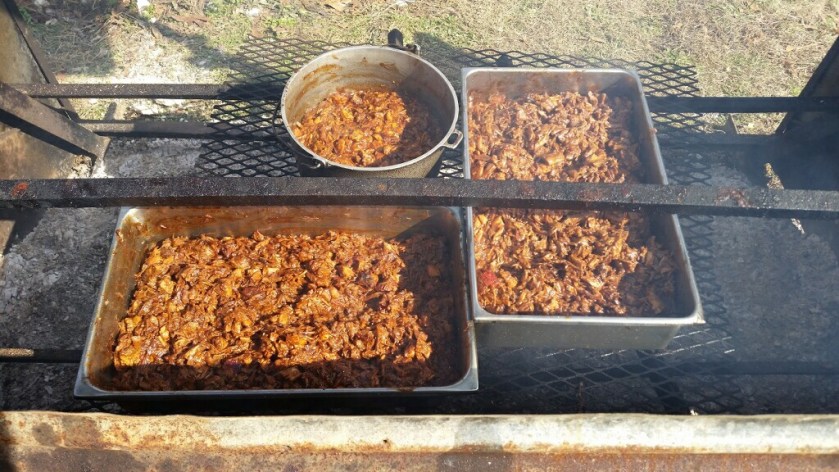
Barbecue also has to have some sauce. My Uncle Johnny was always the self appointed grill master at all of our family get togethers in the summer. Not without good reason though, he is an excellent cook. He would crupper up his own sauce recipe using Kraft Original as a base. “Cattleman’s tastes too much like ketchup, don’t use it.” He would say. When the meat was done, he would pull it apart or chop it up, put it in a deep pan and pour enough sauce over it that it would  almost simmer and bubble as it sat on the grill. He always made two pans, one regular and one hot. He liked it hot. He didn’t have any teeth and chewed tobacco. I don’t think that affected his taste buds though. Once he ate breakfast with us and drank the tomato juice out of the serving plate. I watched him in wonder as he slurped the juice, set the plate down and lick his lips. He sat there a moment enjoying his draught. Then he said,”There was a bad tomato in there.”  Anyone with taste buds that sharp wouldn’t have been inhibited by tobacco juice. Anyway, Uncle Johnny liked his barbecue hot. He liked everything hot. He made gravy so hot one time that the cats wouldn’t eat it. As a kid, my mom would warn me about the hot pan of barbecue. “It’s hot baby, you won’t like it.” I grew up thinking that the hot pan of barbecue was going to burn through my esophagus. When I was finally old enough to fix my own plate, I tried some. It was delicious.

I’ve rambled a little bit here. We were defining Barbecue and I’ve already offended all the Texans and Carolinians. It’s probably just easier to tell you what barbecue ain’t, and that’s hamburger and hot dogs. You’re supposed to fry hamburgers in an iron skillet and roast weenies in the fall around a fire. If you get invited to a barbecue and they’re cooking hamburgers and hot dogs, I’m sorry, but those people have misled you. I’m sure they’re nice people and all, but I wouldn’t let them watch my kids if I were you, next thing you know they’ll have them playing soccer or something crazy like that. 

A Barbecue (see how I capitalized it) is also defined as a sacred feast for Southerners, where pork is cooked on a wood fired grill outside. This feast usually lasts about three days.

In general, we had about four or five Barbecues a year. We did have the official family reunion at my Great Uncle Freddie’s on the river, and sometimes we barbecued there. But all the same people came to the barbecues at my Aunt Edna’s, just up the hill from Pop’s, on Memorial Day, Fourth of July, and Labor Day. And whenever Pop deemed it was angood time to have a Barbecue.  Since the location, menu, and people were the same each time, the only way that I could tell a difference in all of those holidays was that we shot bottle rockets on the Fourth of July. To me, these summer holidays were simply Barbecues.

The Barbecue would start on Friday night. “We’ll serve dinner on Sunday at noon.” Pop would say. Up until then, we feasted. We might have a fish fry while the barbecue was slow cooking. Somebody might throw some Cornish game hens on the grill and eat them while we were waiting on the main course. One time my Uncle James put a Boston Butt on the grill and then left. He come back about six or five hours later and his meat was about half gone. He singled Uncle Johnny out, “You done eat all my barbecue Johnny.”

“I can’t eat t’at James, I ain’t got no teeth!” Uncle Johnny retorted.

“Yeah, but you kin bite a railroad rail in two with them gums of yores.”

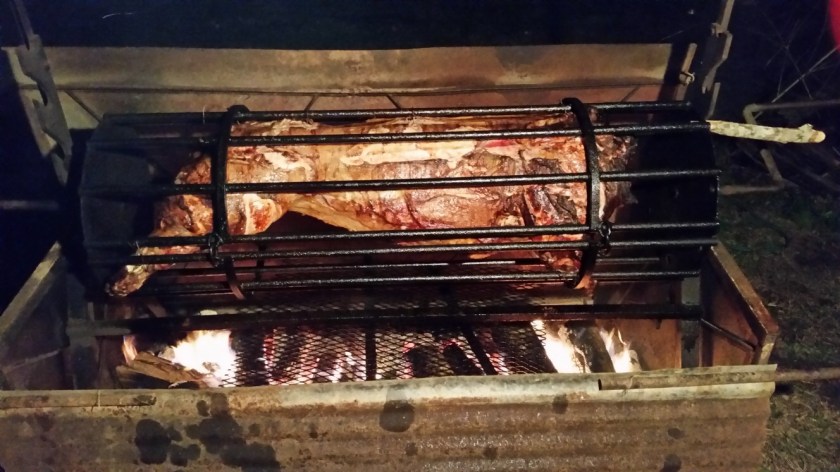
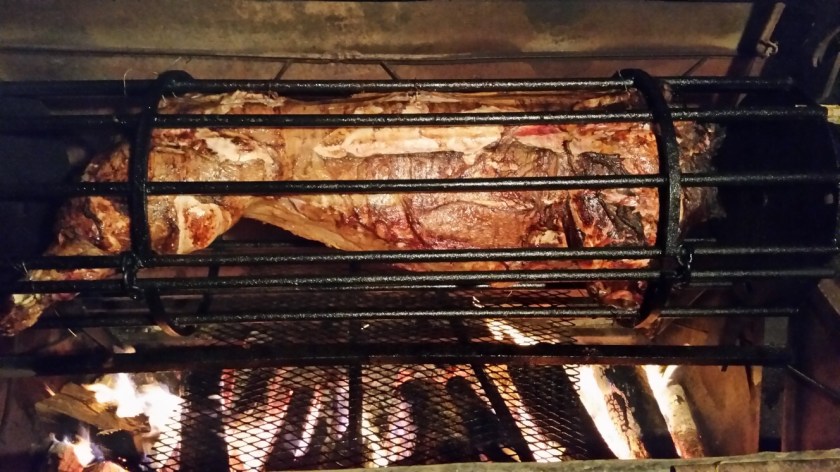
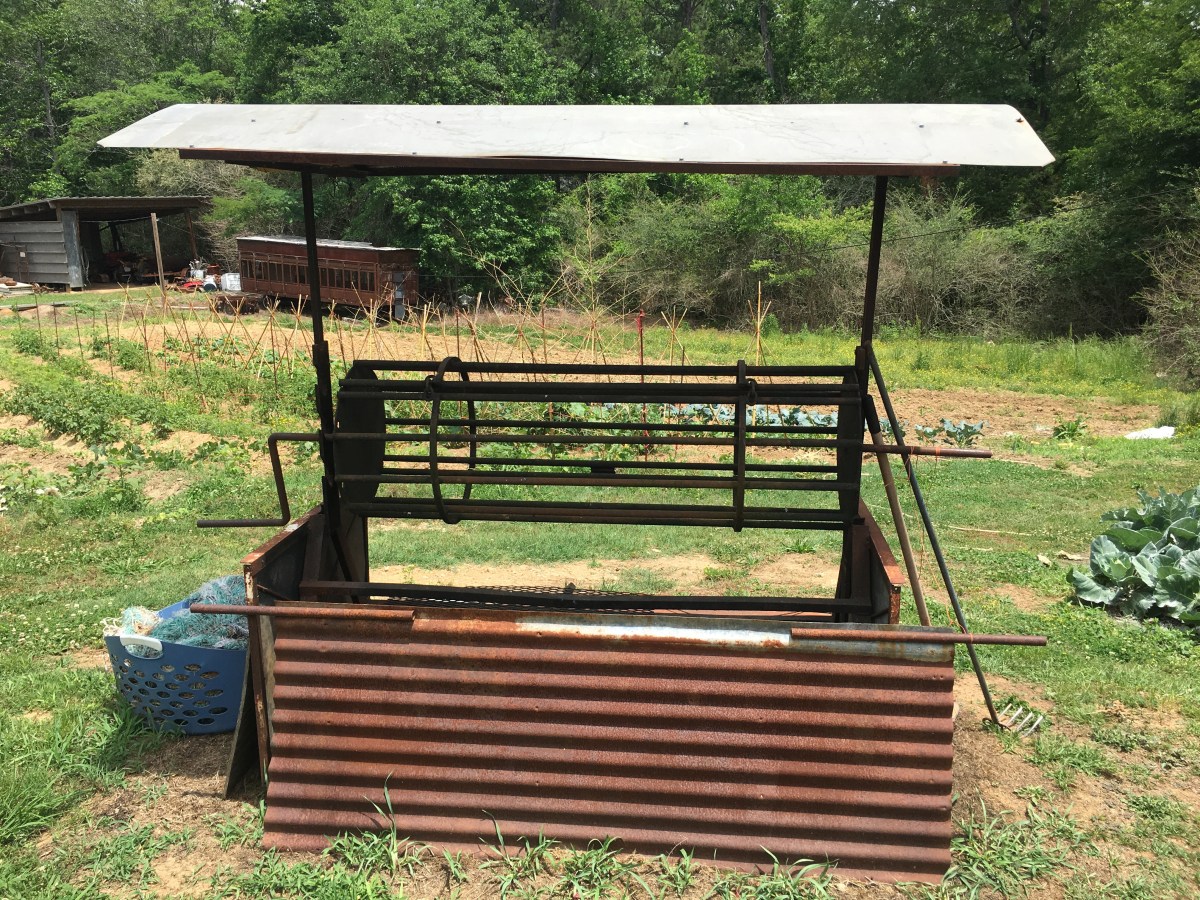
Barbecuing a whole hog is a lot of work, but man is it worth it. There is nothing like slicing the meat off of a hog and eating it around the grill. All it needs is a little bit of salt.

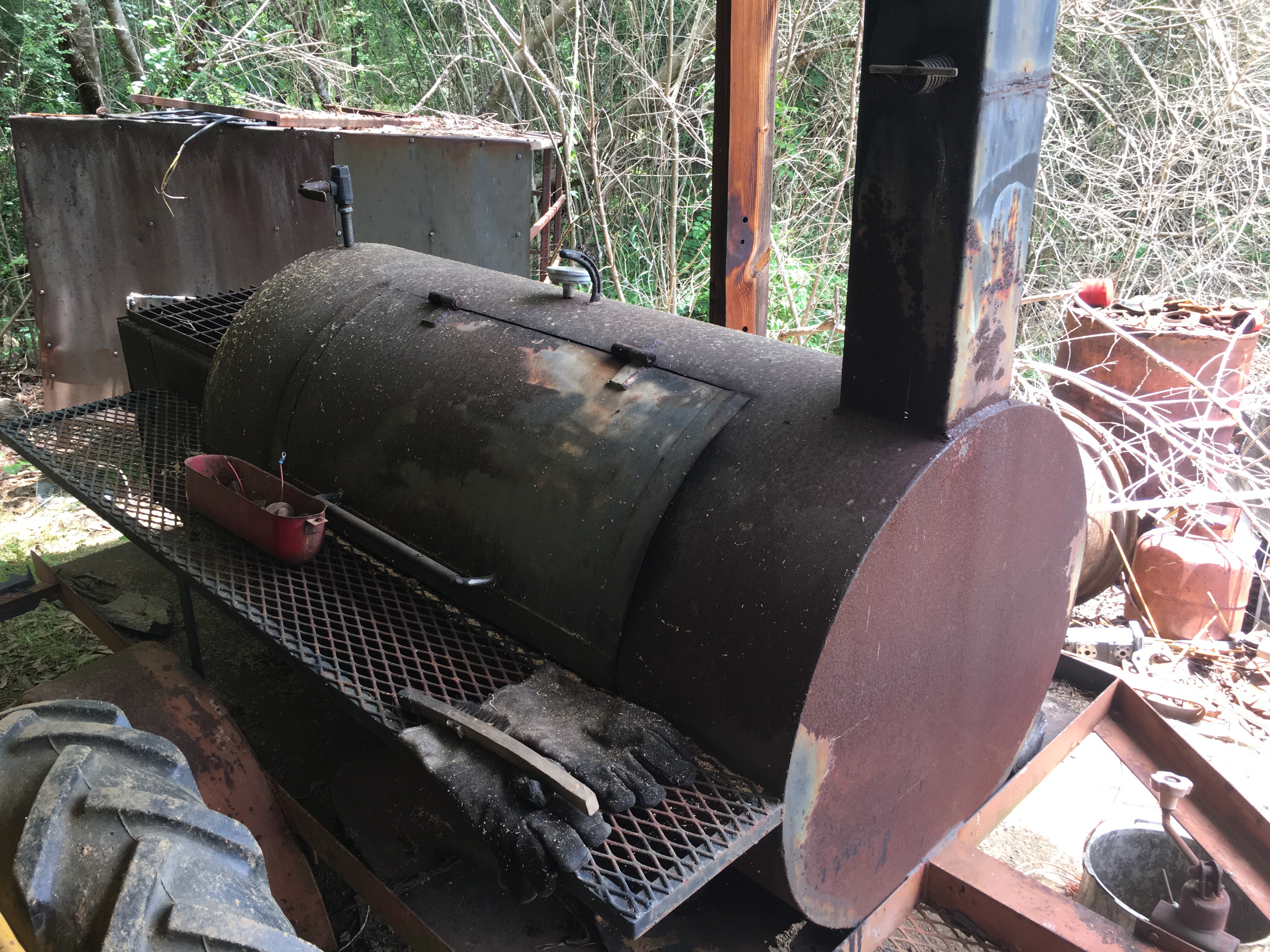
This is the grill that Pop & Uncle Johnny used throughout my childhood. You can see the front peice is on the ground. You can cook whole hogs or just use the grill to cook Boston Butts and ribs. 

When Sunday finally rolled around, we would eat, not just barbecue, but we had a buffet of sides that was five tables long under Aunt Edna’s carport. It was also about fifty yards from the grill. I’m not writing about sides though, I’m writing about barbecue.

When I close my eyes and work up a hankering for barbecue, I still see my family sitting outside around a humongous oak tree. Many of them have passed on now.  I envision myself as a little boy with thick glasses walking to the grill down by the tree line. They were pine trees. Uncle Johnny pulls the front of the grill open to throw a couple of pieces of hickory wood on the fire. Sparks fly everywhere. I walk in front of all the old men sitting around the grill and ask Uncle Johnny to dip me out some of barbecue on my bun. “No sir, I’ll have the regular.” I say. I take a bite of that barbecue sandwich, and blink to get the smoke out of my eyes. That’s really how I define Barbecue.

That giant oak tree finally died and they had to cut it down before it fell on Aunt Edna’s house. I’m sure they used some of that wood for a barbecue. Uncle Johnny showed my brother how to barbecue a coon’s age ago. He wanted to pass it on to the next generation. Although Zach learned on the other grill, I feel like he mastered this one. I’m going to get one of these someday. 

Since I’ve moved to Virginia, I haven’t been to a proper Barbecue in over a decade. Perhaps that’s why I’ve expanded my definition of barbecue to include Brisket, chicken, and dry rub. I even like that old nasty vinegar stuff they try to pass as barbecue down in the Carolinas. No matter what barbecue I try, nothing is quite the same as those summer Barbecues of my childhood in the blazing Alabama heat. It’s hard to capture that whole experience in a restaurant. 

It seems like every year when the weather changes I get invited to someone’s place for a barbecue. I’ve learned to be polite and go, but I know it’s going to be hamburgers and hot dogs.

Faulty Equipment

“Y’all boys are rough on equipment.” That’s what Mr. LaDuke said after my cousin Kent had broken three ax handles, a weed-eater and wrecked a moped. I guess we were pretty rough on equipment, that’s why half the every day tools and gear that we used in the hay field were broken to some degree. Pop was forever adjusting the square baler, which was always shearing pins, whatever that means. Most of the trailer jacks were bent. The old Ford truck had a tricky clutch that I never could get to cooperate. For every piece of faulty equipment, there would be a new oral operating manual that must be followed in order to get that particular item into proper working condition. These instructions were far from intuitive, and in some cases nothing close to the original manual, but I guess it was cheaper than replacement.

This rings true for every other place that I’ve worked over the past twenty years. The copier at one job requires you to jiggle drawer A before you can print. The computer at another place requires a restart before you can use the audio. The espresso machine at another place requires additional warm up time. There are always locks that require an odd key angle and a prayer. And vehicles that require you rev the engine to keep from overheating at a stoplight. I’m sure you’re thinking of a piece of equipment at work that you’d like to hit with a sledge hammer.

Probably the most dangerous faulty equipment that I have worked with were vehicles that required you to start them by bypassing the solenoid. I’m not dead certain what that even means, or why we had to do it, but basically, instead of cranking the engine with a key, like a normal person, you lay a screwdriver across the positive battery terminal and the negative terminal into the solenoid. This bypasses the solenoid relay switch and starts the car. Oh, and the key needs to be in the on positing in your ignition. 70% of the time it works 100% of the time.

This process is pretty simple on a lawnmower. Sometimes you see sparks fly off, but that’s part of the fun. If you have long arms and longer screwdriver, you don’t even have to get out of the seat of a zero turn to start it with this method. It’s a little bit trickier when you’re doing it on a truck. At one particular job, there was an old Ford Bronco that required this staring method. We were in downtown Winchester, VA getting a new lawn mower tire installed when my boss, Shawn, first showed me how to jump start the solenoid to start the truck.

I was so proud of myself when it fired right up and I got ready to back out into the street, with my lawn mowers on the trailer behind me. As soon as I put the Bronco in reverse, the engine stalled. I had to pop the hood, crawl out of the vehicle, and jump the solenoid with a pair of pliers. It fired right up this time. In reverse. The Bronco began backing out into the busy street. Panicking, I flung the pliers down and raced to catch the runaway vehicle. Fortunately I had left the door open and only had to run about twenty feet before I jumped into the moving vehicle. Once I got into the drivers seat and got the truck stopped I started breathing again. I was going to play it cool and just keep driving, but as I put the vehicle into gear I realized that the hood was still popped. I’m sure the people in the tire shop got a good laugh seeing me scramble so. I’d have laughed too. A couple of years later that Bronco burnt to the ground in a Wal Mart parking lot.

Equipment tends to wear out with normal use. But sometimes it gets help from clumsy employees, abuse and misuse. I can hear Mother’s everywhere saying, “This is why we can’t have nothing nice!”

Liars and Lies I’ve Been Told

Since the majority of the history in rural towns is oral, my goal is to give you a few tools to help you differentiate between what’s fact and what’s oral fiction.

I’ve spent much of my life sorting out which of the stories given to me as a child were true and which were not. It’s not as easy as you’d think, because much of the time the truth can be more outrageous than any liar’s tale. For instance, my Great Grandfather, Daniel Webster Wells, used to catch catfish out of the Coosa River that were four feet long. I know this is true, because I have pictures. I know that I shot my neighbor with a BB Gun too, as I got a terrible spanking for that. But there are some stories that I haven’t quite been able to verify. It’s these tales that make you wonder, not because of the bizarre content, but because of the source.  Some people are fun to listen to, but not very credible. In the harshest terms, they are liars. There are so many types of liars that it’s almost not fair to group them all in the same category, but God isn’t fair, he’s just, and he decided that all liars shall have their part in the lake which burneth with fire and brimstone. I do not condone lying, but this is not a sermon, it’s more of a essay on the different types of liars. Since the majority of the history in rural towns is oral, my goal is to give you a few tools to help you differentiate between what’s fact and what’s oral fiction.

Some liars are habitual, and lie for lying’s sake. Jerry Clower said, “Some folks would rather climb a tree and tell a lie before they’d stand on the ground and tell the truth.” These liars have no motive for lying other than it’s just what they do. I had one of these type of liars tell me that there was a family who adopted a child from another country and they were having a hard time with the child because in the former country, yes meant no, and no meant yes. The same person also told me about an infant sitting on their mother’s lap as she was sewing. At some point the child cried out and the mother picked up the baby and held it on her shoulder, patting it’s back. The child instantly let out a gasp, but didn’t cry anymore, but the mother missed her sewing needle. Fifteen years later, the child now a young lady, complained of a pimple on her back. When her mother went to squeeze the pimple the needle shot out of the girls back. I know from experience that these habitual liars get mad when you don’t believe them.

My favorite type of liars are the entertaining liars, they lie because they have an audience. They don’t tend to get mad if you don’t believe them as long as you are entertained by the tale. Most of the entertaining liars I’ve met could have made honest careers as fiction writers. I had a liar of this ilk tell me that as he was driving to my house, he saw a prominent citizen in our community on his roof, dressed as Santa Claus, reading the newspaper while sitting on the chimney, apparently using the restroom. Now that’s pretty funny and outrageous, but if you knew the citizen, you would have found yourself wondering if it was true. Another time, the same talebearer told me that he had heard someone call in to the classic rock station and give the following testimony. “I love the Lord, and I’m thankful that he’s given me a sound mind. I appreciate the uplifting music that y’all play, it really blesses me. I just want the Lord to make me humble and (h)umble.” Of course, we knew who he was lying about, and it was funny, but also not unbelievable. You have to be careful with these entertaining liars, or you will establish their credibility by believing and repeating their lies.

Once, my brother, cousin, and I were building a fence at my grandmother’s place. There was a withered old man with a tracheotomy and cowboy hat who came out to watch us as we built the fence beside his residence. I’m not sure how we got on the subject, but as Zach carried the heavy post driver over to the next post, the old man stated that he had “once picked up a syrup mill by himself.” Now Zach, never been one to “enjoy a good lie”, was not about to let this slide, having recently spent a whole day making sorghum syrup. He dropped the post driver and said, “They ain’t no way you picked up a syrup mill by yourself.”

My cousin, who was quite a story teller in his own right, tried to calm Zach down and let it be, hoping to draw out more of the tale. “Just let him alone Zach, maybe he did.” And then to the old man, “How much did that syrup mill weigh?”

“He ain’t picked up no syrup mill Anthony.” I suppose liars don’t like to be called out, and soon the old man went back inside leaving us to our work.

Some liars will not retreat as easily when faced with the truth. I place these in the category of the ignorant liar, which is someone who doesn’t let their lack of knowledge keep them from teaching. These proud liars will be able to dominate any conversation on any subject with their wealth of knowledge. Some folks call them “Know-it-Alls”. Once I remember a conversation with a man about construction of a building in Childersburg, AL being halted after Indian artifacts were found during the initial excavation.

“I shouldn’t wonder that they found some Indian pottery, you can dig just about anywhere around here and find Indian pottery and arrowheads.”  He said. This was true enough, I used to find arrowheads all the time in the cotton fields behind my house, but he took it further and capped his statement with, “Childersburg is the oldest city.”

I asked him incredulously, “You mean in the Coosa Valley? Or the State of Alabama?”

“Naw! Childersburg is the oldest city in the world!” He said arrogantly.

What makes these particular liars so annoying is that you can’t convince them of what is true. When you argue with a fool, you always lose.

Calling a liar in many cases will get you nowhere. Sometimes it’s best to keep your mouth shut. If someone is lying they’ll eventually trip over one of their own lies. If I feel like I’m being told a lie, I like to ask verifying questions. A liar will never disappoint you when you ask for details. It helps if you can remember these details and then ask again a month or so later. If you’re lucky, they’ll start in on a fresh set of details that contradicted the set from last month. Even better they’ll be unsuccessful in trying to remember the set that they gave you last month.

The last type of liar I’d like to mention would be the exaggerator. What might start out as embellishment, will turn into a full blown lie. I’ve been with people that are recounting a story of which I was an eye witness, and I find myself frowning because I don’t remember it that way. Or someone will tell a lie about something that they didn’t do and then say, “Ask Zane, he was there.” Which is another lie.

My mom was babysitting a child once who told her of all of the things that he’d stolen. My mother was disappointed and admonished the child that it wasn’t good to steal. He replied, “Aw, I’s just lying.” You don’t have to teach children how to lie, you’re supposed to teach them not to lie. If you are a liar though, you show your children how to lie. This is why lying runs in the family. There was a time when it was a shameful to lie, and people knew it was wrong. That must have been a long time ago.

 

Nursing Homes

I was probably too young to go, but my parents were committed, so I went to everything.

I don’t remember whose idea it was to take small children to sing at the nursing home, probably some adult who did not take into consideration how terrifying elderly wheelchair bound people can be to a five year old child. I was probably too young to go, but my parents were committed, so I went to everything. The nursing home we chose was a dismal place. The residents looked completely defeated, the staff had a martial air about them and the whole facility gave you the feeling of complete hopelessness, more like a prison than a care facility. Perhaps the one we visited was simply outdated, but I’ve visited others as an adult and I get a similar feeling.

I was too young to read so I was only obligated to sing from memory. My brother Zach, and Corey Barber did not get off of the hook so easily, since they were capable of not only reading, but counting too, which enabled them to use the Sing Unto The Lord hymnal. Sis. Vivian, Corey’s grandmother sat at the piano with her back to us and called out the page numbers to the each hymn as she played. In our church, we hardly called a song by it’s name, but rather used it’s page number. “Please turn to page 315.” Page 315 was Jesus Hold My Hand. Page 94 was Amazing Grace. As Zach and Corey turned the right page, Sister Vivian would play  an intro on the piano, and by then we were ready to sing. I’m sure our mothers enjoyed it. I think the residents might have just enjoyed seeing some small children, even if they had trouble hearing us. I did not enjoy it. I wasn’t miserable, I just wanted to play.

It was during one of these fidgety moments, probably about the third song, that I decided to pinch Zach on the rear end. He whipped around mid chorus of I’ll Fly Away and gave me a mean look and probably would have hit me but everyone was watching. In the midst of all this the music and the singing never stopped. Mom came and grabbed me by the hand led me to the side of the makeshift auditorium. It was really more of a wheelchair parking lot. Barring this incident, the show kept right on going. As Mom focused on singing I wondered around on the fringe of a crowd.

As we were about to leave, Mom went up towards the front to do something, possibly sing and I was left alone in my seat. One of the residents, an elderly lady in a hospital bed, pointed to me with a crooked finger and said in a weak voice, “Come here to me little boy.” Rear end pinching aside, I was an obedient little boy and I went straight over to her and said, “Yes Ma’am.”

She took my hand and put it on the back of her neck and said, “Scratch here.”

I would like to pause here and give some advice. If you are ever in a strange place and an elderly lady in a hospital bed asks you to scratch her neck, don’t do it. It’s a trap.

No amount of preliminary lecture on my behavior could have prepared me for a situation like this. There I was, not even in Elementary School, in a nursing home, doing the very thing that my parents had spanked me for not doing, minding my elders. As I was scratching the lady’s neck, a nurse rushed over and took my hand away. “Don’t touch the patients.” She said firmly. I didn’t get a chance to explain myself as she led me to Mom.

I’m glad to report that during my subsequent visits to nursing homes over the past twenty five years I behaved myself much better, although a lot of time I still get that same dismal feeling. I will also add that unless you’re playing like Merle Travis or Chet Atkins, don’t bring your electric guitar to the nursing home.


Practical Jokes

“There is a fine line between a good practical joke and all out meanness.”

There is a fine line between a good practical joke and all out meanness. The line is determined by whomever is on the receiving end of the joke. This has always made practical jokes a gamble, albeit an enticing gamble for a mischievous boy. A good practical joke on a sibling could be enjoyed by all, but adults have a finicky sense of humor sometimes, especially if they have been “gotten” by a child. I could only tell when I had crossed the line from good humor over to blatant meanness after the joke had been played, because I always got whooped for meanness.

My grandmother, Nonna, took me to the Tennessee Aquarium in Chattanooga when I was eight or nine. It seemed like it took forever to get there. I don’t know if it was the distance or the Southern Gospel AM radio station that she listened to, WURL, where you are loved. It was worth the wait, because the aquarium was pretty amazing. I still have vivid memories of all of those fish. Nonna let me pick out something from the gift shop, I got a rubber copperhead snake that was about five inches long, which was quite a monster when paired with the 3 3/4″ GI Joe action figures that I took with me everywhere. There was a time in my life that I did not of observe the sacred ritual of the Sunday afternoon nap. Instead, I had the option to “play quietly” as my parents slept between church services. It was one of these afternoons that, on a whim, I put my rubber snake in the salt shaker. My parents, like all good Southerners, were quite fond of salt. Our salt shaker, not the fancy decorative type that people collect, was a solid utilitarian piece resembling a plastic coffee cup with a slightly domed screw-on lid. It was possibly the most used kitchen utensil getting only slightly less use than the sweet tea pitcher. I had to scrunch the snake down a bit since it was taller than the shaker, but eventually I was able to keep it in as I screwed the lid back in place. It took about a month before the salt needed to be refilled, and I had forgotten all about hiding the snake. Dad happened to be the person that noticed that the salt was low, and when he unscrewed the lid, the rubber copperhead sprung out of the shaker. Dad hollered and threw the salt shaker across the kitchen table, spreading the last of the salt all over the kitchen. I was thankful to be in the bathroom at that particular moment, or I would have gotten a spanking. I waited until Dad had calmed down a little bit before coming to survey the fruit of my forgotten labor. I mark this incident as the introduction to my work as a practical joker.

Every Fourth of July and New Years Ever, Zach and I would beg Dad to buy us a brick of bottle rockets. Sometimes we got whistlers and Roman Candles, but in my book, nothing comes close to a bottle rocket. At first, we would try to light our fireworks with those pitiful incense sticks that they give away when you make your purchase at the fireworks stand, but eventually we came to trust in the BIC cigarette lighter. We would nearly burn our thumbs off shooting those bottle rockets into the air, or at each other. Zach once bounced a whistler off my face. Every once in a while you would try to light the fuse and the fuse would come off in your hand. You can still light these fuse and they’ll spit and sputter just like a live firecracker fuse, but without any explosion. Once, while Mom was standing by the stove, cooking something delicious, I lit a fuse and threw it on the kitchen tile. “Watch out Mom!” She scrambled to get to the other side of the kitchen. After the fuse fizzled out and there was no explosion, she was not amused. Not only did I get a whipping, but Zach got to shoot the rest of the bottle rockets without me.

In the third grade, I had a friend named Kevin Boozer. He was a good deal shorter than me, wore a letterman style jacket and had neatly combed blond hair. We were buddies until he moved away abruptly and I never saw him again. We used to talk on the phone after school, and I was surprised to hear him swear like a sailor. Our desks, the table style desks with detached chairs and an open drawer underneath, were arranged in a U and Kevin sat directly across from me. I don’t know how I was able to be so stealthy, but one day as Mrs. Wright was teaching, I crept under the desks and tied Kevin’s shoelaces together. By and by, Kevin raised his hand to be excused to the restroom. This being a mild distraction from the lesson, everyone stared at Kevin as Mrs. Wright gave him permission only after making sure that it was an emergency. His first step was fine, but as he took his second step the laces went taught and he fell face first in front of the entire class. Mrs. Wright stifled a laugh. I had to take a note home to my Mom, who did not stifle her laughter. Despite this injury, Kevin and I remained friends.

One Halloween, Jared and Creed had each received a realistic rubber mask for their costumes. One mask was a gorilla and the other of an old man. Zach and Creed about gave Mom a heart attack when they looked into the kitchen window while wearing these masks.

As an adult, I’ve become a bit more mellow with practical jokes, but only a bit. I was a new hire at my current job a few years ago when I decided to wrap the Christmas Tree in toilet paper. The lady who had spent so much time decorating the tree was furious and took all of the toilet paper, wadded it up and threw it on the desk of the man who she thought had committed the offence. The man, who was out of the office at the time and didn’t know about the tree, did not realize that this was a counterattack, but took it as an unprovoked attack. This set off a chain of retaliations against the two, who didn’t need much provoking to get at each other anyway. I didn’t say anything for a few years, I’ve learned that anonymity is the best policy when playing a practical joke.

Humor, like language, is handed down from one generation to another. Since my recent ancestors struggled in life to provide for themselves, they could do little in the way of inheritance for their great grandchildren. Frankly they were poor. But they were rich in humor. Humor is the closest connection that I have with some of my forefathers. My Uncle Doss loved a good practical joke. He once found a pair of false teeth in the river while he was fishing. After he boiled them in the wash pot, he wore them proudly. That’s not a joke, I’m just letting you know what kind of person he was.

Uncle Doss was my Dad’s Grandmother’s Uncle. I’ll write this filler sentence while you reason that out in your mind. Uncle Doss lived in rural Alabama in the first part of the twentieth century. In a time were the South was still reeling from Reconstruction. There were no streetlights to light the dirt roads and fewer cars than horses and buggies traveling on those same dirt roads. It was a time when superstition abounded. The Black community in Uncle Doss’s time and place were not only superstitious, but also very religious. Each Sunday they would get up early and walk together in large groups through the winding dirt roads through the woods on their way to church. They would spend the entire day at church, having diner between services and returning in a group late in the evening. Knowing this routine, Uncle Doss decided one Sunday evening to lay in wait unseen on one of the embankments that the road had carved into the side of a hill. This way he could dangle a piece of white wrapping paper by a string from about ten feet above the road while making eerie noises as the wind blew the paper to frighten the faithful parishioners on their way home from church. Uncle Doss tied the six foot string to his overall galluses and sat down by a tree on the embankment high above the road to wait for the home bound worshipers to pass. He did not take into account that church would go longer due to a special service, and as he was waiting, he fell into a deep sleep. When he was aroused by the night noises of the dark forest, the first thing he saw was the spectral wrapping paper floating in the wind. He got up and ran in fright, now fully awake and petrified with fear. Looking over his shoulder, he saw to his dismay that the ghost was chasing him. “I ran until the briar patch stopped me.” He later recounted. Sometimes a failed practical joke is funnier than it’s intended end.

Like you, I’ve been involved in too many practical jokes to recount here, and even if I did, most of them would not be funny. All out meanness is never funny, and a practical joke is only funny if nothing gets hurt, except for pride.


Skipping School

“Middle School is one of the most trying times for a young boy.”

Middle School is one of the most trying times for a young boy. Middle schoolers can be some of the meanest people on the planet. Perhaps it’s because the average middle schooler is a walking identity crisis and unsure of their self. This insecurity causes many to lash out at everyone else. Combine this with questionable parenting and the rural Alabama Public Education System and you’ve got the makings of a pretty miserable place for anyone to be, much less try to learn. When I was in Middle School, so much of the teacher’s energy was spent on misbehaving kids who weren’t interested in learning and their parents who weren’t interested in anything that there was little left for students who were there to get an education. As I recall, I got in a number of fist fights in middle school. I don’t say this to brag, but to let you know that I’m not embellishing when I say that middle school was one of the most trying times for me as a young boy. I guess it did prepare me for the real world. I remember everyone getting picked on in my middle school, fat kids, skinny kids, tall, kids, short kids, black kids, white kids, mixed kids, locals, new kids, foreigners, boys, girls. Maybe your middle school experience was different. You should write about it. My experience in middle school is one of the reasons that I am still in youth ministry today.

I tell you this so that you will understand why I would have rather strung tomatoes than taken a field trip to Atlanta with some of the meanest people I knew. When I convinced my Mom that most of my class would be on the field trip and there would be no point in going to school, Dad decided to take the day off and float the river with me. Ordinarily, we would have just gone fishing, but as I recall the boat motor was out of commission, so we decided to float from the Kelly Creek landing to McGraw’s landing, a few miles down the Coosa River.

I remember it being cold as we got an early morning start at Kelly’s Creek. The morning was still and there was fog on the river as we launched the boat. I think when you’re on the river at daybreak you get a more perfect understanding of what God meant in Isaiah when he promised to extend peace like a river. The river is one of the few places where you can still imagine what it the world was like before the industrial revolution, automobiles, and, well, before people moved in. When you’re out there it’s not hard to imagine that the forest you see on the bank goes on for miles and miles.

It was always fun to observe the wildlife on the river, a turtle as big a manhole cover, or a water moccasin, but on this particular day it seemed like we saw more wildlife than usual, probably because we didn’t have our loud outboard motor to break the still air and disturb the peace. One of the first things we saw that morning was a raccoon sitting on a log that hung down into the river from the bank. After pausing for a moment to study us, the raccoon turned around scurried back into the woods. As Dad steered the boat to the Eastern bank with the trolling motor, we watched a pair of turkeys fly silently through the fog across the river, they were just a few feet above the water. When we got to the eastern bank a deer jumped into the river and began to swim across. All of this happened within a few minutes of being on the river.

It seems that the fishing was good that day, even if Dad had to do it all himself. Dad knew all the best spots. We would anchor the boat and sit until the fish stopped biting. Bass like to be around underwater structure and we were anchored by an old concrete pipe when we noticed a school of gar breaking the water not far from the boat. Gar have swim bladders that can be filled by gulping air. They do this to supplement their oxygen in poor water conditions. If you’ve ever seen a gar, it will make you think twice about swimming in the river. They are long skinny fish with long snouts and long sharp teeth.  Gar comes from the old English word for spear and they just look mean. Normally, you wouldn’t want to catch a gar, because they’re not good to eat. But on this day, I thought it might be fun to catch one. Dad made a single cast into the splashing school of gar and caught one on the first try. When he finally reeled it into the boat, it was about four feet long and too big for our net. The top snout had been broken off about halfway down. It’s funny how you remember odd things like that. You have to be careful cutting your lure loose because those gar teeth are sharp.

As the day wore on it began to get hot. We anchored the boat a little south of Buzzard Island in hopes of catching a few fish. I forgot to mention the other wildlife creature that we always seemed to encounter on the river: mosquitoes. The mosquito’s favorite food source is human blood. They sound pretty sinister when you read it like that. We sat in a visible cloud of mosquitoes while Dad tied on a new lure. Since it was so hot and the mosquitoes were eating us alive, we decided to jump in the river to cool off and escape the mosquitoes. It’s surprising how cold the water can be when the sun is as blistering you on the surface. I can never swim too long in the river because my imagination gets the better of me and I start thinking about gar, and alligators, and alligator gar, and water moccasins, and the Loch Ness Monster, and before I know it I start thinking that I’d rather take my chances with the mosquitoes. It’s a little harder to get into the boat than it is to dive out. Especially when you think that there is a five hundred pound snapping turtle about to get you. You’re afraid for a second that you’re going to sink the boat as you climb to safety. Even so, every time we went fishing after that I wanted to go swimming. You tend to forget about the river monsters when you’re about to die of a heat stroke on the river.

Somehow, Dad knocked a rod and reel into the river as he was climbing back into the boat. I should have been more sympathetic, but I was just glad that it wasn’t me that did it. He tried several times to dive and retrieve it but to no avail. He had owned that reel since he was just out of High School, and I know he was upset about losing it, but he didn’t let it ruin our day. It’s never fun to lose a tangible object that is dear to you, or worse have it taken from you. But I value the memories that I’ve taken from the river more than I value the physical things that I’ve lost in the river. Or that Dad has lost river. I think he shares the same sentiment, although I’d be afraid to ask him about it if I had have been the one to lose his fishing pole.

We finally made it to McGraw’s Landing in the late afternoon with a cooler full of fish and a heart full of memories. Of all the years we spent fishing, this particular time stands out vividly. Maybe it was because I was skipping school with my Dad to go fishing. Not that anyone else was at school, since most everyone in my class went on the field trip to Atlanta. I’m sure they had a good time too, making fun of each other, and stressing out the chaperones, but I am pretty confident that many of them might have benefited more from a day on the river with their father than any field trip our public school system could have offered.

Uncle Dave

To describe My Great Uncle Dave Reynolds would be hard because the description fits so many other men of that generation.

To describe My Great Uncle Dave Reynolds would be hard because the description fits so many other men of his generation. He wore overalls, a collared shirt, a cap with a mesh back, and work boots. He drove a single cab pickup truck, and was a farmer. Sounds pretty stereotypical, but it’s true. He should have worn glasses all of the time, but mostly he kept them in a soft case in his shirt pocket. In his old age, Uncle Dave became hard of hearing and had to walk with a cane. I’ve heard rumors that used the cane to correct smart mouthed teenagers at Uncle Raymond’s gas station pool hall, but I didn’t witness it. However, I was sure to not smart off around him no matter how deaf he was. I think his vision might have been going as well at the end of his life, and he was bad about pulling out in front of traffic and driving really slow. I also remember some complaints that he had nearly run cars off the road while he was on his way to sell watermelons in front of the High School, or at the gas station in the neighboring town. He would drop the tailgate, put up a canopy and take a nap in a folding lawn chair until someone pulled over to buy a watermelon.

Uncle Dave was the third of ten children. He was almost named for his father, David Reeves Reynolds, but his parents decided to name him Dave Ray Reynolds. Dave was raised not far from McGraw’s Ferry on the Coosa River, where his father was a sharecropper. Mr. Reynolds also worked across the River at the gunpowder plant during the second world war. One day after returning home from work Mr. Reynolds asked young Dave why he hadn’t plowed very much.

“That mule was getting tired and I stopped him Daddy.” Dave said, thinking that his father would understand. A righteous man regardeth the life of his beast: but the tender mercies of the wicked are cruel. Mr. Reynolds must have not put as much stock in that passage as he did in,“Chasten thy son while there is hope, and let not thy soul spare for his crying”, and he about beat Dave to death for not having plowed enough.

The next day Mr. Reynold’s came home from work and found Dave sitting on the plow in the field with the mule laying down.

“I didn’t stop him today Daddy. He stopped himself.” Uncle Dave had plowed the mule to death.

I didn’t spend too much time with my Uncle Dave and many of my memories come from Easter Dinner at his house. Most of the extended family would make their way to Uncle Dave’s house after church on Easter Sunday, and we would have a massive spread of food outside: Ham, fried chicken, dressing, green beans, deviled eggs, man I’m making myself hungry! Once after the blessing was asked for the food, Uncle Dave put his hat back on and said, “Amen and dig in!” After everyone had eaten, all the young children would wait inside the house while the adults would hide the Easter eggs in the cow pasture. The little kids were hoisted over the barbed wire fence first to get a head start, then the rest of us would climb through the fence being careful not to tear our pretty new Easter clothes, and join in the hunt.  I would sometimes pass over the dyed boiled eggs in search of the prize eggs with money inside. I think for meanness the adults would sometime stick a prize egg in a cow patty. After all of the prize eggs were accounted for and pictures were taken, we would play softball in the cow pasture using paper plates as bases. The game would usually wrap up after a foul ball dented a car parked next to the fence.

Uncle Dave sometimes attended our church on Sunday morning, the United Pentecostal Church that his mother had attended since the ‘50s, and his brother and my grandfather Brant Douglas Reynolds, had served as pastor. I don’t think their father ever attended this church. The story goes that once as my grandfather was trying to invite him, and Mr. David Reynolds said, “Tinker, I’m four things: a Baptist, a Democrat, a Mason, and a Klansman, and that’s how I’ll die.” I’m pretty sure he died that way too.

For a short time, there was a restaurant in Vincent called Yo Mamma’s, and Uncle Dave was a faithful patron, dining there several times a week. He always ordered catfish. This became part of his routine even after the restaurant changed hands. He would also frequent the Huddle House in the neighboring town. One day Dad and I were eating there and Uncle Dave came in and sat down in the booth behind us. After Uncle Dave ordered a young man walked by and Uncle Dave spoke to him.

“Charles Ray! How you doing?” ask Uncle Dave.

“My name ain’t Charles Ray.” The young man said. This simple fact did not seem to bother Uncle Dave, because he was hard of hearing.

”Charles Ray, how’s ye’ mom an’em doing?” Uncle Dave pressed.

“I don’t know who Charles Ray is.” The man said, a little flustered.

“Huh?” said Uncle Dave interrupted the man before he could finish explaining that Uncle Dave had him mistaken for someone else.

“Old Charles Ray.” Uncle Dave said wistfully with a chuckle as the man sidled off.

After this short interaction, I wondered how much Uncle Dave had heard when we had just spoken to him. Uncle Dave probably spent the rest of the day thinking that he had talked to Charles Ray and wondering what Charles Ray had said back.

It seems like the family were always worried about Uncle Dave because he was so much older than many of the brothers and sisters, and he had fought some battles with his health some time before I was born. In spite of their worry he outlived many of his younger siblings by decades. I think about Uncle Dave every time I see an old single cab Ford Truck going well under the speed limit. He set his own pace in life and didn’t get too worked up about anyone else’s agenda. I think we could all benefit from Uncle Dave’s philosophy by slowing down our busy lifestyles. Just keep your glasses on and don’t pull out in front of anyone or run anybody off the road.


Support

Your patronage is greatly appreciated.

$5.00

Ghost Stories

“The true mark of success in ghost story telling is if someone’s mom has to come pick them up from a sleepover in the middle of the night.”

I’ve heard a good many ghost stories in my life, some of which kept me up all night. If you’re interested I’ll give you the tried and true formula for telling the perfect ghost story. This works 100% of the time, if you’re in the third grade. Once you know the formula, you can take turns making up ghost stories on the spot with your friends the next time you have someone “spending the night” with you. If you’re a grown up it’s probably too late since you lost most of your imagination somewhere before you started caring about the opposite sex and after you realized that using deodorant and brushing your teeth might not just be for the weekends.

Rule number one for telling a good ghost story is establishing when the story happened. You don’t want your audience to be so worried about when the story might have taken place that they miss major plot developments.  For a solid opening, I like to use “Once upon a time.” After vaguely establishing the time, it’s good to pause for a dramatic effect before coming in more intensely with where the story might have happened. I usually go for “In the deep dark woods.” I’m getting scared just writing this right now. Now that we’ve created the perfect spooky setting your audience should be sufficiently hooked and want to hear the rest of your story, now it’s time to real them in with the details. For our next line we need to establish who or what the story is about. A ghost story is only as good as it’s villain. You might try a line like “There lived a man.” You might even throw an adjective in for good measure, “There lived an old man.” The more time you spend on describing the villain the better your villain will be, but don’t spend too time with details, you want to make them wonder. We’ll give him long bushy eyebrows, a lazy eye and bad leg that causes him to limp. Now would be a good time to practice your onomatopoeia as you describe the sound made when he walked across the dirty floor in his decaying cabin. For extra credit you can describe how he received the bad leg, “In a gunfight”, or “on the railroad”, are always good choices if you get stumped. Our next step requires action, what did the old man do? Did he collect toenails, kidnap dogs and cut off their ears, or just knock on doors and run away? Whatever he did, it needs to be something that relates to all of your audience. We’ll go with “Turned off the lights whenever you went to the bathroom.” Now you can wrap up your story with, “And if you’ve ever been in the bathroom and the lights go out, you’ll know it was the old man!” Maybe throw in a little scream at the end for good measure. It helps if later during the sleepover you can cut off the lights while someone is going to the restroom.

It seems humorous writing about it as an adult, but I remember being genuinely scared of improvised ghost stories, even if I was the one telling them. It’s good to know when to stop telling ghost stories and go to bed so you won’t be too scared to sleep. My rule of thumb is to stop whenever I start getting scared at my own story telling. The true mark of success in ghost story telling is if someone’s mom has to come pick them up from a sleepover in the middle of the night.

I remember being quite upset by a ghost story on the 5th grade field trip to a camp in North Alabama. The camp counselor told us that the cabins we were sleeping in were built on Indian Burial mounds that had to be excavated before they were able to start building the campgrounds. During this excavation they found a skeleton that was missing a hand. No one knows for sure, but they think that this hand was lost during initial excavation when they discovered the burial mounds. The counselor told us that every once in a while they saw a skeleton hand, supposedly searching for the missing body. Every time that they had seen the hand they had also heard the Chickasaw Death Whisper. The counselor had been gradually lowering his voice and we were on the edge of our seat with anticipation. He said, “This is how the Chickasaw Death Whisper goes,” and after a slight pause he yelled at the top of his lungs.

A little unconventional, I know, because he deviated from the usual ghost story formula, but I was so scared that night that I eventually got in the bunk with my friend and I didn’t care what anybody said. Perhaps my imagination was a little over active from not having a television in our home. Many of the other students laughed harder than they had screamed once they got over their initial fright. Feel free to tell this one some place I’ve never been.

I remember telling ghost stories with our neighbors, Jared and Creed numerous times. Jared and Creed had a popup camper that they would take on vacation to the Great Smoky Mountains. I know they went to the Great Smoky Mountains because while they were gone I fed their Blue Tick hounds and I still have a pack of Great Smoky Mountain playing cards that Jared brought back as a thank you gesture. I’m sure Mr. McDaniel appreciated the break from his shift work for Alabama Power at the Logan Martin Dam. There was a leak in the dam and his job was to pump concrete into the hole. He’d been pumping concrete for about 30 years. Whenever they got ready to go on vacation, they would air out the popup camper in the basement and this was the perfect place to tell ghost stories. We all four piled into the camper and began the time honored swapping of improvised ghost stories. Zach told one and we all laughed, he was always to jolly of a story teller to be all that scary. Creed told one and it must have been pretty scary, because Jared moved to the back of the camper where Creed and Zach were, leaving me in the front. Now it was Jared’s turn to tell a story. I think he was still doing character development on his villain when I decided that it would be a little safer on the other side of the camper with the other three boys. As I crossed over to the other side the trailer tipped swiftly backwards and the tongue banged against the ceiling of the basement right beneath the living room where Mr. McDaniel was trying to catch up on his sleep in the recliner. Mr. McDaniel was jarred awake by the commotion in the basement and stormed downstairs. We were more afraid of Mr. McDaniel than any ghost story villain our imaginations could drum up, mainly because Mr. McDaniel was real, and at the moment, he was “real mad”. He looked at each of us in turn as we were piling out of the camper, then he said to Zach and Me, “Boys, it might be a good time for y’all to go on home.” We quickly obliged him. I hope his vacation brought his blood pressure down.

In the rural community that I grew up in legends were still very much alive. These legends spawned grown up ghost stories that were terrifying to children. What’s even scarier than that is that many adults still whole heartedly believed that they were true. One example that comes to mind was the legend of The White Thang. I’m sure I should spell it “Thing”, but that isn’t how I heard it spoken. The White Thang was a fantastic white creature that lived on the mountain and terrorized the community. Sort of. No one ever fully saw the White Thang, they just described it as a flash of white. What people were able to describe in detail was the ear splitting noise that the creature made. Some said is sounded like a woman screaming, or a panther. It was taken so seriously by the community that I remember it making the newspaper at least three times in my life. There isn’t much to tell, maybe that’s why it was so widely believed and what makes it so scary, the fear of the unknown. All of the stories about the White Thang were pretty similar. Someone was on the mountain hunting and they heard a scream like a woman and saw a flash of white, or someone was fetching wood late at night and heard a wild screech and saw a flash of white. It may have been an albino panther or mountain lion. There was never enough moon light for anyone to get a good glimpse of the creature. More likely there was too much moonshine. Whatever it was, many people of Sterrett, Alabama swore up and down that it was real and they had heard it and seen it, or at least a credible relative you had seen it. The White Thang might be more believable than some people’s credible relatives.

I haven’t told or heard a good ghost story since the last time I went camping as a teenager. I think I finally realized that I don’t like being frightened. These days I shy away from ghost stories in general because real life is scary enough.

Support

Your patronage is greatly appreciated.

$5.00