Practical Jokes

“There is a fine line between a good practical joke and all out meanness.”

There is a fine line between a good practical joke and all out meanness. The line is determined by whomever is on the receiving end of the joke. This has always made practical jokes a gamble, albeit an enticing gamble for a mischievous boy. A good practical joke on a sibling could be enjoyed by all, but adults have a finicky sense of humor sometimes, especially if they have been “gotten” by a child. I could only tell when I had crossed the line from good humor over to blatant meanness after the joke had been played, because I always got whooped for meanness.

My grandmother, Nonna, took me to the Tennessee Aquarium in Chattanooga when I was eight or nine. It seemed like it took forever to get there. I don’t know if it was the distance or the Southern Gospel AM radio station that she listened to, WURL, where you are loved. It was worth the wait, because the aquarium was pretty amazing. I still have vivid memories of all of those fish. Nonna let me pick out something from the gift shop, I got a rubber copperhead snake that was about five inches long, which was quite a monster when paired with the 3 3/4″ GI Joe action figures that I took with me everywhere. There was a time in my life that I did not of observe the sacred ritual of the Sunday afternoon nap. Instead, I had the option to “play quietly” as my parents slept between church services. It was one of these afternoons that, on a whim, I put my rubber snake in the salt shaker. My parents, like all good Southerners, were quite fond of salt. Our salt shaker, not the fancy decorative type that people collect, was a solid utilitarian piece resembling a plastic coffee cup with a slightly domed screw-on lid. It was possibly the most used kitchen utensil getting only slightly less use than the sweet tea pitcher. I had to scrunch the snake down a bit since it was taller than the shaker, but eventually I was able to keep it in as I screwed the lid back in place. It took about a month before the salt needed to be refilled, and I had forgotten all about hiding the snake. Dad happened to be the person that noticed that the salt was low, and when he unscrewed the lid, the rubber copperhead sprung out of the shaker. Dad hollered and threw the salt shaker across the kitchen table, spreading the last of the salt all over the kitchen. I was thankful to be in the bathroom at that particular moment, or I would have gotten a spanking. I waited until Dad had calmed down a little bit before coming to survey the fruit of my forgotten labor. I mark this incident as the introduction to my work as a practical joker.

Every Fourth of July and New Years Ever, Zach and I would beg Dad to buy us a brick of bottle rockets. Sometimes we got whistlers and Roman Candles, but in my book, nothing comes close to a bottle rocket. At first, we would try to light our fireworks with those pitiful incense sticks that they give away when you make your purchase at the fireworks stand, but eventually we came to trust in the BIC cigarette lighter. We would nearly burn our thumbs off shooting those bottle rockets into the air, or at each other. Zach once bounced a whistler off my face. Every once in a while you would try to light the fuse and the fuse would come off in your hand. You can still light these fuse and they’ll spit and sputter just like a live firecracker fuse, but without any explosion. Once, while Mom was standing by the stove, cooking something delicious, I lit a fuse and threw it on the kitchen tile. “Watch out Mom!” She scrambled to get to the other side of the kitchen. After the fuse fizzled out and there was no explosion, she was not amused. Not only did I get a whipping, but Zach got to shoot the rest of the bottle rockets without me.

In the third grade, I had a friend named Kevin Boozer. He was a good deal shorter than me, wore a letterman style jacket and had neatly combed blond hair. We were buddies until he moved away abruptly and I never saw him again. We used to talk on the phone after school, and I was surprised to hear him swear like a sailor. Our desks, the table style desks with detached chairs and an open drawer underneath, were arranged in a U and Kevin sat directly across from me. I don’t know how I was able to be so stealthy, but one day as Mrs. Wright was teaching, I crept under the desks and tied Kevin’s shoelaces together. By and by, Kevin raised his hand to be excused to the restroom. This being a mild distraction from the lesson, everyone stared at Kevin as Mrs. Wright gave him permission only after making sure that it was an emergency. His first step was fine, but as he took his second step the laces went taught and he fell face first in front of the entire class. Mrs. Wright stifled a laugh. I had to take a note home to my Mom, who did not stifle her laughter. Despite this injury, Kevin and I remained friends.

One Halloween, Jared and Creed had each received a realistic rubber mask for their costumes. One mask was a gorilla and the other of an old man. Zach and Creed about gave Mom a heart attack when they looked into the kitchen window while wearing these masks.

As an adult, I’ve become a bit more mellow with practical jokes, but only a bit. I was a new hire at my current job a few years ago when I decided to wrap the Christmas Tree in toilet paper. The lady who had spent so much time decorating the tree was furious and took all of the toilet paper, wadded it up and threw it on the desk of the man who she thought had committed the offence. The man, who was out of the office at the time and didn’t know about the tree, did not realize that this was a counterattack, but took it as an unprovoked attack. This set off a chain of retaliations against the two, who didn’t need much provoking to get at each other anyway. I didn’t say anything for a few years, I’ve learned that anonymity is the best policy when playing a practical joke.

Humor, like language, is handed down from one generation to another. Since my recent ancestors struggled in life to provide for themselves, they could do little in the way of inheritance for their great grandchildren. Frankly they were poor. But they were rich in humor. Humor is the closest connection that I have with some of my forefathers. My Uncle Doss loved a good practical joke. He once found a pair of false teeth in the river while he was fishing. After he boiled them in the wash pot, he wore them proudly. That’s not a joke, I’m just letting you know what kind of person he was.

Uncle Doss was my Dad’s Grandmother’s Uncle. I’ll write this filler sentence while you reason that out in your mind. Uncle Doss lived in rural Alabama in the first part of the twentieth century. In a time were the South was still reeling from Reconstruction. There were no streetlights to light the dirt roads and fewer cars than horses and buggies traveling on those same dirt roads. It was a time when superstition abounded. The Black community in Uncle Doss’s time and place were not only superstitious, but also very religious. Each Sunday they would get up early and walk together in large groups through the winding dirt roads through the woods on their way to church. They would spend the entire day at church, having diner between services and returning in a group late in the evening. Knowing this routine, Uncle Doss decided one Sunday evening to lay in wait unseen on one of the embankments that the road had carved into the side of a hill. This way he could dangle a piece of white wrapping paper by a string from about ten feet above the road while making eerie noises as the wind blew the paper to frighten the faithful parishioners on their way home from church. Uncle Doss tied the six foot string to his overall galluses and sat down by a tree on the embankment high above the road to wait for the home bound worshipers to pass. He did not take into account that church would go longer due to a special service, and as he was waiting, he fell into a deep sleep. When he was aroused by the night noises of the dark forest, the first thing he saw was the spectral wrapping paper floating in the wind. He got up and ran in fright, now fully awake and petrified with fear. Looking over his shoulder, he saw to his dismay that the ghost was chasing him. “I ran until the briar patch stopped me.” He later recounted. Sometimes a failed practical joke is funnier than it’s intended end.

Like you, I’ve been involved in too many practical jokes to recount here, and even if I did, most of them would not be funny. All out meanness is never funny, and a practical joke is only funny if nothing gets hurt, except for pride.



Skipping School

“Middle School is one of the most trying times for a young boy.”

Middle School is one of the most trying times for a young boy. Middle schoolers can be some of the meanest people on the planet. Perhaps it’s because the average middle schooler is a walking identity crisis and unsure of their self. This insecurity causes many to lash out at everyone else. Combine this with questionable parenting and the rural Alabama Public Education System and you’ve got the makings of a pretty miserable place for anyone to be, much less try to learn. When I was in Middle School, so much of the teacher’s energy was spent on misbehaving kids who weren’t interested in learning and their parents who weren’t interested in anything that there was little left for students who were there to get an education. As I recall, I got in a number of fist fights in middle school. I don’t say this to brag, but to let you know that I’m not embellishing when I say that middle school was one of the most trying times for me as a young boy. I guess it did prepare me for the real world. I remember everyone getting picked on in my middle school, fat kids, skinny kids, tall, kids, short kids, black kids, white kids, mixed kids, locals, new kids, foreigners, boys, girls. Maybe your middle school experience was different. You should write about it. My experience in middle school is one of the reasons that I am still in youth ministry today.

I tell you this so that you will understand why I would have rather strung tomatoes than taken a field trip to Atlanta with some of the meanest people I knew. When I convinced my Mom that most of my class would be on the field trip and there would be no point in going to school, Dad decided to take the day off and float the river with me. Ordinarily, we would have just gone fishing, but as I recall the boat motor was out of commission, so we decided to float from the Kelly Creek landing to McGraw’s landing, a few miles down the Coosa River.

I remember it being cold as we got an early morning start at Kelly’s Creek. The morning was still and there was fog on the river as we launched the boat. I think when you’re on the river at daybreak you get a more perfect understanding of what God meant in Isaiah when he promised to extend peace like a river. The river is one of the few places where you can still imagine what it the world was like before the industrial revolution, automobiles, and, well, before people moved in. When you’re out there it’s not hard to imagine that the forest you see on the bank goes on for miles and miles.

It was always fun to observe the wildlife on the river, a turtle as big a manhole cover, or a water moccasin, but on this particular day it seemed like we saw more wildlife than usual, probably because we didn’t have our loud outboard motor to break the still air and disturb the peace. One of the first things we saw that morning was a raccoon sitting on a log that hung down into the river from the bank. After pausing for a moment to study us, the raccoon turned around scurried back into the woods. As Dad steered the boat to the Eastern bank with the trolling motor, we watched a pair of turkeys fly silently through the fog across the river, they were just a few feet above the water. When we got to the eastern bank a deer jumped into the river and began to swim across. All of this happened within a few minutes of being on the river.

It seems that the fishing was good that day, even if Dad had to do it all himself. Dad knew all the best spots. We would anchor the boat and sit until the fish stopped biting. Bass like to be around underwater structure and we were anchored by an old concrete pipe when we noticed a school of gar breaking the water not far from the boat. Gar have swim bladders that can be filled by gulping air. They do this to supplement their oxygen in poor water conditions. If you’ve ever seen a gar, it will make you think twice about swimming in the river. They are long skinny fish with long snouts and long sharp teeth.  Gar comes from the old English word for spear and they just look mean. Normally, you wouldn’t want to catch a gar, because they’re not good to eat. But on this day, I thought it might be fun to catch one. Dad made a single cast into the splashing school of gar and caught one on the first try. When he finally reeled it into the boat, it was about four feet long and too big for our net. The top snout had been broken off about halfway down. It’s funny how you remember odd things like that. You have to be careful cutting your lure loose because those gar teeth are sharp.

As the day wore on it began to get hot. We anchored the boat a little south of Buzzard Island in hopes of catching a few fish. I forgot to mention the other wildlife creature that we always seemed to encounter on the river: mosquitoes. The mosquito’s favorite food source is human blood. They sound pretty sinister when you read it like that. We sat in a visible cloud of mosquitoes while Dad tied on a new lure. Since it was so hot and the mosquitoes were eating us alive, we decided to jump in the river to cool off and escape the mosquitoes. It’s surprising how cold the water can be when the sun is as blistering you on the surface. I can never swim too long in the river because my imagination gets the better of me and I start thinking about gar, and alligators, and alligator gar, and water moccasins, and the Loch Ness Monster, and before I know it I start thinking that I’d rather take my chances with the mosquitoes. It’s a little harder to get into the boat than it is to dive out. Especially when you think that there is a five hundred pound snapping turtle about to get you. You’re afraid for a second that you’re going to sink the boat as you climb to safety. Even so, every time we went fishing after that I wanted to go swimming. You tend to forget about the river monsters when you’re about to die of a heat stroke on the river.

Somehow, Dad knocked a rod and reel into the river as he was climbing back into the boat. I should have been more sympathetic, but I was just glad that it wasn’t me that did it. He tried several times to dive and retrieve it but to no avail. He had owned that reel since he was just out of High School, and I know he was upset about losing it, but he didn’t let it ruin our day. It’s never fun to lose a tangible object that is dear to you, or worse have it taken from you. But I value the memories that I’ve taken from the river more than I value the physical things that I’ve lost in the river. Or that Dad has lost river. I think he shares the same sentiment, although I’d be afraid to ask him about it if I had have been the one to lose his fishing pole.

We finally made it to McGraw’s Landing in the late afternoon with a cooler full of fish and a heart full of memories. Of all the years we spent fishing, this particular time stands out vividly. Maybe it was because I was skipping school with my Dad to go fishing. Not that anyone else was at school, since most everyone in my class went on the field trip to Atlanta. I’m sure they had a good time too, making fun of each other, and stressing out the chaperones, but I am pretty confident that many of them might have benefited more from a day on the river with their father than any field trip our public school system could have offered.

Uncle Dave

To describe My Great Uncle Dave Reynolds would be hard because the description fits so many other men of that generation.

To describe My Great Uncle Dave Reynolds would be hard because the description fits so many other men of his generation. He wore overalls, a collared shirt, a cap with a mesh back, and work boots. He drove a single cab pickup truck, and was a farmer. Sounds pretty stereotypical, but it’s true. He should have worn glasses all of the time, but mostly he kept them in a soft case in his shirt pocket. In his old age, Uncle Dave became hard of hearing and had to walk with a cane. I’ve heard rumors that used the cane to correct smart mouthed teenagers at Uncle Raymond’s gas station pool hall, but I didn’t witness it. However, I was sure to not smart off around him no matter how deaf he was. I think his vision might have been going as well at the end of his life, and he was bad about pulling out in front of traffic and driving really slow. I also remember some complaints that he had nearly run cars off the road while he was on his way to sell watermelons in front of the High School, or at the gas station in the neighboring town. He would drop the tailgate, put up a canopy and take a nap in a folding lawn chair until someone pulled over to buy a watermelon.

Uncle Dave was the third of ten children. He was almost named for his father, David Reeves Reynolds, but his parents decided to name him Dave Ray Reynolds. Dave was raised not far from McGraw’s Ferry on the Coosa River, where his father was a sharecropper. Mr. Reynolds also worked across the River at the gunpowder plant during the second world war. One day after returning home from work Mr. Reynolds asked young Dave why he hadn’t plowed very much.

“That mule was getting tired and I stopped him Daddy.” Dave said, thinking that his father would understand. A righteous man regardeth the life of his beast: but the tender mercies of the wicked are cruel. Mr. Reynolds must have not put as much stock in that passage as he did in,“Chasten thy son while there is hope, and let not thy soul spare for his crying”, and he about beat Dave to death for not having plowed enough.

The next day Mr. Reynold’s came home from work and found Dave sitting on the plow in the field with the mule laying down.

“I didn’t stop him today Daddy. He stopped himself.” Uncle Dave had plowed the mule to death.

I didn’t spend too much time with my Uncle Dave and many of my memories come from Easter Dinner at his house. Most of the extended family would make their way to Uncle Dave’s house after church on Easter Sunday, and we would have a massive spread of food outside: Ham, fried chicken, dressing, green beans, deviled eggs, man I’m making myself hungry! Once after the blessing was asked for the food, Uncle Dave put his hat back on and said, “Amen and dig in!” After everyone had eaten, all the young children would wait inside the house while the adults would hide the Easter eggs in the cow pasture. The little kids were hoisted over the barbed wire fence first to get a head start, then the rest of us would climb through the fence being careful not to tear our pretty new Easter clothes, and join in the hunt.  I would sometimes pass over the dyed boiled eggs in search of the prize eggs with money inside. I think for meanness the adults would sometime stick a prize egg in a cow patty. After all of the prize eggs were accounted for and pictures were taken, we would play softball in the cow pasture using paper plates as bases. The game would usually wrap up after a foul ball dented a car parked next to the fence.

Uncle Dave sometimes attended our church on Sunday morning, the United Pentecostal Church that his mother had attended since the ‘50s, and his brother and my grandfather Brant Douglas Reynolds, had served as pastor. I don’t think their father ever attended this church. The story goes that once as my grandfather was trying to invite him, and Mr. David Reynolds said, “Tinker, I’m four things: a Baptist, a Democrat, a Mason, and a Klansman, and that’s how I’ll die.” I’m pretty sure he died that way too.

For a short time, there was a restaurant in Vincent called Yo Mamma’s, and Uncle Dave was a faithful patron, dining there several times a week. He always ordered catfish. This became part of his routine even after the restaurant changed hands. He would also frequent the Huddle House in the neighboring town. One day Dad and I were eating there and Uncle Dave came in and sat down in the booth behind us. After Uncle Dave ordered a young man walked by and Uncle Dave spoke to him.

“Charles Ray! How you doing?” ask Uncle Dave.

“My name ain’t Charles Ray.” The young man said. This simple fact did not seem to bother Uncle Dave, because he was hard of hearing.

”Charles Ray, how’s ye’ mom an’em doing?” Uncle Dave pressed.

“I don’t know who Charles Ray is.” The man said, a little flustered.

“Huh?” said Uncle Dave interrupted the man before he could finish explaining that Uncle Dave had him mistaken for someone else.

“Old Charles Ray.” Uncle Dave said wistfully with a chuckle as the man sidled off.

After this short interaction, I wondered how much Uncle Dave had heard when we had just spoken to him. Uncle Dave probably spent the rest of the day thinking that he had talked to Charles Ray and wondering what Charles Ray had said back.

It seems like the family were always worried about Uncle Dave because he was so much older than many of the brothers and sisters, and he had fought some battles with his health some time before I was born. In spite of their worry he outlived many of his younger siblings by decades. I think about Uncle Dave every time I see an old single cab Ford Truck going well under the speed limit. He set his own pace in life and didn’t get too worked up about anyone else’s agenda. I think we could all benefit from Uncle Dave’s philosophy by slowing down our busy lifestyles. Just keep your glasses on and don’t pull out in front of anyone or run anybody off the road.


Support

Your patronage is greatly appreciated.

$5.00

Snow

It decided to snow yesterday.

It decided to snow yesterday. This was the first snow of this season and we ended up canceling church. Like a true Southerner, I love the snow because where I grew up snow only came once or twice every five years. I appreciate snow because rare things are often precious, like when your parents had company, which is what we called visitors who were invited. Visitors who were not invited, were simply called visitors, and it is not offensive if the visit is confined to the front porch swing and rocking chairs when visitors drop in. My siblings and I loved when we had company or visitors. Canceling church because of snow is like canceling your birthday party because you had company over, both were things you enjoyed, but you are miserable because you can’t enjoy both.

Snow was a treat when I was a child. I can only remember just a few times when we had enough snow to last through the day, most of the time it melted away by afternoon. The first real snow that I remember was The Blizzard of ’93. I see you remember that too. It was such a catastrophic event that people in the South still refer to it as The Blizzard. The snow knocked the power out for what seemed like a week and neither of the two snow plows in State of Alabama made it to my county, so we had to wait until the eighteen inches of snow melted before we could venture out. The entire region was completely shut down. It was alright though, we had bread and milk. That was the first time that I was introduced to Snow Cream, which I think is one of the reasons that you have to buy milk when snow is in the  forecast. Mom made me wear all of the winter clothes that I owned before she allowed me to walk outside for just a few minutes. Most of my outside time was wasted in being rescued from the ditch, where the snow was much deeper. I remember jumping into the big pile of snow that had drifted into the ditch, only to learn that once you’re in snow over your head it’s impossible to move.

I honestly don’t remember another time when snow lasted for more than a day. Whenever we knew that there might be a chance of snow, my brother and sister and I would stand at our front door and stare out into the yard hoping that the flurrying snow would “stick”. On the rare occasion that the snow did decide to stick, we understood that it was a cardinal sin to defile the pure snow as it was falling. We waited patiently and gratefully until it had stopped snowing so that we could take an official measurement of how much snow we had gotten, before we went outside and made the saddest looking snowmen that you could imagine, even after you had borrowed all the snow that you could from the neighbor’s back yard. It was always sad when you had been watching snow pile up in the yard while you thought about what fun it would be to hit your brother in the head with a perfectly formed snowball, only to have those dreams wash away as the snow turned into rain. Sadly this was too often the case during an Alabama snowfall.

It snowed on us once while we were camping. My brother, cousins, and I used to camp every other weekend in the fall it seemed. We were talking around the fire deep into the night when we noticed the snow falling. I’ve always enjoyed the sound of rain. It’s beautiful steady music. People even play recordings of rain to help them sleep. The beauty of snow is that it falls so quietly, a prevailing stillness that hushes any rustling leaves or critters. The noisy world holds it’s peace whenever the snow falls. Sitting around the campfire we watched in awe as a thin layer of snow covered the countryside. We were able to rake up enough snow to each have a snowball or two. The snow melted as soon as the sun rose.

When I went to college in St. Louis, Missouri, snow was commonplace in that region, and many of the folks who had grown up with snow like I had grown up with oppressive heat chuckled at us Southerners who were playing in the snow like school children. Our first snow that semester was the most snow that my future wife, a Floridian, had ever seen at one time. To see snow that lasted for more than twelve hours was a new experience for us. We made snow angels, and proper snow men. Eventually, a large group piled into my minivan and we went sledding at the park. There was a hill at the park that was about a hundred and twenty yards at a steep angle, which was perfect for sledding, as long as you bailed off the sled before you got to the woods at the bottom. This was a departure from what we called sledding back home, which was sliding down the icy asphalt hill in one of the turtle shell lids from a Little Tykes sandbox. Now I had a chance to sled on real snow, with a real sled, and sledding professionals who had been privileged to experience snow every winter of their life. In my giddy state of excitement, I agreed to let a friend ride down the hill on my back. “Don’t bail off at the bottom!” He said. “Let’s see how far we can go into the woods, it’ll be fun!” He said. I would like to pause here and talk about the dangers of peer pressure. Flying down a snowy hill on a sled with questionable steering, in the dark, is not the time to listen to new ideas from someone who is yelling in your ear. I should have been able to recognize this as bad influence, but as usual, that revelation came afterward. We flew down the hill at an alarming speed which didn’t check as we cleared the woods. I put my head down and closed my eyes. I hit a log headfirst and was knocked unconscious. My friend was getting worried as he called my name several times without any answer. I lost my glasses, chipped all four of my incisors and had a bruise on my face that was so bad that I was sent home from work the next day because I looked so rough.

Learning to drive in the snow was also quite an experience. What I was taught about driving in the snow was “don’t”. That wasn’t an option when I moved away, my boss didn’t understand the concept of everything shutting down so everyone could make the most of the snow. My first venture out onto the icy road was on my way to work while I was in college. The route to work required me to merge onto the interstate, which required making a left turn. I sat in the turning lane looking at the hard packed ice and snow that covered the ground wondering why I didn’t just call in to work. When the light turned green, I pressed the gas and started to make the left hand turn, the vehicle spun slowly around on the slippery ice and when I finally got it stopped, I was on the opposite side of the road in the lane heading back from where I had started. I just kept driving and called in that day. Sometimes you’ve got to know when you are defeated.

I think Southerners have the best experience with snow, because we have so little experience with snow. I know children that have never seen snow and I was four or five before I remember seeing any. Now that I live in a land where snow is not a rarity, everybody and his brother has a snow plow and they even salt the roads, I realize that these people have a different understanding of snow. They have no problem ruining the pure unadulterated snow by walking or driving through it. It’s always sad to see the well-meaning snowplows turn the beautiful white snow into an ugly black.This is too much for me. Can’t we just let the snow be pretty for a while before we start trying to get out of the house? Snow has a way of making everything look beautiful. Snow can make a house with a bad roof look like a Christmas card. Just a couple of feet of snow can make your neighbor’s junk pile look like one of the prints on those three flavored popcorn tins. It’s no wonder that the Lord used the image of snow when he said, “Come now, and let us reason together, saith the Lord: though your sins be as scarlet, they shall be as white as snow; though they be red like crimson, they shall be as wool.” It’s a very peaceful thing to experience a snowfall and watch the world turn to white, but it’s a laborious, noisy, and dirty job to remove snow. Maybe it’s the little boy in me, perhaps I’m lazy, but something  about shoveling snow just doesn’t feel right.

Support

Your patronage is greatly appreciated.

$5.00

Cutting Grass

“It has been my unfortunate lot in life to have cut a double portion of the usual requirement of grass.”

It has been my unfortunate lot in life to have cut a double portion of the usual requirement of grass. I’ve even cut grass for a living, that’s where I learned to say “mow lawns”, which sounds better to the rich people. I first started helping cut grass shortly after I learned to walk. That’s only partially true as my duties were limited to “picking up sticks.” The late Victorian House in which I was raised was situated on a former pecan orchard, so there was no want of limbs to pick up, as you may be well aware that these trees are prone to splitting. There was also no want of pecans to pick up, which is what our task was whenever there was no grass to cut. Dad was very interested in keeping us boys busy, “You boys fill this five gallon bucket up with pecans and I’ll let you wash the car.”

While I picked up limbs Dad would cut the grass with his ancient Snapper riding mower and Zach would push a faded red push mower around the tight places where the Snapper couldn’t reach. Once I was finished picking up the sticks I had to “roll the kudzu back.” Kudzu is an invasive vine brought over from China by the government years ago to help slow erosion. It can grow as much as a foot per day in a climate like central Alabama and if you don’t keep it in check it will soon overtake your yard. I’ve seen kudzu grow up over sidelined box cars on the railroad after they’ve sat for a couple of weeks. You roll the kudzu back by picking up as much of the vine as you can and pushing it back on top of itself. It’s also a good idea to set fire to a kudzu patch once a year or so. It helps if a responsible adult is nearby, but that’s another story.

The first time Dad let me drive the Snapper I drove it straight into the kudzu patch. The vines tangled the blades and shut the mower off. After Dad freed the blades he let me try to drive it again and I almost flipped it when I turned too close to a Pecan tree. I never have had good luck with those Snapper mowers.

Eventually the faded red push mower and the Snapper died from being overworked and Dad bought Zach and me brand new, matching grey Briggs & Stratton push mowers. He was very thoughtful, knowing that we might fight over who got to cut grass. Our Pastor had asked over the pulpit for volunteers to cut the church grass, my Dad spoke up immediately, “Me and the boys will do it.” Cutting the church grass wasn’t all that bad, since the church was only about two hundred yards down the hill from our house. The biggest problem with the church grass was that for the most part it was a just a ditch about fifty yards long. This is where I learned to hate Weed-Eaters. I was grown before I realized that Weed-Eater was a brand, so it’s hard to call them anything else. Cheap trimmers always rotate the wrong way and turn your pants green with grass clippings. Once I slipped and fell while trimming the weeds on a huge pile of top soil that sat too long from a parking lot expansion. I fell on top of the still running Weed-Eater and it whipped my shins for a few seconds as I tightly gripped the handle, which maxed out the throttle. A lot goes through your mind when you’re in a tight spot like that.

When Zach got his license Dad upgraded us to a Murray riding mower. Now, in addition to mowing the church grass, we got to load the riding mower in the truck and go cut my grandmother’s grass. This wouldn’t have been an issue if we’d have had a ramp to load the mower. We learned to despise that mower because the blades would come loose. Sometimes you wouldn’t realize that until you got ready to make the next lap. When the blades came loose, the entire mowing operation came to a halt. You had to find your brother who was fighting a losing battle with a cheap Weed-Eater, because tightening the blades was a two man operation. We would lift the front end of the mower and stand it up perpendicular to the ground, one brother would hold the mower steady and the other brother would try to tighten the blades with a rusty pair of channel-locks and a crescent wrench. This whole issue could have been remedied in about two minutes if Dad would have had a socket wrench set. My brother and I thought that a socket wrench set was the most expensive tool kit made.

As a teenager I did some work for our local blacksmith doing odd jobs around the farm. While he did have a nice Weed-Eater that didn’t throw the grass clippings on you, he still had an old Snapper mower. You don’t complain much when you’re finally getting paid to mow, so I put a smile on and learned to drive the Snapper. There were fences all over the property and some of them were electric. There was one particular hill that I had to mow that had an electric fence at the bottom. Although it was a little nerve racking to mow on an incline next to the electric fence, I soon got the hang of it. The trick was never to drive down the hill toward the fence, but rather to drive alongside of it. One early morning I was mowing the grass still wet with dew. I made the first pass right up against the fence without any issues, but somehow when I was turning to make another pass the mower tires slipped on the wet grass and I was heading straight toward the electric fence. I managed to make a right turn as I slammed into the electric fence. The hill was so steep that I slipped off the mower as I was flying down the hill. When I finally stopped, my left foot was caught under the still running mower deck, my right foot was on the mower and I was pinned between the heavy mower and the electric fence. A lot goes through your mind when you’re in a tight spot like that. I couldn’t reach the ignition switch to turn off the mower that was still in gear forcing me against the electric fence. Electric fences are not like what you see in Superman cartoons. Thank God. They only send pulses of electricity. I don’t know how long I sat there getting shocked every couple of seconds and feeling the mower blade cut into my boot. Eventually the top strand of wire on the fence broke allowing me enough range of motion and presence of mind to switch off the Snapper. I never have had good luck with those Snapper mowers.

When I moved away from my hometown I had a brief stint knocking doors for a lawn care business. We were supposed to be securing leads for the field reps to come give estimates on lawn care and irrigation. When I learned that people were willing to pay money to install sprinklers for the sole purpose of making grass grow I was dumbfounded. Who in the world would want to make grass grow on purpose? I had spent a good portion of my life up until then keeping grass at bay by mowing it as low as I could. Once I started working for a professional mowing service I learned that it is “more healthy” for the grass if you don’t mow it so low. I also learned that you’re supposed to sharpen your mower blades once in a while. But my biggest revelation came when I learned that a socket wrench set was in fact quite affordable. This was a lot of information at one time. Do y0u remember how you felt after first learning that Santa Claus wasn’t real? Or that feeling when you realized that your big brother’s Bowie knife had not actually belonged to the real Jim Bowie, but in fact was made in Pakistan? Or the sinking feeling you had when you learned that the Lone Ranger was just an actor? If you remember those feelings, then you understand how I felt. I decided that it might be time to start looking for another job.

In recent years I have been fortunate enough to be in retirement from cutting grass. Now you’re probably expecting me to write about reconciling with all the mowers of my past and let this story have a happy ending. I could write something sentimental about how now I realize that I learned many life lessons behind the wheel of a Murray lawnmower. I could describe the therapeutic feeling that mowing lawns brings because you’re able to see the finished work. I could tell you that I miss the relaxation and solitude of riding a zero turn mower while listening to opera on fancy noise cancelling headphones. But I won’t, I don’t like to lie. I hate cutting grass and I don’t miss it.

Support

Your patronage is greatly appreciated.

$5.00

Bargain Town

Growing up in small town Alabama we enjoyed the freedom of running wild outside without worrying about murderers and kidnappers.

Growing up in small town Alabama we enjoyed the freedom of running wild outside without worrying about murderers and kidnappers. There were no murderers except for the man across the street from our house who was crazy and would shoot squirrels with a .30 06 and eventually went to prison for shooting his wife one afternoon with a .45. And of course there was the lady down the street that ended up going to prison for hiring a hitman to knock off someone, the details are a little fuzzy since that happened before my time. Maybe it wasn’t as safe as I remember, but we certainly didn’t worry about anything as children. Besides that, we only ever played with Jared and Creed, the two neighbor kids down the street. And Bargain Town, the town drunk.

Perhaps you don’t know, but Bargain Town was a chain of dollar stores in central Alabama.  I only remember the one in Childersburg, but I say chain to sound more prestigious. I don’t know who gave him the name Bargain Town, but it stuck. When my brother found out his name was Wayne Edwards and called him Mr. Edwards being respectful, Bargain Town got upset and retorted, “You ain’t gotta call me Mr. Edderds, son! Bargain Town, or just plain ole B.T. is good enough.” Bargain Town was perpetually inebriated. Zach once watched him trip over a sales receipt in the parking lot of the local grocery store where he bought his beer. I think he was about 6’3” if he ever stood up straight, but he was stooped over from the burden of a lifetime of poor decisions. He probably weighed 160 lbs even without a haircut, as his dark hair was usually a month late for an appointment with the barber. He always had a trucker hat, the kind with the foam front and mesh in the back. His eyes were beady and black and his skin looked like wrinkled leather, another testament of his hard living. He had a twitch in his face and his hands were very shaky from years of alcoholism. He was a faithful Milwaukee’s Best drinker and rolled his own cigarettes with Bugle Boy Tobacco. It was quite a scene to watch him roll a cigarette since he struggled so much with his shaky hands. He would bite his tongue to keep his face from shaking, and on a good day only spilled about half an ounce of tobacco. Bargain Town looked like a weather beaten scarecrow walking down the street always carrying a case of “Momma’s Best.” His gangling limbs were made all the more unwieldy, due to his extreme skinniness. He was a gaunt caricature to be sure, but harmless.

I first remember meeting Bargain Town in a game of hide and seek at Jared and Creed’s house. It was my turn to search for the other three boys when a voice came from across the road, “He’s over there behind ‘em bushes.” Startled, I whipped around to see who had spoken. There sat Bargain Town, Indian style drinking a can of beer. He was in Mr. Tom Bell’s pasture. We were petrified of Tom Bell, who was about 85 years old and owned half of Vincent, and was half blind with age. Legend has it that he had boasted, “Vincent is as big as I want it to be.” I’m not sure why we were so afraid of Mr. Bell, probably because we thought he was going to catch us playing on his land, which we were all to guilty of doing, it being a shortcut to the river and all. This fear was only exacerbated by the fact the Mr. Bell had nearly killed Jared with his ancient Ford truck one day when Jared burst out of the woods on a bicycle. Fortunately Jared got away with only a broken arm. The fact that Bargain Town was sitting in Mr. Tom Bell’s pasture so casually, in broad daylight made him an instant hero in my eight year old mind. Here was a man who was immune to the crippling fear of Mr. Tom Bell. Bargain Town flippantly tossed his empty beer can into Mr. Bell’s pasture, stood up, took what seemed like two steps to the fence that stood about five yards away, and throwing his leg in front of him stepped over the decrepit barbed wire fence. We went on to find all of the boys.

From then on, it seemed like just about every time we were playing, Bargain Town was with us. Whether we were fishing, walking the tracks, or just playing in the pasture. Sometimes Clemmy came too. Clemmy was Bargain Town’s girlfriend, I think. She was about the same age and looked like a raisin. She didn’t talk much. They had another friend named Peanut that had a car. I’m not sure what Peanut’s name was, but he stank to high heaven. I could smell him three aisles away at the grocery store. We didn’t hang out with Peanut.

Bargain Town talked with a peculiar idiosyncrasy in that he finished every sentence with “and evah’thang”, or “and evah gol’dang thang”, or more colorfully “and evah G.D. thang.” Oddly enough he would use the initials and the full vulgarity equally. This made for interesting conversation.

I remember one day Jared, Creed, Zach and I were walking down the railroad tracks on our way to our favorite swimming hole. We had just passed the water tower and were at the intersection where the service road crossed the railroad tracks, when we were hailed by Bargain Town to “hold up”. Looking over into the field, another of Tom Bell’s, we saw where Bargain Town had constructed a tent by draping a blue tarp over a round bale of hay. We waited for Bargain Town to come and meet us, he gathering all of his accoutrements, namely his case of beer and cigarette ingredients. He finally made it to the crossing and I guess the fifty yard trek had winded him because he said, “Hol’ on a minute boys, I got to set down and have me a col’beer, an’ evah’thang.” Bargain Town did not drink beer, he drank “col’beer.”

Bargain Town was a bit of a philosopher. It was a bit hard to follow a drunken man with a wandering dialect when you are eight or nine years old, but I did my best. He said to me that it was not good to not talk, “You keep all that in ye head, an’evah’thang, and never let it out, an’evah’thang, and then one day it all comes out and it blows up! an’ evah’G.D.’thang.” He usually saved the G.D. for the finale, and thus drove his point home. I didn’t know what to say so I didn’t say anything. I guess me not talking made him nervous.

Once He finished his beer he stood up and said, “Where y’all headed?”  We told him that we were going swimming in the creek. “That creek ain’t deep enough, let me take you to the spring, an’evah’thang.” So we discussed it amongst ourselves and as our usual swimming hole was only about knee deep in most places we thought that it was a good idea and agreed to let Bargain Town lead us to deeper waters. We did not take into account that this spring was right in the middle of Tom Bell’s pasture, so we were nervous the whole trip.

We finally did arrive without Mr. Bell noticing and firing up his Old Ford to run us down ( I make him much more of a villain than he was, he was in fact a kind man who had beautiful handwriting, if that makes a difference.) The spring was in the middle of the creek that was surrounded by trees. Bargain Town flopped down and began to roll a cigarette, “There she is boys, I’ll be in after I have myself a col’beer an’evah’thang.” We began to strip down to our trunks and wade into the water. The water was freezing, even in August, and the spring was deep, but not very wide. The most amazing thing about a spring like that is how crystal clear the water is. We were having a big time ducking each other under the water and playing Marco Polo when someone pointed out that B.T. was turned away from us and taking off his shirt. It doesn’t seem odd or out of place to take your shirt off to go swimming, but in all our years hanging with B.T., he had never been swimming with us and thus we had never seen him without his shirt. We were shocked by what we saw. I’m not talking about the extreme farmer’s tan, because we all sported one of those, but the long scar on his back that ran from his left shoulder to his right hip. He had told us about being in the “Pen”. He would get upset if you didn’t use his lingo on a lot of things, I learned that “jail” or “prison” were quite offensive terms to someone who had done time in the “Pen”, or Penitentiary, although I still struggle to make out the difference. “I used to help cook in the Pen, an’evah’thang. They wouldn’t wash the beans and they’d be bugs and worms an’evah’thang in ‘um. You always ‘post to wash ye beans ‘fore you eat’em an’evah,thang.” Although we had heard this story a few times, none of us had ever dared to ask him why he had been in the “Pen”. Here we sat in the water looking at the proof of how he got in. We stared in wonder. Finally someone bucked up the courage to ask him how he got that scar. “Somebody cut me.” This is all the answer we got, but it seems that I heard the story from an adult when I told them about the scar.

We were told that Bargain Town had been in a bar fight. Someone had followed him into the bathroom and slashed his back with a jackknife. Bargain Town in turn broke the toilet tank lid over the knifeman’s head. This may have been why he ended up in the Pen.

I think it was less out of being stingy and more out of respect that Bargain Town never offered us alcohol or cigarettes. He was not evangelistic in his bad habits, but rather knew that he was a sinner and realized that we were untainted from the vices that bore down so hard on him. Bargain Town was from a generation which still believed in right and wrong and he knew that he was wrong. Even with this knowledge he could not break free from the consequences nor the grip of a life time of bad decisions. It’s pitiful to think about now that I’m an adult and this should be reason enough for anyone to avoid alcohol.

As I got older, I got a job at the local grocery store. We no longer went on long walks through the woods with Bargain Town, pausing every hundred yards or so to wait on him as he had a col’beer, but I still saw him a couple of times a week as he came in to get groceries and beer. Mostly beer. Since he didn’t have a car and was never sober enough to drive anyway, sometimes he would come to the store with Peanut, whose stench preceded him. But more often than not, he came alone. One day I was stocking the milk in the cooler, one of my only duties at the store on the evening shift, when I noticed Bargain Town walk in the front door, which could be seen from behind the milk shelf in the cooler at the back of the store. I knew that he was going to come get a case of Milwaukee’s Best so I decided to mess with him a little. As he stumbled over to the beer case and reached in to retrieve a case of beer, I held down each case that he grabbed for a few seconds as he struggled to pull it out. I put on my best ghost voice and said as spookily as I could, “Bargain Town!” He wheeled around and looked down the aisle both ways wondering who had called him. I said his name again, and he jerked around and hunkered down to look through the beer shelf. He recognized me and realized that I had been pulling his leg. “Shoowee! I thought my Momma’s Best was talking to me!” For the rest of the evening I wondered what Momma’s Best had told him over the years.

I would not recommend that you let your children roam around town with the town drunk, especially these days. I know that Mr. Edwards would have not let anyone bother us, and I don’t think he would have let us partake in his bad habits even if we had begged him, stingy would have taken up where honor left off. Through the eyes of a young child I watched first hand as Bargain Town struggled through life with the crushing weight of alcohol addiction. I watched him stumble over the lines in the road, and try catch his balance while standing still. I watched the involuntary twitching in his face and his trembling hands as he tried to roll his own cigarettes. I watched him week after week buy case upon case of the cheapest beer sold at our little grocery store. Somehow I don’t believe that this was the life he had hoped for as a young man. Maybe it was, but I doubt it. Although us boys spent far too much time romping around town with a drunken man fifty years our senior, at least none of us turned out to be alcoholics. I think Bargain Town would be glad to know that.

Floating the Creek

“One of the things that my brother and I looked forward to as boys was going fishing in the boat on the Coosa River with Dad.”

One of the things that my brother and I looked forward to as boys was going fishing in the boat on the Coosa River with Dad. I have never been much of a fisherman, but I still enjoyed going, I was just always ready to come home a lot sooner than Zach and Dad ever were. Dad would announce that we were going fishing on Monday to build anticipation for the week. Friday night Zach and Dad would bring all of the fishing tackle into the living room and waste their time by re-spooling their reels with fresh fishing line. I’d have to hold the spool of line on a pencil as Zach reeled it onto the reel. They would carefully select a lure and piddle around in the myriad of tackle boxes.  Saturday morning after we loaded the boat with all of our fishing rods and tackle boxes, was when the real preparation started. We would swing by the BP to fuel the boat, fill a cooler with ice, and more importantly make our snack selections. I’m not sure who made the rules of what is proper fishing fare, but we sure stuck to them as if they were handed down from Mt. Sinai by the Lord himself. Vienna Sausages, potted meat, and saltine crackers are the staple diet of avid fisherman. Vienna sausages is spelled just like the capitol of Austria but pronounced “Vie-Eena”. Saying it like the capitol of Austria will make you sound like a city slicker and destroy your credibility on the river. This fishing diet is best appreciated with a canned coke and a pack of saltine crackers. You could also pack some bologna sandwiches-again, not pronounced like the Italian city, but “baloney.” Chips are permissible, but real fisherman lean toward the standard saltine. I am not a real fisherman and would usually make a more flamboyant selection like Doritos, or Pizza flavored nacho chips. Dad’s drink of choice was Pepsi, while Zach would get Dr. Pepper. I got Dr. Pepper because Zach did.

My philosophy of fishing has always been pretty simple, catch one fish, and dig into the potted meat, Vienna sausages, and cold cokes. I was usually ready to go home about four hours before anyone else was.

The first boat Dad had was an old brown fiberglass boat with stick steering. We soon graduated to an aluminum boat with a steering wheel for steering. The aluminum boat was a much needed upgrade where many fond memories were made, but I guess the most memorable boat we had was an aluminum flat bottom boat that Dad had procured from my Uncle Johnny.  After a couple of tubes of calk we used that death trap to “float the creek”. Kelly Creek flows into the Coosa river a mile or so South of the Logan Martin Dam. Kelly Creek is only a couple of yards short of being a river, rivers being measured in length.

The biggest difference in going fishing in the River and floating the Creek is the logistics. In the river, you drive yourself to the boat landing, launch the boat, and then return to the same location and the comfort of your truck and boat trailer when you’re finished fishing. When you float the creek, you have to con someone into dropping you off at the crack of dawn at point A up the creek and then picking you up at point B later in the day. Sounds simple enough these days, but you should try it without a cell phone for a more realistic effect.

The first time we floated the creek, we manhandled the boat into the back of the truck and drove down a dead end road where the frame of an old steel bridge still spanned the creek. It would take the rest of the day for us to reach the boat launch on Kelly Creek which was five or seven miles away. The landing was about a mile from the river. This dead end road was the closest access to the creek, but not at all ideal for launching a boat. How bad you want to go fishing is reciprocal to your willingness to carry a flatbed aluminum boat half a mile through the bushes and down a cliff. The manufacturers were kind enough to put handles on the boat. It probably wasn’t as bad as I remember since my job was to carry the tackle boxes and cooler, and we were too excited to complain about paltry things like briars and torn clothes.

There are a number of marked differences between fishing in the river and fishing in the creek. For starters, the Coosa River was a good five hundred feet wide, whereas Kelly Creek might be fifty feet wide at the widest point, and much narrower in general, which meant that for the most part you were in the shade for the whole day on the creek. The river was a good deal deeper too, some places up to forty feet. We had to get out and carry the boat across rocks in some places on the creek and the deepest point might have been fifteen feet. I loved how quiet it was on the creek. You hardly hear any cars or engines it’s just you and the creek. It also helps if you are with people that you love. I do not consider myself a sportsman today, but this aspect of many outdoor activities is still incredibly appealing.

Floating the creek was more memorable than fishing in the river for a few reasons, the biggest being that you were committed to it, you couldn’t crank the outboard motor and go home. Even on the river when our motor died once, there was someone to tow you home. Not having a motor wasn’t a big deal since you were floating with the current, but if you needed a helping hand from a stranger you were out of luck. You hardly saw anyone on the creek until you were about a mile from the river.

The narrower and shallower creek was also more challenging. On our maiden voyage down the creek we had just rounded a bend when we encountered one of our first challenges, a huge oak tree had fallen across the creek and there was only about eighteen inches of clearance from the water. Zach and Dad stopped fishing. I stopped eating. We all stared at the tree across the river not saying a word.  A duck with four or five ducklings paddled under the tree.

“What are we going to do boys?” Dad asked.

“Let’s do what the ducks did.” I finally piped up since Zach was not offering any ideas.

We all laid down flat of our backs and slid under the oak tree. I remember Dad having to pull us through since we got wedged under there a couple of times. It’s a wonder a water moccasin didn’t drop down into the boat with us.

Being a shallow body of water, there are a number of places on Kelly Creek where there are white water rapids, which would be fun if you were in a kayak, but is a downright nuisance in a flat bottom boat. The first time we came upon the rapids we decided to “shoot” them rather than get out and carry the boat. Everything went fine. We zipped right through the rapids without so much as a bang and by the time we got to the next set of rapids, we had thrown caution to the wind and were hoping for the same outcome. We braced ourselves as Zach tried to steer us to what seemed like the best route, but the rapids sucked us in and the boat grounded on the rocks with a thump. We rocked the boat to try to free ourselves, but the boat wouldn’t budge. We decided the boat was too heavy so I got out in order to lighten it, but the boat still held fast. Zach got out, but the boat still wouldn’t budge. As Dad was standing up to step out, the boat lunged forward and he fell flat of his back in the stern, snapping a fishing rod as water rushed into the boat. He was soaking wet, but most concerned about his waterlogged wallet. When Zach and I recovered from laughter, we decided in might be time to have lunch. We were able to sail on smoothly for the rest of the day though it was a long four hours for Dad to sit in his sopping wet clothes.

As the day wore on we could hear voices from other fishermen who were coming up the creek from the landing, it’s pretty cool how far the water will carry a voice. When we finally met up with the other boat we got to witness one of the guys set the hook and fight a humongous fish for what seemed like an eternity. When he finally got the fish netted he realized that it wasn’t what he had hoped for, “It’s a drum.” He said, one of the least desirable species in the river. He used a more colorful adjective than I feel comfortable even writing, which was unnecessary since his voice carried the most disappointing emotion that I’d heard all day.

I hope my Dad wasn’t as disappointed when one day he woke me up to go fishing on a Saturday and I told him, “I don’t want to go fishing. I don’t like fishing. I don’t even like Dr. Pepper.” I imagine that this revelation stung him a bit as he and Zach loaded up the boat without me for the first of many fishing trips. Sometimes it takes a while to figure out what you like and what you do just to be with the people you love. I’m going through the same thing with my boy now. Since he was about four minutes old, we could tell that he loved to be outside. He’s only been fishing about three times, but he already loves it. It looks like I’m going to have to endure a few more fishing trips just to spend time with my little outdoors man. That’ll be alright though, I’ll pack plenty of snacks.wesfish

Support

Your patronage is greatly appreciated.

$5.00

The Mysterious Magnetism of the Railroad

“Now you probably think I’m a bad person, but there’s not a more satisfying sound than hitting an empty boxcar with a rock.”

There is something inside every young boy that is drawn to the railroad tracks. This attraction is only made stronger by the boundaries set by Mothers and the signs that read “No Trespassing Violators Will Be Prosecuted”. Growing up about 100 yards from the Norfolk Southern railroad tracks, neither my Mother’s warnings nor the mysterious signs deterred me from exploring the railroad tracks. Stolen waters are sweet, and bread eaten in secret is pleasant. So anything you do on posted property is sweetened by the fact that you are not supposed to be there.

Some of my earliest memories of the railroad were rushing outside to see some of the last passenger trains pass by our house. My mom even took some pictures of those sleek silver trains. I also remember being petrified of the noise of the train at my great grandmother’s house. Her house was even closer to the railroad tracks than ours and also closer to a road crossing, which meant the train had to signal. I must have been two years old when the train came barreling by in front of the house blasting the whistle.  I was sitting on the front porch swing and I remember the noise of the whistle being painful. This was the only time that I remember being scared of a train. Somehow Grandmother’s train was meaner than ours.

I don’t ever remember being scared of the train at our house.  You kind of have to get used to the noise when you live so close to the rails. Our ancient house would shake whenever the train rolled by, and the Doppler Effect would cancel out any sound in the house so that it felt simultaneously loud and quiet, you could feel the compression of the air. We learned to suspend conversation as the train went by. The shaking was especially bad in the upstairs part of the house. We never really thought about how inconvenient this was, we had just learned to live with it. However, to a guest the train was quite disconcerting, especially in the middle of the night. My brother had a friend over that was awakened in a couple of ways by the midnight train. He thought with his whole heart that the rapture of the church was taking place as the train thundered by outside, sounding it’s trumpet and shaking every house on the street with fury and terror.

The railroad was my introduction to crime. Not only did I trespass, I destroyed government property by placing pennies on the track. Sometimes Honest Abe would look like a mule after he’d been stretched a good two inches and you were lucky enough to find your penny. This being an expensive hobby and too much like gambling since the odds were clearly in the trains favor, I quickly gave it up. I did not, however, give up on one of my first ventures into crime: Throwing rocks at trains. Now you probably think I’m a bad person, but there’s not a more satisfying sound than hitting an empty boxcar with a rock. I never felt comfortable throwing rocks at moving trains or tank cars. Even criminals have some morals.

The crime that we never really got over was trespassing, or as we called it, walking the tracks. One of our favorite haunts was an abandoned railroad steam platform by the creek about a mile North-West of my house. You had to slide down the steep embankment of the tracks right before the tracks crossed an old arched brick bridge. Directly under the bridge the bed of the creek was concrete and only about shin deep. The platform was about halfway up the embankment. If you were standing on the tracks it was about thirty five feet from the creek. The platform was made of concrete and had the remnant of a crane base which would hoist water to steam engines from the concrete box in the creek situated at the base of the concrete platform.finalfort.jpg Diesel Engines replaced steam long before my time, so this platform had been neglected for forty or so years and it was a veritable paradise for boys. We had a real fort shaded from the tracks with heavy foliage, a swimming and fishing hole, and the thrill of getting caught any moment. I remember falling headfirst from the platform into the concrete box once. It was winter and we were bundled up, perhaps I was a little clumsy from all the extra clothes. I was leaning over the edge of the platform to get a good look into the box, which was a good twelve feet down. It was interesting to watching the crystal clear water roll into the four feet square box and swirl. I lost my balance and fell headfirst, I must have hit my shoulder on the box and spun around because I landed flat of my back in the freezing water. It’s a miracle that I didn’t break my neck or anything else. I learned later that week that someone had been praying for me about the same time that I fell.
My friend and I had a brilliant idea of trying to ride our bicycles on the rail road. I do not recommend this. I also do not recommend modifying a go-cart so that it would sit on the rails.

We must have walked a hundred miles on those old railroad tracks, heading down to the platform to play, or on past it to the steel bridge where the water was deeper and the fishing was better, hiding in the brush if we heard a train coming. Most of the time in the sweltering heat. I can still see the heat waves rising up off the track and blurring the track like the reflection in the water after you throw in a rock. We spent hours on the track, seeing how long you could walk a rail, looking for stray rusty rail road spikes. I still have one on my bookshelf. Once we were going to try to collect railroad spikes and sell them for scrap metal. We got one five gallon bucket full and quit. Do you know how much a five gallon bucket full of rusty steel weighs? I also found a rusty hand held counter, probably dropped by some rail worker years ago. I used it to count cars after that, I still have it somewhere.

About a mile south of my childhood home the Norfolk Southern line crossed the CSX line. If you got on the CSX line at the crossing it was only two miles North East from the Coosa River. The Norfolk Southern line continues South and doesn’t cross the river for another six miles. From time to time we would walk to the river on the CSX to go fishing. We didn’t do that very often because six miles round trip is a long way to walk in order to fish for thirty minutes without a bite. We really weren’t going to fish, we were going to be going somewhere. Your feet get tired after walking on the railroad tracks for a mile or so. And none of us ever packed enough water either.

We would sometimes follow the creek through the woods to the river and then walk home on the CSX tracks. This way we wouldn’t have to backtrack the same way and the scenery would be different for the whole trip. Plus we had the added thrill of trespassing on Mr. Tom Bell’s land and not just the CSX and Norfolk Southern railway property. We had a red-haired friend named Chip that lived close to the crossing and he went with us once. Chip’s mom had a cell phone and he had talked her into letting him take it with us in case of emergency. We weren’t really worried about emergency, but it seemed more official to have a cell phone. In the late ’90s you might as well have said Chip had an airplane, since cell phones were still a relatively new novelty and expensive to operate. On the way back from the river we happened upon the carcass of a dog long since dead. If a dog ever gets in front of a train on the tracks it will try to outrun it instead of getting off the tracks. I’ve found more than one dead dog on the railroad. Ordinarily, we would have kept on trekking, because as I remember, it was late in the afternoon and the sun was scalding us and Chip’s fair skin was already burnt to a crisp. But this particular dead dog had a collar with a phone number on the tag. And we had a cell phone. This called for a council, so we sat down on the rails and began to deliberate. Was this warrant enough for us to use the cell phone? Wouldn’t you want to know what had happened to your beloved pet? We all decided that calling was the Christian thing to do. So Chip called. We all sat with rapt attention as Chip dialed the phone.

“It’s ringing.” Chip said. We all nodded gravely.

When the lady answered the phone Chip’s face lit up. The conversation went something like this.

“This is Chip. We found your dog on the railroad tracks. It’s dead. It’s been dead a looong time.”

There was a pause and then the lady said something.

“Just thought that you’d like to know.”

A shorter pause.

“Bye.”

This was one of my first lessons in diplomacy. Perhaps we could have elected a different spokesperson, but it was Chip’s cell phone. There’s the right thing to do and then there’s the right way to do it.

The track directly in front of my house was a double track and good bit of time there were empty boxcars parked on the side track. One of the coolest sounds you will ever hear is a mile long train taking off from a dead stop. There is slack in all of the couplings and when the train takes off the slack is let out one car at a time with a tremendous bang. The bang travels from car to car down the line. It’s an impressive musical piece that played heavily in the soundtrack of my childhood. With parked trains in front of my house more days than not, my curiosity soon overcame any fear I had of rail workers early on in life, and I must say that I’ve been in quite a few boxcars. One thing that you’ll notice about a boxcar when you get up close is how high they are off the ground. You can easily hunker down and walk under a boxcar. One thing your mom will notice after you’ve been playing in an empty boxcar is how filthy your clothes are.

As often as I played on the empty boxcars, I never was really tempted to ride a moving train. My Uncle Melvin once hopped on a slow moving train to save himself from having to walk so far to his hunting grounds. He told me, “It’s easy to get on when the train ain’t moving too fast, but you’ll be a couple a miles away in just a minute when it gets up to speed and It’s a little harder to get off when you’re going that fast. You don’t stop when you jump out, you just keep rolling and rolling.” Melvin was still laying on the ground in pain when my Dad, who did not jump on the train, finally walked to where Melvin had bailed off.

My friend Jared and I were walking to the platform one day when one of the rail riding pickup trucks crept up behind us. We had been caught.

“You boys know that you’re trespassing?” The driver asked.

“No.” We lied. I say we lied, but we never really thought that what we were doing was trespassing. We’d been playing on these tracks for years and sort of thought that we owned them. I always thought those signs were for bad guys and didn’t really apply to fun loving boys.

“You see how quietly we snuck up on you in this truck. We could have run over you. Y’all go on home and don’t let me catch you on these tracks again.”

We said yes sir and high tailed it back home.

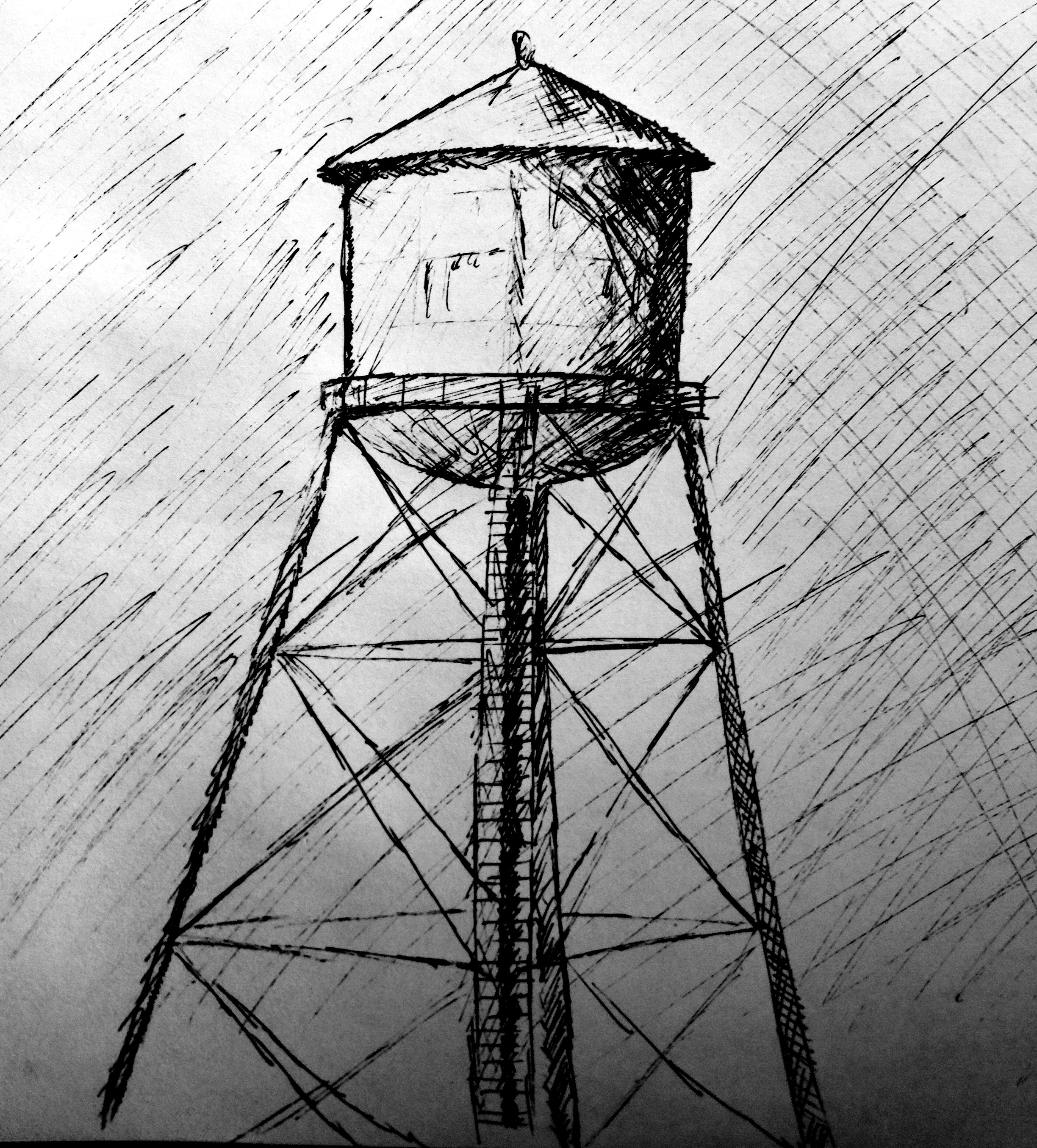
From then on we took the service road out of town a few hundred feet to where the track wasn’t so visible from the main road, the grocery store, police department, town hall, and, well basically the whole town. This was the service road that the trucks used in order get onto the rails and it ran parallel to the tracks and was heavily shaded by trees which provided us plenty of cover. The service road took us right by the water tower. This water tower was probably built in the 1930’s and was the tallest structure in the town. It was painted a silvery grey and had a roof that covered the catwalk around the tank. This roof and the ten foot chain link fence topped with three strands of barbed wire gave the water tower a decidedly severe watchtower look. From time to time the tank would overflow and water would spill out of the tower. If this happened in the winter time there would be a frozen waterfall pouring out of the water tower.WaterTowerVin.jpg

One day a friend and I chanced to walk by the water tower on our way to the fort and noticed that a tree had fallen across the chain-link fence, which was too much for our curiosity. We decided it would be best to come back after dark and climb it rather than let the whole town see us climbing it in the middle of the day. On one of the four legs of the water tower there was a ladder that followed the angle of the leg all the way up to the tank where the ladder went from slanted to straight up to the platform. Now when you’ve been climbing a ladder in the dark for about a hundred feet it starts to feel like you’re climbing straight up, no matter what the angle, and by the time you get to the part of the ladder that is straight up, you feel like you start to climb backwards. I clung to the dew wet ladder at the point where the angle changed, looking up at the rusty platform, looking down into the darkness below, and then around me for miles. The bright moon lit up the quaint little town and I could see for miles. I was waiting for the last little bit of courage I needed to climb that last ten feet straight up to the catwalk. It never came. I hope that you’re not disappointed, but I would like to remind you that this is a story about rail roads and not water towers and if you have a better water tower story I would love to hear it.

I think one of the things that drew us to the rail road so much was that it was an escape. Not that we had bad families, or terrible lives, or even hated the town, all of which would make for great fiction writing. We just wanted to go, and the railroad took us. At my boring adult job my office window faces the railroad tracks. Whenever things get a bit dull I look out at the railroad track for inspiration. I’ve always wondered how far those tracks would take you, if you wanted to go.

Hauling Hay, My Introduction to Work

“I haven’t found many things more disconcerting than picking up a bale of hay only to feel a snake crawl down your leg.”

The first job I ever had was Hauling Hay with Pop, my paternal grandfather. We called him Pop, but everyone else called him Slim. Or Slee-um, as we were in rural Alabama. Hardly anyone knew him by his real name, Dan Theo Wells. He was tough and strong, and I never heard anyone say a bad word about him, and if they did they would have been lying. I don’t remember exactly when I started working in the hay field with Pop, but I think it was sometime around the 1st or 2nd grade. I earned $5.00 per hour driving the manual transmission truck since I was not big enough to pick up a bale of hay.

Hauling hay, for those not familiar with this worthy vocation, involves a tractor with three or four different attachments, the cutter, the rake and the baler, and a truck and trailer to gather the finished product. You usually let the hay grow about a foot and a half then wait for a dry day and you cut it with the cutter, which is similar to a lawnmower but causes the hay to lay flat instead of being strewn all over the field. Then you allow the hay to dry for about a day before you rake it into windrows. If the hay isn’t sufficiently dried, you’ll need a fourth tractor attachment called a fluffer.  The final step before you can load hay on the truck and trailer involves running the baler along the windrow where it compacts the hay into a square bundle about 18”x 36” and binds it with two strands of baling twine. Square bales of hay can weigh anywhere from 40-75 lbs depending on what type of hay, how wet, or how many fire ant beds are in it. Fire ants have a peculiar strategy of holding their fire until they have enough troops on the ground for an entire regiment to fire a volley. You learn to notice if you feel anything crawling on you before they have a chance to take aim. You also learn to kick hay over before you pick it up to carry it to the truck. Other animals can take to the refuge of a square bale in the field or barn, field mice, rabbits, and worst of all, snakes. I haven’t found many things more disconcerting than picking up a bale of hay only to feel a snake crawl down your leg.

As I got older I graduated from the air conditioned cab of the truck to the position of stacker. I would stand on the trailer or truck and stack each bale of hay in an alternating pattern five bales high, so in the end the stack would have 20 bales each. Then I would tie down each stack with a rope so they wouldn’t fall over on the high. If you’ve ever had to restack a load of hay because someone stacked it poorly in the beginning then you will know how important the job of stacker is. And if you’ve ever stood 20 feet high in a barn in an Alabama August with dust flying as your big brother throws bale after bale of hay up for you to stack you will know how uncomfortable the job of stacker is.

Once I moved up to stacker, Pop would have Henry McGloughlin drive. I don’t know how old Henry was, but I remember going to his funeral once I was in High School. Henry wore overalls, had the same glasses since 1978, and chewed tobacco. The tobacco juice ran out both sides of his mouth, which made it a little awkward if you lost your Styrofoam cup at the community water keg, you didn’t want to have to drink after Big Henry.  Henry also had an allergy to deodorant, I think, so you didn’t want to have to ride in the middle of the truck when Henry was driving either.

One of the nice things about being the stacker was you didn’t have to walk on the uneven ground.  You could just ride on the trailer as the truck pulled you across the rough hayfields. Eventually, I gained enough strength and height to walk alongside the moving truck, picking up the bales and stacking them from the ground, only getting on the trailer to straighten and firm up the loose bales. My brother was so strong that once he threw a bale clean over the loaded trailer and onto my head on the other side of the truck, knocking me down.

We not only would load the hay in the field and unload it in the barn, we also delivered hay, which meant we loaded it our barn, or chicken house, and unloaded it in someone else’s barn. Pop was not just feeding his cattle, he was running a hay business. We delivered to people with cows, people with horses, people with all manner of livestock, construction companies, and even the county for building roads. What this meant was early mornings loading the trailer while the barn was cool and then a long drive to our delivery location. Pop was not much of a talker and we hardly listened to the radio when on these long trips. It was not an awkward silence, I think Pop was enjoying spending time with his grandsons, and I cherish the memories of those long truck rides with him.

Sometimes we would spend the night with Pop so to get an early start before the sun came up, beating the Alabama heat as best as we could. This often meant eating a bowl of cereal at Pop’s or on special occasions, going to a restaurant and getting a biscuit.

We had some cousins that would occasionally work with us, but never on a consistent basis. Pop said they “was a different breed”. What I think he meant was they were lazy, and wild. They had not enough of the strong work ethic that Pop was so steadily instilling in us. I remember the last time that they worked for us, one of them hit me in the head with a rock. I told Pop and I never worked with those particular cousins again. One of them turned out just like Pop said he would, “Sorry.” He said it like it tasted bad in his mouth.

I had another cousin that was a chronic complainer and hated working in the hayfield. One day my Dad said to him, “You are Slim Wells’ grandson, this is not just what you do, it’s who you are. You don’t just haul the hay, you are in the hay business. It’s who we are, get over it.”

In all of the years of working with Pop, whether we were delivering a load of hay or planting potatoes, quitting was never an option. Even if we were doing something as uncomfortable as castrating bulls, leaving the job never crossed my mind. I’m thankful for the work ethic that I gathered from Pop. Pop also helped build my confidence.  He never made me think that I couldn’t do something, he just told me to do it. I also thought he was the strongest person I had ever met.  I believe that he got a much needed confidence boost when he was drafted into the Army.

Pop was also a champion of education and was so proud of my brother Zach and me when we graduated high school and went to college. I often wonder how different he would have been if he didn’t have to drop out of school in order to help make ends meet around the house. Pop was extremely mechanically inclined and could fix just about anything. Perhaps he would have been an engineer. One thing he was not was a patient teacher, but he “learned” me a lot of things in his own way.

The older I got the more I could anticipate what Pop was trying to say. Perhaps it was from years of trying to decipher his hand signals while backing the truck, or from his tractor across the field. He didn’t say it much but he told me I love you in a lot of different ways, from getting me jobs, to creating work so that I could have some spending money when I went to college.

The only real regret that I have from working with Pop is the one time I refused to retrieve the truck from about half a mile away. It wasn’t so much the distance, but the difficult truck. The White Truck as we called it, an ancient F-150 that had a tricky transmission. The fact that it was a standard made no difference as that was all I knew how to drive until I was about 13 and we loaded a customer’s truck in the field. I hopped in the cab to pull the truck up and didn’t know how to stop it sense there was no clutch. The deal with the White Truck was that I could never get it started, I always dumped the clutch, and it was embarrassing. On this day, we had just finished loading the trailer and needed to go get the White Truck for some reason, I don’t rightly remember. At any rate, I told Pop that I didn’t want to go get the truck, and he got up and went to get it himself.

It wasn’t very long after that event that I was riding in the middle seat of the truck with Pop driving and Zach in the passenger seat, we were delivering a load of hay. I noticed that Pop’s right hand was shaking as he had firm grip on the steering wheel. I didn’t say anything about it, but a few weeks later Pop let us know that he had been to the doctor and had been diagnosed with Parkinson’s disease. From that day on I noticed a gradual decline in Pop’s range of motion and his face became more and more grave.

After I was grown I chanced to watch some old VHS tapes of Pop leading me around on one of his mules. I must have been about two years old in the video and Pop was as fit and peppy as I ever remembered him in the hayfield. It wasn’t for nothing that they called him Slim, he was around 6’1” and lean but muscular. In this video Pop was beaming with joy, you could tell that he was showing off his grandchildren. It’s hard to believe that he is the same man since Parkinson’s has taken a toll on him.

Now that I’m grown and work a sedentary office job, I often reminisce about working with Pop. I’m glad that he taught me about work and I hope that I am able to instill a work ethic into my children, although they may not have the opportunity to work on a farm. Work is more enjoyable when you love the people that you are working with. I remember one Sunday morning around 6:00am Pop, Dad, Zach and I were about to unload around 1,000 bales of hay before church for Mr. Terry LaDuke, the local blacksmith. Zach and I were still wiping the sleep out of our eyes and quietly grumbling about having to work on the Lord’s Day, although, I don’t remember us grumbling much while hunting after church on the Lord’s Day. Mr. LaDuke said in sarcastic manner, “Boys, this is quality time.” And it was.

Support

Your patronage is greatly appreciated.

$5.00