Apostolic Youth Ministry

The Bible does not contain a youth ministry model separate from adults, children, or elders.

Sarah and I drove from Alabama to Virginia this last weekend to attend the funeral of a man who had been a young person while we were leading youth ministry. Being there and seeing the teenagers-now grown people with families-whom we spent nearly every Friday night of our 20s with brought back a flood of memories. I love those people. And I still recognize a familiar connection that is not easily built with people.

In light of eternity, I am reminded that not everything we can involve ourselves with has equal importance. Not all activities or pursuits weigh the same. There are weighty things like righteousness, temperance, and the judgment to come, that make people uncomfortable to talk about. So they pursue, and try to find purpose in the frivolous and trivial. There is a grave danger in binding your life up in superficial things that have no eternal significance. Coming through The Valley of the Shadow of Death has also caused me to reflect on the eternal weight of glory that was being stored up in youth ministry. There are some things that we do that are far more important than other things. I wholeheartedly believe that Youth ministry is one of the important things that I have ever done.

And as he reasoned of righteousness, temperance, and judgment to come, Felix trembled, and answered, Go thy way for this time; when I have a convenient season, I will call for thee. Acts 24:25

In the name of personal development, I have read some superfluous and shallow books on the topic of Youth Ministry.

While there are many books about Youth Ministry, there are not many books about Apostolic Youth Ministry. As an Apostolic Christian, I believe in the Oneness of God, and have obeyed the commandment of the Apostle Peter-the man with the keys to the Kingdom- in Acts 2:38. This distinction-and many others-set Apostolic believers apart from mainstream Christendom. So when a non-Apostolic attempts to write a book on Youth Ministry it fails to address foundational concepts of Apostolic Christianity. To be clear, I make no claims to being an expert in Youth Ministry. Indeed I have made many mistakes. But I did serve for 12 years as a Youth Pastor and for a while now I have felt the gravity of the need to write about Youth Ministry from an Apostolic perspective. So today is a start at the very least.

The Bible does not contain a youth ministry model separate from adults, children, or elders. There are instructions at times to these demographics, but no formula for a church service that is unique to a specific age group. This is something that was largely ignored in the many youth ministry seminars, clinics, and training sessions that I attended in pursuit of excellence. Something else that was never at the forefront of these training was an emphasis on preaching in Youth Ministry. In fact there was often a strong emphasis on teaching in place of preaching. I think this is a mistake. Without doubt it is possible to build something without anointed preaching, but it will not be an Apostolic Youth Ministry.

I stood in front of that casket this past weekend and relived those Friday night youth services from days gone by. It was not the shoestring budget that we operated on, nor whatever trendy teaching series that was in circulation, or any hip stage design that came to mind-all these things are fleeting. It was preaching and the response to preaching that made the difference. At its essence, Apostolic Youth Ministry must contain prayer, and preaching. And not just any prayer and preaching, but the kind of prayer that shakes the house, and the kind of preaching that turns the world upside down.


For after that in the wisdom of God the world by wisdom knew not God, it pleased God by the foolishness of preaching to save them that believe.            I Corinthians 1:21

I wrestled with a man nearly all night when I learned that I would be saying something at the funeral. Not because I didn’t know what I would say-God had already told me- but because of how important words are, and how not all moments are created equal. I did not get rest until I had prayed and written this out:

Think not that I am come to send peace on earth: I came not to send peace, but a sword.
Matthew 10:34

Preaching is an offensive action. Its about the most offensive thing that you can endure.
There is no more offensive word than repent. The Word of God is a sharp sword that goes for the jugular. But God chose preaching to save them which believe
.

The law and the prophets were until John: since that time the kingdom of God is preached, and every man presseth into it.
Luke 16:16

Matthew records this same passage in this manner:

And from the days of John the Baptist until now the kingdom of heaven suffereth violence, and the violent take it by force.
Matthew 11:12

There is something combative about the Kingdom of God.

When I think of Brandon I first see a skinny little middle school aged boy sweaty from playing basketball before Youth Service on a Friday night. And there was preaching. And I see Brandon now as a teenager at Youth Camp not as sweaty anymore because he is trying to impress Makayla. And there was preaching. I see Brandon every Sunday morning, every Sunday night, and every Wednesday night with his crooked glasses. And There was preaching. And I see Brandon now as a young man of God in his office praying, and listening to preaching.

The preached Word of God speaks to us in our essence, or our full potential in the Spirit world. This is why the angel of the Lord spoke to a cowering Gideon threshing wheat by the wine press as a Mighty Man of Valor.

I watched Brandon look into the mirror of the preached Word of God and see Brandon, the man of God that could be.

Brandon heard the Word preached, mixed it with faith, and pressed his way violently into the Kingdom of God. And as his youth pastor, I watched him wrestle with heavenly potential. I could cheer him on, but it was his fight alone.

And Jacob was left alone; and there wrestled a man with him until the breaking of the day.
Genesis 32:24

I can see Brandon in those altars, alone, without his parents, wrestling with God; the Brandon who Was wrestling with the Brandon Who Could Be.

And I see him grab ahold of God and not let go. I see him wrestle some things to the ground. And I see him walk away, limping, and victorious.

At last I see him by faith, leaning on the top of his staff and worshipping as he died.

Brandon…you are the kind of person that I want to be: a man who died In the Faith.

I never really think about who may read whatever you want to call what I write, until I meet them in person and they tell me. If you are in Youth Ministry today I want to speak directly to you. Have a nice stage. But Preach the Word. Have great music and cool lights. Don’t try to give a TED Talk, Preach the Word.

I charge thee therefore before God, and the Lord Jesus Christ, who shall judge the quick and the dead at his appearing and his kingdom; Preach the word; be instant in season, out of season; reprove, rebuke, exhort with all long suffering and doctrine. For the time will come when they will not endure sound doctrine; but after their own lusts shall they heap to themselves teachers, having itching ears; And they shall turn away their ears from the truth, and shall be turned unto fables. II Timothy 4:1-4

Books of 2023

I was cutting my hair this week and some of the pieces of hair stuck to the scissors. So I turned the water on and just washed it down the sink. I was instantly transported back to my childhood living room with various members of the family sprawled out on every available piece of furniture and the floor. Each lounger with their own unique piece of literature. The Sunday Comics, a National Geographic Magazine, a novel from 1902, an Encyclopedia. There was “The Reading Chair”, one of the only pieces of furniture that Mom ever bought brand new. It had an ottoman, a side table and lamp. This chair must be surrendered to an adult. The same rule applied to the couch. This fixture that allowed the most seating was most commonly yielded to Dad, who occupied his territory in the supine recumbent position. There was no noise save for the steady rustle of turning pages, and the occasional internal laughter that manifested itself often in shaking and catching of breath. It was not uncommon for a reader to address the entire household with an impromptu reading of a passage selected for the edification of he that hath an ear.

“Archeologist find intact hair on a 3,000 year old mummy.” Dad read from his text.

“Y’all quit washing hair down the drain.” He gave the practical application and then slipped back into his silent reading.

I smiled and decided to not wash any more hair down the drain as I recalled this scene.

So they read in the book in the law of God distinctly, and gave the sense, and caused them to understand the reading. Nehemiah 8:8

I still enjoy reading. I still believe that it is important. I have a habit of reading my favorite books again and this year I reread Treasure Island by Robert Louis Stevenson, A Tale of Two Cities by Charles Dickens, and Hie To The Hunters by Jesse Stuart. I also enjoy audiobooks.

Sometimes you need to read something to just escape the present tasks that are pressing in upon you. So you choose to read something light and entertaining. Then there are books that truly challenge your thinking, cause deep introspection, bring fresh ideas, and promote a positive change in your life. This is the kind literature that I am interested in reading. Here are some books that I read this year that fall into that category.

Atomic Habits by James Clear

I am late to the party on reading this best seller. To say that I was inspired by this book is a gross understatement. I am persuaded that our daily habits have the power to shape our identity. I strongly recommend this book. The one takeaway that I would like to share from this book is concept of identity based thinking. You can think your way into a new behavior and vice versa.

Mr. Clear also references a book called Talent is Overrated, which provides research that supports the importance of practice over natural propensity toward a task. I have noticed this over the years with children that may quickly grasp the concept of guitar or a piano, but that alone is not sufficient to make them a master. There is no avoiding practice. The practicers usually advance.

This is Your Brain on Music: The Science of a Human Obsession by Daniel J. Levitin

I am fascinated by the brain. I enjoyed my psychology course in college so much that I would have changed my major but I did not want to lose my scholarship to study business. Levitin is a neuroscientist and musician. He writes that music in the brain almost behaves like a language. For example, you use one part of your brain to play music, and a different part of your brain to speak English. What is interesting to me is that you must use a third part of your brain when you put musical concepts into English. This explains why some people can play an instrument but struggle to tell someone else how to play. Or why someone may speak English and Spanish but have a hard time teaching one or the other.

This book convinced me of the importance of early music education. Whether or not a child becomes a great musician is not the issue, although early music education will certainly work in their favor toward mastery. More significantly is that children who took early music lessons scored better in other subjects as well. In short learning music makes you a better learner.

This book is continuing to challenge and inspire my thinking and musicianship. It has also prompted me to seek out and listen to How Music and Mathematics Relate by David Kung and Bach and the High Baroque by David Greenberg. Both of these are from the Great Courses series offered by the Teaching Company. I highly recommend This is Your Brain on Music to every musician.

Reflections on the Revolution in France by Edmund Burke

Unless you have a firm grasp on the history of the French Revolution as well as English history, you will be totally lost if you pick this book up. Mr. Burke was writing to his contemporaries about current events now two centuries removed. This book made the list because Edmund Burke makes me want to be a better writer. I will warn you that his rhetoric may seem boring or stuffy to many modern readers, but I found myself not only agreeing with him-he was pretty accurate about The French Revolution-but admiring his writing style. It made me question my writing style. Am I consistent? Am I clear and coherent? What would make someone want to read something I wrote?

I don’t have all the answers to these questions but I did ask ChatGPT to describe the writing style of zanewells.com.

The writing style of Zane Wells is characterized by its thoughtful, reflective tone and his ability to seamlessly blend humor and introspection. The website’s content often explores complex or abstract topics, but does so in a way that is accessible and engaging to a broad audience. The author’s prose is typically well-crafted and evocative, employing vivid imagery and sensory detail to bring his ideas to life. Additionally, the writing is often marked by a sense of curiosity and wonder, with the author frequently expressing awe and appreciation for the natural world and the mysteries of human experience. Overall, the writing style of Zane Wells is distinctive and memorable, reflecting a deep sense of thoughtfulness and an abiding sense of wonder about the world around us.

Not quite Edmund Burke, but I’ll take it.

The Great Debate by Yuval Levin

I read this book because I wanted to know more about Edmund Burke. Levin addresses the question of why there is clear division of major political, moral, and social issues between the American Left and Right. For example, if someone is pro-gun rights they’ll probably be also be pro-life. Levin endeavors to get to the heart of why these generalizations or stereotypes ring true. At the foundation we find the argument between the liberal Thomas Payne and the conservative Edmund Burke. Levin proposes that what someone thinks about the origins of human government-God ordained, or human ordained-has a profound impact on what they think about many of the current issues today.

I have read Common Sense by Thomas Payne as an adult and a teenage student in AP American History. I can appreciate that he wrote in a manner that was accessible to uneducated people and no one can deny his influence on the American Revolution. Yet the more I study about his concepts of human government the less I agree with him. This is not to say that I fully agree with Edmund Burke on every issue. I can say that this book was very thought provoking and I will probably read it again in a couple of years. And I encourage every American to read this book.

Surely You’re Joking Mr. Feynman by Richard P. Feynman

This was recommended by Audible because of a string of audiobooks I had listened to about the Manhattan Project, in which Feynman played an important role. Aside from hearing his name, I wasn’t really sure who Richard Feynman was. This is essentially his autobiography. I learned to appreciate his sense of humor. I found myself laughing out loud at some of Mr. Feynman’s experiences. If you remotely enjoy physics, the Manhattan Project, or good storytelling, then you will enjoy this book.

A key takeaway from this book is The Feynman Technique, a method of independent learning.

  • Choose a concept to learn
  • Teach it to yourself or someone else
  • Return to the source material if you get stuck
  • Simplify your explanations and create analogies

After I finished this audiobook I pulled up a few of his lectures on YouTube and was impressed by his manner of teaching. I also learned a little bit about Physics. I recalled some of my favorite teachers throughout my academic journey. The best teachers loved their subject material, but they also had a strong sense of connection with the student.

I recommend this book to all of my teacher friends.

American Prometheus: The Triumph and Tragedy of J. Robert Oppenheimer by Kai Bird, Martin J. Sherwin

I have been eyeing this book for a while since you cannot discuss the Manhattan Project without discussing J. Robert Oppenheimer. This Pulitzer Prize winning biography is able to go into such fine detail because this man’s life was closely scrutinized and documented by the FBI. This work left me with a deep sense of the cruelty of politics.

To read the biographies of great men is to take a close look at their lives and in doing so take a broad look at world history during their lifetime. In seeing J. Robert Oppenheimer we see World War II, the dawn of the atomic age, the birth of the Cold War, and American politics of the mid 20th century.

The life of J. Robert Oppenheimer makes me not want to hold any grudges.

Genghis Khan and the Making of the Modern World by Jack Weatherford

Genghis Khan is a singular example of one man who changed the world. He may not have been a good man, but he was a great man. The lasting impact of the Mongol Empire that followed him can still be felt in the world today. I’m not sure that I want to glean any character traits from Genghis Khan, but I did find his history very intriguing. I was also inspired to begin trying to fill in the substantial gap in my understanding of Asian history. If you read this book and enjoy it, you will probably also want to check out Barbarian Empires of the Steppes by Kenneth W. Harl from the Teaching Company.

Words Fitly Spoken

This year I read Reflections on the Revolution in France by Edmund Burke. I was initially intrigued by this work because I was on a French Revolution kick brought on by reading through A Tale of Two Cities yet again. What I found was I became far more interested in the writing style of the author than the subject material. This mastery of the English language is also what makes me, and countless others, Dickensian disciples. Mr. Burke writes a series of letters to a “French Friend.” Thankfully his friend could read English. As the title implies, these letters are his well thought out reflections on the French Revolution, an event that he watched unfold. The reflections were published and widely read during Mr. Burke’s lifetime. If you study political science today, you will become familiar with Edmond Burke as a political theorist. But I think he ought to be studied for his formal writing style.

How often have you had a conversation with someone and after it is over you find yourself wanting to edit what you said? It happens to me quite often. It is much easier for me to craft a clear response if I can write it. I am far more likely to choose appropriate words when given the luxury of reflection. With discipline and that most valuable resource time, I believe that anyone can put their deepest thoughts and feeling into written words. And people used to make this a habit in the form of diaries, journals, and letters to actual people.

Why do emails feel so stuffy and written letters seem so personal?

Although I keep a journal, and if you use your imagination I suppose you can call this blog-what an ugly word- and form of journalism, I cannot remember the last time I wrote someone a letter. For that I am a bit ashamed. At the same time I cannot remember the last time I received a letter. Most of our communication with friends today is done via text messages, FaceTime, and decreasingly for my generation, phone calls. All of these forms of communication lack the forethought and planning that a personal letter requires.

Even so, I believe that words fitly written are mere practice for words fitly spoken. As I said before, anyone can write if given time and inspiration, but it takes a truly gifted communicator to bring forth a fitly spoken word in real time. Words are powerful. Maybe this is why public speaking is a common fear.

A word fitly spoken is like apples of gold in pictures of silver. Proverbs 25:11

I am a long way away from where I want to be as an in person communicator. For that matter, I am a long way from where I want to be as a writer. But I am practicing. Thank you for allowing me to practice with you today.

Thanksgiving

Thanksgiving is probably my favorite holiday. It’s just like Christmas, but you don’t have to get anyone a gift. I don’t really need any help getting sentimental, but Thanksgiving seems to draw it out of me. I am genuinely thankful for all that God has done for me, and I think it’s proper to have a holiday set aside to be grateful.

Every good gift and every gift is from above, and cometh down from the Father of lights, with whom is no variableness, neither shadow of turning. James 1:17

Though it is my favorite holiday, I’m not attached to any Thanksgiving traditions. Perhaps in part because my grandfather Tinker Reynolds died on Thanksgiving day in 1989. He had suffered a heart attack earlier and it affected him so deeply that he asked the Lord to just take him the next time rather than put him through another heart attack. After he died, we never developed a Thanksgiving tradition that stuck as a family; it was different nearly every year. This just adds to the charm for me.

The first year I was away at college, a friend invited me across the Mississippi River to spend Thanksgiving with his family in Illinois. The extended family came over to eat and other than actual home made cranberry sauce not from a can, stuffing that was made from croutons instead of cornbread, and the midwestern accents, it reminded me of being back at home. I did turn out to be a big fan of whip cream on the pumpkin pie, I don’t know why we never thought of that. I was thankful to get to spend the holiday with family, even if it wasn’t my family.

I had to report to work the next morning at my retail job, so a different friend and I rode back to the college dorm on Thanksgiving night. The interstate was almost like a parking lot, there were so few cars. The campus was nearly deserted. I think there were only a couple of Canadians camped out in their dorms enjoying the week off. The abandoned college campus called to our adventurous nature and we forcefully explored one of the older buildings after a friend cut his hand on a broken window. I’m not sure how the statute of limitations works on all that, but I think the Lord has forgiven me.

I skipped Thanksgiving a few years ago to move into the first house I bought. But I haven’t missed a Thanksgiving with Zach and Lindsay since our Mom died. Our kids think that this has always been a tradition. They don’t know that when Lindsay asks me to taste the dressing we are both secretly comparing it to Nonna’s. They don’t know that when we consciously add the extra butter to melt on top of the mashed potatoes we are doing it because that’s what Mom did. In short, our kids don’t know that we don’t really know what we are doing. They just know that they are with their cousins.

One day I’ll be a proper old man with a pocket full of peppermints.

This year my sister introduced us to a brand new baby boy. He doesn’t even know that we are celebrating Thanksgiving as we pass him around and spoil him. Other than his birthday, this is his first holiday. He will probably always think of me as an old man. This will lend me credibility as I help establish Thanksgiving traditions for him. We may teach him how to carve a turkey one day. But maybe he’ll just figure it out by watching us. That’s how we learned how to do everything at Thanksgiving.

Dog Walker

I went for a walk at my brother’s house while visiting him for Thanksgiving. I picked up a stick out of a brush pile on the side of the road. It just feels right to walk with a stick. And the last time I went on this walk a dog bit me. I would not describe myself as a dog person. No sooner had I picked up the stick a dog came running towards me. I was ready for it. But when I saw the dog cower down and still continue to crawl to me, like a servant bowing before a king, I lowered my scepter. I mean my stick. Still a bit unsure I decided to just tell the dog to go home and continue on my walk. The dog did not go home, but trotted along side of me. I concluded that if a dog was going to be this agreeable I would welcome a companion on this walk. After all, the thing hadn’t even barked.

The first time a car slowed down to pass me I didn’t even think about the dog. It was not my dog, why should I care if the thing was run over and killed?

So on we walked, the dog darting back and forth across the road, wandering into yards, and occasionally glancing over at me. Once it stopped and growled a low growl at a house sitting close to the road. I couldn’t see what he was growling at, but I took a good look at the house in case the dog was trying to communicate some important information to me.

The next car that came along I felt that I should return the favor and keep the dog out of the road. I don’t remember cars slowing down that much for just a person walking on the side of the road.

I made it all the way to the highway and I was about to turn back. I felt it was my responsibility to tell the dog it was time to go back home. He kept right on following me as I headed back the way we came.

About halfway back a group of three little white and black dogs came running and barking at us. Growling and snapping at Rover. We’d come this far together I felt I needed to call him something. I raised my stick and broke up the little ruckus.

The dog followed me all the way home today. And I hope we can do this again tomorrow.

The Spirit of Ignorance

Poverty has many roots, but the taproot is ignorance.

Lyndon B. Johnson

Ignorance simply means the lack of knowledge or information. If you pause to reflect on how many books are in your local library, or better yet how much information is on the internet (64+zetabytes) you can begin to see how much there is to know that you don’t know. You may become overwhelmed with how ignorant you are. Before you get caught up feeling bad about this it is important to understand that it takes people a lifetime of study to become masters in a single field. That is why we call a particular branch of knowledge a discipline. A microbiologist may be an expert on cyanobacteria but have virtually no understanding of group theory, the Battle of Tours, or even how an internal combustion engine works. Even the immortal Sherlock Holmes baffled Dr. Watson with his ignorance of heliocentric motion because it was outside of his desired field of study. It is safe to say that we are all ignorant of many things, and that is perfectly acceptable in most cases. You’ll probably be fine if you do not understand game theory, statistics, or the psychoacoustics. But If you do take some time to study these topics I believe that your life will be enriched by this knowledge. That is the wonderful thing about learning, it is the only way to deliver you from ignorance.

Through wisdom is an house builded; and by understanding it is established: And by knowledge shall the chambers be filled with all precious and pleasant riches. Proverbs 24:2-4

To reject knowledge or instruction in our ignorant state is a dangerous folly, and to prefer ignorance over understanding is the root of the Spirit of Ignorance. I grew up in a small community where most of the people were working class. I didn’t know many people that had gone to college, I’m sure they were there, but I just didn’t know them. There was an extremely gifted young man a few grades ahead of me that was simultaneously revered and ridiculed by his peers for his remarkable intelligence. On one hand they were proud to know someone who was so smart, on the other hand he was unable to get them to embrace learning for themselves and in that regard they failed to understand him and considered him a freak of nature rather than an a disciplined independent learner. He graduated with high honors and went on to study at a prestigious university and never came back. This is what happens in small communities, all the smart kids end up moving away. Sociologists call this phenomenon Brain Drain and after a few generations it takes a tremendous toll on rural areas. What is left is a perfect breeding ground for the Spirit of Ignorance.

My people are destroyed for lack of knowledge: because thou hast rejected knowledge, I will also reject thee… Hosea 4:6

Ignorance can be deeply rooted, but often manifests itself as pride. People may feel personally attacked when their ignorance is confronted. No one enjoys being told that they are doing something wrong, or they don’t know what they are talking about, especially if they have been doing it for a long time.

Sometimes when people say they have done something for 20 years what they really mean is they have have repeated one year’s experience 20 times.

Dr. Nathaniel Wilson

This is one of the principle ways that the Spirit of Ignorance can be defeated: unlearning what you thought was true. When someone’s understanding is built upon fallacy, or false preconceptions, these must be confronted before any real learning can happen. I am reminded of Galileo’s conflict with the Catholic church over heliocentric motion. The Catholic church was in predicament because it was confronted with evidence contrary to its doctrine on heavenly bodies. The Catholic church failed in its response to Galileo and rather chose willful ignorance. Furthermore it waited over 400 years to fumble an opportunity at an apology.

“Experience keeps a dear school, but fools will learn in no other, and scarce in that.”

Poor Richard’s Almanack, Benjamin Franklin

There is a strong possibility that I will face a new concept, or a better way, that may challenge what I have always done or thought. I cannot afford to be hard-headed, or stiff-necked to borrow a Bible term when in these opportunities. Neither can I ignore them. Ignorance contains the root word ignore. To ignore something takes a conscious decision. This is the essence of the Spirit of Ignorance: ignoring truth.

It was important to the Apostle Paul that we would not be ignorant on certain topics or doctrine. I would not have you ignorant… There are a few people in my life that when I hear them talk, teach, or preach I get a strong sense that they too alongside of Paul are at war against the Spirit of Ignorance. And they make me want to join in the fight.

Downhill Uphill

“He went downhill fast.” That’s the kind of thing we say when someone gets terminally ill and doesn’t recover. It is a difficult thing to watch people go downhill. This is one of the reasons that I dread visiting nursing homes.

I was thinking about this phrase this morning as I was going down a steep hill on my bicycle. It really doesn’t take much effort at all to go downhill. Everyone can go fast downhill. You just keep it in the road, if that is the course that is set before you. But it takes real work to go uphill. And to go uphill fast demands an extraordinary amount of energy.

Do you ever get caught in this situation? You are riding shotgun and the driver answers the phone and the phone call plays through the vehicles sound system. You become an involuntary, nonspeaking party to the phone call. It is not that you are intruding by listening, but you would be intruding by talking. You go through something similar in real life watching people make decisions. I guess that is some how wrapped up in minding your own business. Anyway, It is hard for me to not pay attention to a conversation. By the way, do you ever quit listening to someone that is talking to you because you overhear a more interesting conversation off to the side? That is something that I struggle with. I won’t go into the finer details of what the conversation was about but this line stood out to me.

Things are going well but its all uphill.

I guess that means that they are putting in the effort. It sure sounded like it. And that is the point I am trying to make: making progress is really just a gentler way of saying that you are doing a lot of hard work and it is paying off. And you know, work is fun to watch. Especially if someone else is doing it.

I remember when we added an education wing to the church in Winchester. Cecil and I met every morning just down the hill from the church before we started our mowing rounds. I was not the early riser that I am today and Cecil always beat me to work. I’d pull in and start getting the truck and mowers in order before I almost had to drag him away from the construction site. He would be up there talking to the workers, pointing at things, telling them God knows what. Checking on that construction site really made him grin. Old men and little boys can watch bulldozers all day. I think we all like to watch work because it is inspiring.

I catch myself doing it now. Man they didn’t waste any time getting that house built! (Is this how you talk to yourself?) Progress is exciting. My community is patiently waiting for our Chick Fil A to be rebuilt. We are all emotionally invested in the progress of that building. We celebrate at each milestone. They got the sign on the wall!

When you are actually working on the construction site, or really any kind of project it can be difficult to appreciate your progress because you are constantly seeing it. Watching children grow up is a similar phenomenon. You hardly notice it when you see them every day, but the folks that just see them at Thanksgiving are shocked by their growth. If you are working on something that matters, it is good to remind yourself every once that your labor is not in vain.

Galatian 6:9 And let us not be weary in well doing: for in due season we shall reap, if we faint not.

Out of Tune

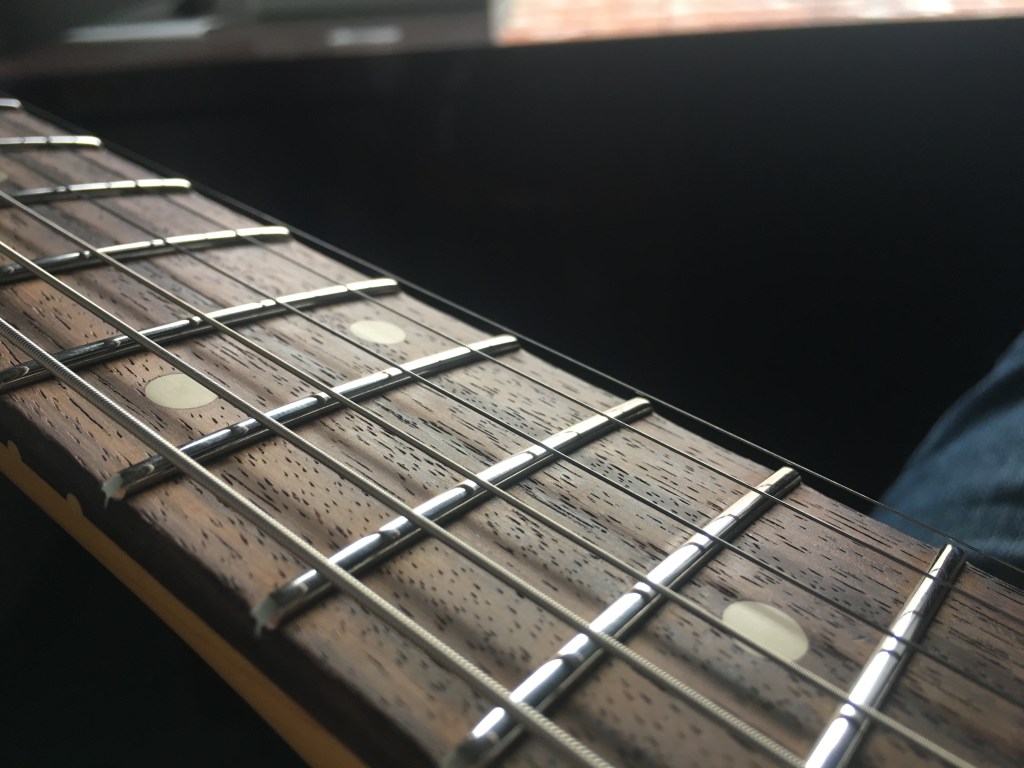
Have you ever wondered why guitars have frets and violins do not? I didn’t think so. I guess I better tell you what a fret is now. A fret is a thin strip of metal that runs perpendicular to the strings on a guitar. In theory it makes it easier to play a correct note. On a fretless instrument you have to rely in your ear and not a fret to play the correct note.

I do not own a violin but I spent a little time with one in my first round of college. I kept asking the wrong questions. Where is C? I should have asked, What does C sound like? I have come a long way since then on guitar. And I am beginning to understand why the concert music world did not respect the guitar until players like Andreas Segovia and Julian Bream paved the way for classical guitar in the twentieth century. I suppose I might as well tell you now that the guitar is out of tune. Or you could say it is equally in and out of tune. And this has bothered me for years.

I discovered this issue as a young player when I realized that guitars need regular maintenance. You need to tune a guitar’s open strings every time you play, but occasionally you have to check the guitars intonation. That means you make sure that the guitar is in tune at the 12th fret octave as well as the open string. If it is flat at the octave you can adjust the guitar’s bridge to make the string shorter and therefore sharpen the pitch. You lengthen the string to flatten it if the pitch is sharp at the octave. But there is a mathematical problem with tuning that is highlighted on fretted instruments: you can either have the octaves in tune, or the Fifths in tune, but not both. (Fifths are the fifth degree of the major scale and are the foundation of western music.) I did not have this information all of those years ago, I just noticed that I could never get the tuning perfect. And I thought there was something wrong with my instrument. It turns out it was not my guitar, but the whole tuning system in general. The piano suffers from the same problem.

I am tuning an octave on this old piano by ear. When you play two frequencies that do not match, say 400 hertz and 445 hertz, you can hear the difference of 5 hertz as a thumping sound called beats. You should be able to hear the beats disappear as the octave is brought in tune.

There have been a number of attempts made to deal with this issue over the past thousand or so years. Various temperaments, or tuning systems have been developed to to mitigate the Pythagorean Comma, or tuning gap. Apparently Pythagorus- yes that Pythagorus from your geometry class- wrestled with this issue.

Now that we have the tuning system worked out people only want to write four chord pop songs.

Enter the guitar around 500 years ago. I’d like to think that a prototypical guitar player invented the guitar. He was probably aware of the tuning issues, and thought, What if I just put these frets on the neck, make everything straight, and hope for the best? Guitar players are infamous for not being able to read music. Maybe he put frets on the fingerboard because he was tired of guessing where to put his fingers. Maybe he didn’t want to memorize notes but was happy to play patterns. At any rate guitars have been using equal temperament tuning since the renaissance and pianos waited to adopt it until right after the Boer Wars. And I think that’s why the guitar didn’t start gaining notoriety until the 1930s. Equal temperament tuning compromises the fifths in each key so the instrument can play fairly in tune across all the keys. This is why I have never been able to tune my guitar to my idealists standards. That brings me a small amount of psychological pain. But I have fallen in love with the guitar and I believe we can work our differences out.

Imagine now if this tuning phenomenon did not plague musicians and instrument makers. What if we could have the octaves and the fifths in tune? I don’t think that music would be what it is today. Part of the beauty of music is figuring out what works and what doesn’t. If everything was perfect there would be no dissonance, and how could we write music about pain and suffering without dissonance? J.S. Bach wrote his masterpiece The Well Tempered Clavier on an imperfect instrument. He wrote a piece of music in every key for the Harpsichord or Clavichord. These are stringed keyboard instruments that predated the piano. The genius of these pieces are the notes that he avoids because the well tempered tuning system still had some major dissonance issues. This piece is still studied today by aspiring pianists.

Think about this: more than likely, all of the piano music that you have ever heard in your whole life has not been in tune.

I suppose every good story needs a moral. Life is not always perfect. It can be frustrating to find the perfect balance because there may be no perfect balance. You just have to do the best that you can do with what you have. And often that ends up being the most beautiful thing anyway.

Loss of a Coworker

Getting to know people who are not like me has always been one of my favorite aspects of working with the public and attending public school.

Coworkers are people that you may not have anything in common with the except that you both work at the same place. So you end up building a special relationship with someone that you ordinarily would not have made friends with. Getting to know people who are not like me has always been one of my favorite aspects of working with the public and attending public school.

Losing a coworker is a strange feeling. I remember Dad losing a coworker to cancer when I was just a lad. I think his name was Ed White. Dad had visited him a few times while he was in the hospital. I remember how he would tell Mom how the visits went. I don’t have anyone to verify this-they are all dead-but I am fairly certain that Ed White paid the hospital bill when my sister was born. Mom and Dad went to the funeral without us kids. We didn’t know all of the details but we could tell by Dad’s countenance that it was not a time to be rowdy at the house.

“Paul passed away this morning.”

I got this text a couple of weeks ago from my boss at my former State job. I only saw him once or twice a month for the years that I worked there. But I talked to him on the phone quite often. He was one of our field officers and spent most of his time covering a large part of east Alabama. It was always a welcome diversion whenever one of these officers dropped into to see the people like me who hardly left the office. Those officers all had the best stories.

He carried a cane. He would walk by and smack that cane on my desktop and say things like:

“You’re fired.”

“You’re working too hard, take a break.”

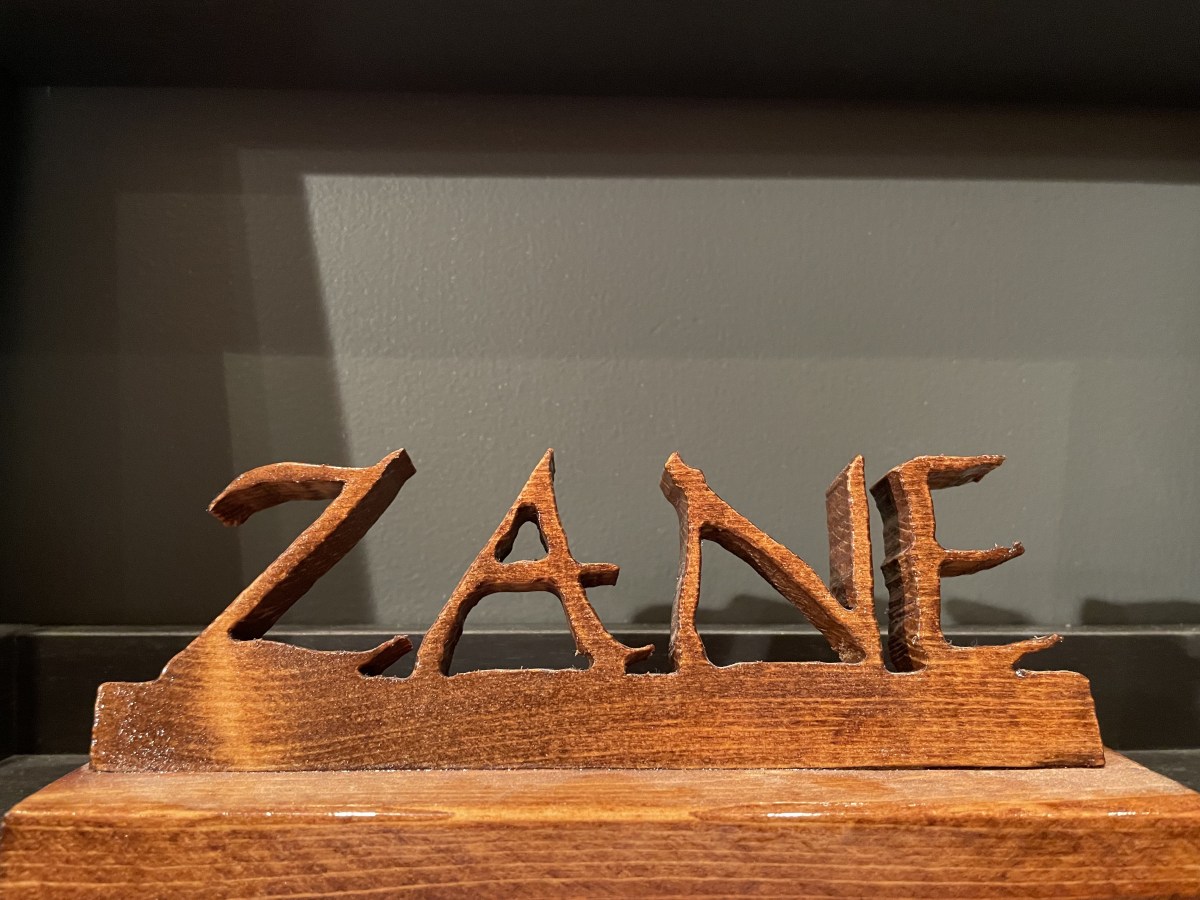
He was good at saying nice things in an abrasive tone of voice. He was also a very giving person. My first week or so at work he made me a wooden stand with my name. I still have it in my new office. It means a little more to me now. One day he brought me a bunch of metal straws. At first I thought, what in the world am I going to do with these? But they have been in constant use since I brought them home to the kids. Recently I have gained a deeper appreciation for these straws since I have slipped into the habit of drinking milkshakes nearly everyday.

Paul had served in more than one branch of the military and was a veteran of Iraqi Freedom. This may be where he picked up the cane. After he retired from the military he landed the gig with the State and that’s where I met him. He retired in the last year or so because his health. He had been fighting cancer. God I hate cancer. Paul was indeed a character. He made me want to be a better gift giver.

The first coworker that I ever lost was named Chavelo. Although I think that was his nickname. His real name was Isabel. I had never heard a man named Isabel, but I was so much older then, I’m younger than that now. He was from El Salvador and he introduced me to papusas. He would share them for breakfast. We were working for a man up in our church who owned a commercial lawn care business. We all went to church together. I was the truck driver and chief weed-eater operater, Cecil-another Alabamian-and Chavelo drove the big mowers. Neither one of them spoke proper English. And now that I think of it, I don’t think they even tried to talk to each other, they just each talked to me.

Chavelo told me that he had worked on a dairy farm in El Salvador.

“Tha macheen dat meelk da cow. It bad por da cow chitty. We meelk by hand.” He made a squeezing motion. I’m not sure what I was supposed to do with this information, but it has brought me a lot of joy over the years.

As we drove from job to job, Cecil would point out houses that he had sanded the floors in. The two would interrupt each other to talk to me. It was so entertaining.

“You see that bank right there Brother Zane?” Cecil asked one day.

“Yes.” I said, not fully paying attention as I navigated the truck and trailer through the streets that had been designed for horses and carriages.

“Somebody robbed that bank with a banana!”

“What?” I asked incredulously, now fully paying attention.

“It was a chocolate covered banana.” Cecil replied. I’m not sure of the veracity of this story, but I know for certain that Cecil believed it. I really hope it is true because I want to believe it too.

That’s what it was like working with these two. They were both old enough to be my grandad. I did a lot of laughing back then. That’s what the best coworkers do, they make you laugh.

Chavelo was sick one week for a few days, and when he returned I noticed that his eyes were yellow. After a month I began to noticed that his upper belly was protruding. He was not an overweight man by any means and this protrusion turned out to be bloating from liver cancer. I noticed the same symptom in Paul a while back. Chavelo went down hill pretty quick. I went to see him a few times while he was on his deathbed to pray for him.

“It’s no good Brother Zane.” He burst into tears one day. I cried too.

When he died they asked me to speak at the funeral. That was the first time I had ever spoken at a funeral and also the first time that I had ever spoken with a translator. I said something along these lines.

Chavelo and I had a language barrier, but not a communication block. We couldn’t always understand each other’s words, but we understood each other’s thoughts. Love transcends language. Chavelo was always sharing and we were always laughing. That connection was worth more than words could explain.

I sometimes think of Chavelo when I get discouraged while trying to learn Spanish. Chavelo helped me understand that speaking English is not the only sign of intelligence.

Eventually I got a job with Parks & Recreation and left the mowing industry. I was sitting at my desk one day and I got a phone call on my personal phone. I didn’t recognize the number so I didn’t answer. It is one of the biggest regrets I have. Pastor Dillon was out of the country so that’s probably why they called me. When I finally checked the message I was gutted.

“Cecil has had an mowing accident and he didn’t make it. Please call us.” It was from one of Cecil’s family members.

When they described the hill that he had been mowing when his mower flipped over on him I knew exactly where they were talking about. It was steep and tall. I never liked mowing on it myself.

Two things changed in me after Cecil died. I still answer the phone even if I don’t recognize the number. This does mean that I talk to a lot of people in Kolkuta, India, but I don’t mind. I also don’t play around with zero-turn mowers and I don’t feel bad telling people, “Hey man, you need a roll-bar on that thing.”

When I got the text about Paul it brought back a lot of memories for me. God and Death are no respecters of persons. I don’t know if this has helped anyone, but it has helped me.

Compliments

Are you better at giving or receiving compliments?

I imagine that most people like to have nice things said about them. Especially the Words of Affirmation people. I never remember exactly what my love language is because I never finished reading that book. There wasn’t enough plot for me. However, I have always enjoyed complimenting people. Although my sister-in-law, sister, and even my wife sometimes tell me that I am not very good at it. They say things like, I never know if you are being nice or making fun of me.

Compliments are like bubble gum, its ok to chew on them for a while, just don’t swallow them.

For instance a generic compliment to one of them might sound something like this, “I like that dress.” That is boring, and easily forgotten. To give a good compliment you have to imagine that your 3rd grade teacher is grading you on your effort. “I like that dress” is at best average. It lacks creativity and inspiration. Now try something like, “That dress reminds me of some curtains I saw at a museum exhibit about Japanese textiles.” See how that is more memorable? Some thought went into that. But even my best efforts get responses like Zane, no woman wants to hear that her clothes look like curtains.

Death and life are in the power of the tongue: and they that love it shall eat the fruit thereof.

Proverbs 18:21

Maybe I am not very good at giving compliments but I really do try because I believe in the power of words. I believe that words can be a source of inspiration. I believe that words can set a person’s mind in the right direction. This is why I feel compelled to write. But maintaining a blog in the era of the reel to sometimes feels like a lost cause. I must admit that I occasionally wonder if my energy is being wasted. And it is difficult to find inspiration to write when you are questioning whether what you are doing matters.

And then I’ll meet a real live person who has read my blog and they will compliment me on my writing and it inspires me so much that I stay up until 2:45am writing run on sentences because I am drawing inspiration from the power of their words.

Let me back up a little bit. I know that people read my blog because the website tells me these kinds of things. But it uses numbers and I have always thought that numbers were so impersonal. So meeting a reader in person gives me a clearer context for the numbers.

Whenever someone approaches me to tell me that they read my blog I feel incredibly vulnerable. I usually write in isolation so to me it feels like I am merely putting thoughts into words as a mental exercise. Some of the essays that have reached the most people were really not intended for entertainment but were my way of grieving. Many of the things I have written are simply thoughts that will not leave me alone and I only get peace when I release them to the outside world. There is something cathartic about reaching into the infinite and grabbing hold of something and wrestling it into the finite so that others can view it.

I also feel that since no one saw me write it that no one knows that I wrote it. I take refuge in this assumed anonymity. Furthermore, because I feel like that what I write already exists in a perfect form in the infinite, I can only take a small amount of responsibility for making it finite. These personal psychological constructs give me a false sense that no one really reads anything I write.

Whenever you read someones work you get an insight into their mind. In a sense you become familiar with the deepest part of that person. As the reader you also enjoy a sense of real anonymity in relation to the author. This is why I always feel vulnerable when I meet with someone who is a fan of my work because I feel like they can read my mind, but I cannot read theirs. But I can see it in their eyes if they really have read. Maybe they cried with me. Maybe they have the same questions that I do. Maybe they too used to go swimming in the creek with the town drunk when they were kids.

It happened to me last night as I was walking out of the conference center here in Pigeon Forge, TN. They took me by surprise.

“Brother Wells I read your blog and I love your style of writing.”

Whenever something like this happens I just say “Thank you!” But I try to say it in italics because I really mean it and I am otherwise speechless. I always think of something nice to say or questions that I should have asked hours later.

Then they said, “I feel like I know you.” This may be one of the highest compliments I have received on my writing. Complimenting someone involves a going out of yourself in much the same way that writing does. Saying something has the power of putting your thoughts into words and transferring them into someone else’s mind. And you may never know how much your words may help someone.