Year-Round School

I went to Vincent Elementary School and Vincent Middle/High School. For a long time I thought that I had a pretty normal public education. For the most part, I enjoyed school because I enjoyed learning. It wasn’t until I went to college that I realized that my small town Alabama education, particularly the schedule, was a radical departure from the traditional academia. The Vincent school system, somewhat isolated from the rest of Shelby County, was chosen to operate on an experimental “Year-Round” schedule. I think that parents voted to try the schedule. In short, we attended school nine weeks at a time. After each nine weeks, we got a three week break, and a slightly longer seven week summer break. The year round schedule went into effect when I entered kindergarten in 1992 and concluded after I graduated in 2005.

I’m sure that qualified individuals conducted studies on the effectiveness of this schedule- I recall there being evidence of higher test scores- and you can probably can read about it in some moldy academic journal if you know where to find it. Just keep in mind that it was probably written by someone who never actually experienced year-round school as a student, which unfortunately, is a severe blow to their credibility. As someone who attended year round school until college, I realize that I am biased, but I am strongly for year-round school. Perhaps I like it because it’s all I’ve ever known, but what is not to like? I recall pretty clearly that schedule was popular with the faculty.

So why did Vincent stop doing year round school? I’ve always theorized that it was due to an out of sync athletic schedule. This was the only complaint that I remember hearing about year-round school. This is only partly true, the real reason that Vincent was taken off of year-round school was because Vincent was different.

Here is an excerpt from a Gadsden Times article titled Vincent fights to keep year-round school schedule from January 30, 2005.

Amy Martin, a teacher and parent at Vincent schools, said the year-round schedule works and doesn’t need to be changed.

“If you insist on everybody being on the same calendar, fine,” she told the Shelby County school board. “Put them on our calendar.”

All other Shelby County schools are on a traditional schedule and Vincent should join them, says School Superintendent Evan Major. But the county school board on Thursday night opposed Major’s recommendation. The board tabled the issue until two separate calendars can be drafted for consideration.

Major wanted one calendar for all schools because two separate calendars is inconvenient, he said. Major said he’s not disappointed in the board’s decision.

“We have a system and that system works,” he said.

Eventually, School Superintendent Evan Major got his wish, and today Vincent is on the same schedule as the rest of Shelby County. This makes me wonder how much progress has been halted in the name of convenience?


Enduring Country Music

I grew up listening to a lot of country music, not because it was my first choice, but because my brother was an autocratic DJ. Although there are a few country songs and even country artists that I enjoy, for the most part, I endure country music. I endure it because I have been constantly subjected to it over the years. Being subjected to any type of music breeds a disdain for it. At my current job I am subjected to not just country, but modern country music, a term as oxymoronic as honest politician or men’s lotion. I could endure the modern country station with a little more patience, but I haven’t heard a single Merle Haggard song, not one!

What makes Country music enduring is tradition. These modern country lyrics are shallow. The content is overtly sexual, objectify women, and smacks of immorality, rebellion, arrogance, ignorance, and alcohol. I miss the days when country music lyrics were about Jesus. And America. And being rebellious, and cheating on your wife, and alcohol, and racism, and…well the music was better anyway.

Country music has always been most popular with working class Americans because the lyrics were so very relatable and emotional. Country musicians were bards who entertained in the local beer joints, singing to men and women who were often stuck in a socioeconomic situation with no hope of a way up or out. These songs gave them escape and release. These songs were ballads which told stories which connected with the very real struggles that working Americans were living out in their daily lives. It also appealed to their aspirations, traditions, and desires. Country Music gave a voice to many Americans.

With todays changing society, much of the culture of the American working class is rapidly becoming outdated, and in some cases taboo. People don’t farm like they did in post depression and World War II generations. There is a massive urban and suburban migration, and many dying small towns. It’s not as socially acceptable or politically correct to sing lyrics like, “Be proud you a rebel cause the South’s gonna do it again.” Today’s country musicians are aware of this and so a new image of the country musician is being forced upon one of the most loyal fanbases in the music industry. There has been a shift from singing about real social and economic issues heard in songs like, Working Man’s Blues, and Sixteen Tons, to shallower generic lyrics about girls, trucks, and having a bad attitude. In essence, modern country has long since abandoned the Southern culture and is trying to appeal to a wider audience, hence the hip hop influence and rapping. Of course there is still love to sing about, but the newer country songs push the limits of vulgarity that were set by rock and roll bands of the 70’s and 80’s.

It’s often the case that great oppression brings great hope. Although I am daily oppressed (and depressed) by modern country music, now more than ever I feel like I may have what it takes to be a professional songwriter. I think there’s probably good money to be made by writing a few tunes and letting one of these modern country guys record one of my songs. Since many establishments insist on playing modern country music, I think I could retire early. I’d like to share a few lyrics in the style of modern country that I’ve been sitting on for a while.

I got a Ford truck I painted primer gray

I’m going to go fishing when I get off work today

Little girl you ought to come with me

Maybe we can drink a little whiskey

I might look just like all these other country guys

But I’m different let me tell you why

(right here there needs to be a musical cut, then the band comes in full with chorus)

I’m a real country boy

I love Jesus, but sometimes I cuss

I ain’t into drama, don’t like to fuss

I play guitar, but I listen to rap

Got a fake accent…

Never mind. I’m fixing to go listen to some choir music.


Purple Martins

I was working in the lumber department of our local big box home improvement store when I was flagged down by an elderly man in a rambler scooter. He had clear blue eyes that peered out from underneath a mesh backed hat. He moved and spoke at such a pace that when I focused on him the hubbub of the lumber department seemed to become a blur, like a photograph shot with a wide aperture.

“I’m looking for some one by fours to build a bird house for purple martins.” He said. It’s often the case with a customer like this that a simple, “Aisle forty-nine, on the right” answer will not cut it. So when he begin to describe with his arthritic hands how he planned to build the bird house I abandoned my original errand and gave him my undivided attention.

I showed him where we kept the cedar boards since he had explained that “Purple Martins won’t stay in houses built out of treated lumber.” Of course the cedar boards were outrageously priced and I eventually ended up selling him a bundle of cedar shakes for much cheaper. “Now I’ll need some finishing nails.” He said as he kept describing how he would drill a hole an inch and three quarter since anything bigger would allow other birds to come in. He kept right on expounding the virtues of purple martins the whole five minutes, four aisle trip. By the time that we got to the finishing nails I had almost decided to build myself purple martin house since purple martins eat mosquitos “by the truckload.”

I finally found some satisfactory finishing nails for him and I was afraid I was going to have to shop with him for the rest of the day when a spry old man with a flannel shirt and tinted faded prescription lenses walked up and started talking to him. They both spoke loudly to each other, although by the responses that I could hear I’m sure it wasn’t loud enough. As I walked away I understood by their conversation that they were next door neighbors. I almost made it to the end of the aisle when the newcomer hailed me for assistance. “Where’s your pressure treated one by sixes? I need to replace the fascia on my house to keep them cotton picking purple martins from roostin’ in there.”

Easter Eggs

Last night we dyed Easter Eggs with several kids at Wesley’s birthday party. Just like I remember as a child, I was unsure whether the kids or adults were having more fun. Mom used to get the egg dyeing assembly line ready in the kitchen before she would allow the kids to come in and make a mess, which is what we specialized in. She prepared the Easter Egg baptistries with ceremony, which is always intriguing to a child. She was always doing things with ceremony and making us kids get out of the way. Perhaps she just wanted five minutes by herself, but in any case, children were not allowed to help set up the dye. (Or carve the pumpkins or make the gingerbread house). Although she sometimes let us watch from our barstools as she mixed the magical potion that changed the color of Easter Eggs.

I don’t remember Mom ever getting the plastic eggs filled with candy: Mom is a traditionalist. We had to find the plastic eggs at the Easter Egg hunt in Uncle Dave’s cow pasture. I did not care for hard boiled eggs as a child, so I was always hopeful that Mom would bring some candy and plastic eggs home from the grocery store. I once snuck a package of candy from the Easter Egg preparation pile on the kitchen table, hoping that she had gotten plastic eggs that year. I took the candy to my bed room where I struggled with the wrapper for a few minutes before I opened a pack of the nastiest Sweet Tarts that I had ever tasted. I spit out the one I had tried, I think it was orange, and dropped the rest of the package down a knothole in the floor of my sister’s room. Which was where you dropped things that you didn’t want anyone to know about.

A few minutes later as Mom was preparing the egg dying ritual, she noticed that the dye was missing. After searching around she asked, “Did somebody take some candy off the table?” She looked at each child in the face as she was asking this. She looked and me and I knew she could tell that I took, and also that I hadn’t brushed my teeth that morning. Mom’s have that way of looking at you.

“Yes.” I confessed. “But it was nasty.” Hoping that this would have been punishment enough.

Realizing my mistake, my desire to dye Easter Eggs overcame the fear of getting a whooping and I told Mom that the dye was under the house. To my surprise, there was no corporal punishment, only laughter. Zach was sent under the house to retrieve the dye and ten years worth of LEGO mini figures, army men, and other assorted items and toys that had been dropped to the abyss (probably with ceremony) through the knothole.

This is a happy story. Mom was able to finish dying the eggs, sans orange, and no one got whipped. Each Easter, we remember this story, which has lasted longer than any Easter Egg, hardboiled or plastic. I am still a bit wary of sweet tarts though.

Catfish

There was a restaurant in Childersburg, AL called Whiskers. They named their business after the grossest part of the catfish. To some, everything about the catfish is gross: catfish is a polarizing dish. People generally love it, or are grossed out by it. Although there is only one way to cook catfish, that is battered in cornmeal and fried in a skillet or fish fryer (I am thoroughly resolved on this matter), there is division on how it should be dressed before frying: whole or filleted. When you dress them whole, or bone in, you gut them, skin them, and cut their heads off, leaving the tail that crunches up like a potato chip after it comes out of the skillet. You have to be careful when you eat whole catfish because the bones are sharp. When you eat one properly you’ll be left with a perfect fish skeleton just like the kind in the comics. When you filet a catfish, you slice him right behind the pectoral fin all the way to the spine, then turn your knife and slice him all the way to the tail. Once you reach the tail you flip the slice away from the body and cut the skin away. Once you get real good at it, it looks like one fluid motion. “You waste a lot of meat when you fillet them.” You hear these kind of complaints from people who aren’t cleaning fish at all. I grew up eating fish, not just catfish, filleted. But I’m not so stuck up that I won’t eat a whole one tail and all.

I remember a conversation my dad had with John Smith. John was giving Dad directions to somewhere near Rockford, AL. “Bro. Perry, You know where that Catfish restaurant is on the right?”

“I know where that is. I’ve always wanted to stop and see if they have some good catfish in there.” My Dad asked.

“Brother Perry. Man do they have some catfish! You talking ’bout some good eating.” John began to get excited as he described the catfish in a little more detail.

“Are they good?” Dad asked, now more interested in the catfish than wherever John had been directing him in the first place.

John got a real sheepish grin on his face.

“I don’t know.” he said. “I had a cheeseburger.”

Home Remedies

img_3339“Have hemorrhoids? Try siting on a potato.” My cousin Anthony read aloud from Gram’s home remedy book. Now a person who had not experienced the power of home remedies would have only found humor in this statement. I still laugh when I think about how silly it sounded, but I as I recall, Gram only smiled a little and then looked pensive before she asked, “Do you need to cook the potato?” I guess she wanted to get the recipe right before trying it out, or more likely, before she recommended it to someone else.

Home remedies almost have a mystical element to them, like magic spells. My Great Grandmother could talk away burns. She would whisper some kind of incantation and the burning would stop. Her husband would buy warts. You had to wait till the next full moon for them to go away. He said they wouldn’t go away if you gave them to him, he had to pay for them.

“I cut myself one time with a knife while I was pealing potatoes. Granny washed the sliced finger real quick and rubbed ashes from the fireplace on it, then wrapped a bandage around it.” Dad recalled. I remember him reflecting, “I don’t know if the remedies actually worked, or if people just needed to believe in something. As often was the case, professional medical attention was simply unaffordable.”  This is probably true, but when you’re in pain I guess you’ll try anything. I once sprayed WD-40 on a severe case of psoriasis on my foot. This medical experiment failed, and I wouldn’t recommend it. But the home remedy of peeing on my feet in the shower had failed me and I was at the point of desperation.

Home remedies come in a wide spectrum, and can’t all be ruled out as kooky. The range of the spectrum is significant. On one end you have remedies like this: “Tie a match behind your left ear and drink a pint of buttermilk to help with indigestion.” On the other end you have common sense. Anytime we had a headache, stomach ache, or just about any ailment that was not inflicted by a rowdy sibling or cousin; Nonna would look over her glasses and ask us, “Did you bo-bo today?” Bo-bo should be a good euphemism-a lady like expression for a man sized fact- for defecate, but it isn’t. It puts you in the mind of being constipated in a public restroom with single ply toilet paper that didn’t fully get the job done and now you need to change underwear. But, usually this home remedy worked.

Another case of an effective home remedy was when Dad had the flu or a severe cough. Granny pulled out a jar of moonshine with some sort of root sitting in the bottom (perhaps sassafras). “It was like drinking fire.” Dad said. “I don’t know if it helped me with my sickness, or just put me to sleep.” Either way there was relief.

If you called Gram today and told her you had an ingrown toenail, or perhaps an ear infection, she would recommend a buttermilk poultice. Essentially, you mix up biscuit dough; flour, buttermilk, and a little lard, and put it in a plastic bag an stick your toe or whatever is ailing you in it and keep it over night. In the morning the poultice will have turned a dark green color. “It will pull the infection out.” She said. Or grow bacteria, I’m not really sure which. But I remember Dad, Zach, and Lindsay trying it out before Zach and Lindsay lost faith and went to the podiatrist.

From rubbing Clorox or tobacco juice on a bee sting, the virtues of coconut oil, and drinking apple cider vinegar for just about any ailment; the list of home remedies is a mile long. I’d like to hear your home remedy experiences. You can leave your comments at mostlyfrommemory.wordpress.com

Thank you everyone for reading and sharing my blog. I hope it makes you smile. 

Zane Wells

Portrait of a Southern Gentleman, or Things I Learned From My Dad

I was brushing my teeth this week, and while I generally do it every day, I can’t remember which day, so, I was brushing my teeth this week. I look in the mirror while I’m brushing my teeth. I was taken off guard to see that my forearms have grown considerably since I’ve been working in a more strenuous environment. For a moment, I thought that I was looking at my Dad’s arms.

I think my earliest memories of my father is of him splitting wood in the back yard. His forearms swelling as they gripped the maul. I was watching from my upturned five gallon bucket chair. Now I see him open the chicken pen and feed the chickens. Now I am standing on the back porch watching Dad wade through the flooded back yard in the pelting rain with a chicken under each arm. I watch a chicken snake as long as a fishing pole swim between his legs. I remember him killing the snake with a hoe. I remember him loading a rusty wood stove with the wood that he split. I remember riding around in his red Mazda. Mostly, I remember him coming home from work just about every day. Because my Dad is a faithful man.

Proverbs 20:6 Most men will proclaim every one his own goodness: but a faithful man who can find?

My Dad did not teach me how to be faithful, he showed me. He has been faithful to his wife. He showed me the importance of loving your wife.

“In 1936c King Edward VIII of England abdicated the throne to marry a woman from the United States. He would rather marry that woman than be the king of England. I don’t know what it’s like to be the King of England, but I do know what it’s like to love a woman.” -Perry Wells at the dedication of Wesley Wells.

My Dad has been faithful to his family. He loves his kids. He has shown me how to love my children. How to speak kind and lovingly. Dad never talks to babies like babies, he talks to them like they’re grown people. I think that may be why children love him so much.

Dad went to work every day because he was faithful to his family and to his job. He only took vacation time to take us to camp meeting, and Alabama Revival Conference, and Men’s Retreat, and Youth Explosion and Back to School Rally. Dad’s family was his top priority and the best thing he could do for us was to take us to church.

My Dad has been faithful to his God. We missed about two Sunday services in my life to go the family reunion at Uncle Freddy’s place on the river. There was never any question of whether we were going to church. Even when times were strange. Not to say it couldn’t have happened, but I never once remember thinking that my Dad might backslide. Dad didn’t just attend church, he lived it at home.

Dad would have been an excellent candidate for college, but he did not have the opportunity. He started working in a foundry right out of High School. And so he worked all of my life, getting promotions as I grew older. I remember Dad buying a set of World Book Encyclopedias from a door to door salesman. I read through them about twice. A year. For the next thirteen years. Dad gave me a hunger for learning and an appetite for literature. Dad values learning in a way that I hardly saw in the public education system. He is a voracious reader, and because of this, there is hardly a topic that he isn’t at the very least conversationally knowledgeable.

Which brings us to conversations. I’ve never met someone that Dad couldn’t have a conversation with. My Father can talk to anyone about anything. Whenever Dad found out that Pastor Dillon was considering me for a Youth Pastor position in Winchester, Virginia, Dad called him up and talked to him like they had known each other for years and as if Pastor Dillon had been expecting the call. Dad has always been my biggest salesman. Perhaps you’re reading this blog because he forced you to read about a town drunk. Thanks for reading. And thank you Dad for being my biggest fan.

My Dad is a music lover. He would drive us boys around in the truck and we’d listen to Motown and British Invasion on the oldies station. He loved to sing along with the radio.

I love to hear him sing at church too. My favorite selection from his repertoire is House Of Gold. I can’t imagine any voice but his singing…

Some people cheat, they steal and lie
For gold and what it can buy
But don’t they know that on the judgement day
Gold and Silver will melt away?

What good is gold and silver too
If your heart’s Not pure and true?
Oh sinner heed me when I say
That gold and silver will melt away

I’d rather be in a deep dark grave
And know that my poor soul was saved
Than to live in this world in a house of gold
And deny my God, and doom my soul

After he realized that I didn’t like hunting or fishing, and after I played the broom for two years, Dad bought me my first guitar. It was a sacrifice at the time, but Dad sent me to Mars Music and I picked out the Squier Strat Pack, “Rock N’ Roll in a box, everything you need is right here.” The salesman said. Dad also paid for my lessons with Marky Vincent. I still play that guitar everyday. I keep it out so it’s easily accessible, I think about my Dad every time I play it. Sometimes I play his favorite requests and imagine him listening in, bobbing his head and singing along, even though he is so far away. House of the Rising Sun, My Girl, Every Breath You Take.

Dad showed me how to tell a story. That’s why you, dear reader, have made it this far reading an essay that you will not be graded on. Dad knows how to captivate your attention and get you genuinely interested in a story. He sometimes leaves you hanging on the edge of your seat wondering what comes next while he shakes his head and rocks back and forth laughing so hard that he cries and loses his breath. Dad knows how to flavor a story with colloquialisms, short sayings that are stories in themselves, sometimes bizarre but still relatable. Growing up I thought everyone’s dad was as good of a communicator as my dad. The older I got the more I realized that Dad is a naturally gifted bard. Here are a selection of my favorite of his colloquialisms.

“Dangerous as doo-dooing in a well.”
“Heavy as a widow’s heart.”
“Goofy as an eight day clock.”
“Wild as a team of goats.”
“Ugly as pootin’ in church.”
“Mean as a snake.”

It was September 11th, 2017. I was vacuuming the church in the altar area, listening to Dragnet on my headphones when I got a call from Mom. She was crying. “I got some bad news. Dad has cancer.”

Cancer. I’d heard of it. A terrible disease that happens to other people and their family members. Cancer takes on a new meaning when it happens to you or someone you love.

Dad’s response was, “If God heals me, I’m going to live for God. If He doesn’t heal me, I’m going to live for God.”

It’s been a rough few months. A hard time. I’ve cried a lot. I’ve prayed a lot. There are a lot of things I don’t understand. I don’t know why my Dad got cancer. I don’t know why the first doctor missed it nearly a year ago. I don’t know why we found out so late. I don’t know why the medicine doesn’t seem to be working. I don’t know why God hasn’t healed him. I don’t know why…but this I do know:

Romans 8:28 And we know that all things work together for good to them that love God, to them who are the called according to his purpose.”

For the duration of my adult life, I’ve called my dad just about every day. He was there to give council. He was there to comfort when we had a miscarriage. He was there when the money was tight. I’ve been able to share a lot with my dad over the years. Every time I hit a major milestone in my life he would rejoice with me, then he’d quote this scripture:

III John 1:4 “I have no greater joy than to hear that my children walk in truth.”

It’s not an easy thing to think about passing from this life into eternity. Recent events in my life have caused me to reassess my priorities. When I weigh what it is important in the light of eternity it is sobering to think that what most men are breaking their back and neglecting family to obtain does not even make the list of important things. But I don’t want to be like most men, I want to be a faithful man.

Thank you Dad.
Thank you for showing me how to walk in truth.
Thank you for being a man’s man.
Thank you for whipping me when I smarted off to you.
Thank you for being faithful to Mom. Thank you for loving her and honoring your vows. Thank you for sticking together through hard times, through hellish times.
Thank you for being faithful to God. I know that you loved the book of Job, but I didn’t think that you were going to have to relate to it on this level. Thank you for not charging God foolishly.
Thank you for taking out a second mortgage to send me to Bible college. Thank you for raising me to follow the will of God even though it broke your heart when I moved eleven hours away to pursue God’s will.
Thank you for living what you believed.
Thank you for making me get a haircut.
Thank you for buying me my first guitar.
Thank you for buying me my second guitar.
Thank you for giving me my first vehicle, the purple Tacoma.
Thank you for teaching me how to drive a manual transmission.
Thank you for giving me my second vehicle just in time for college. The old Plymouth Grand Voyager.
Thank you for paying for all the times that I went over my minutes talking to my future wife.
Thank you for showing me how to be a man.
Thank you for teaching me how to work.
Thank you for listening to me flesh out all the sermons I preached over the years.
Thank you for loving me.
Thank you for being a faithful man.

Parades

My family and I recently moved to Cullman, Alabama. It’s not necessarily important that you know that, but I thought I’d get it out of the way, and use it as an excuse for not blogging in over a month. Anyway, I thought the best thing that I could do as a new member of the community was to attend the Cullman Christmas Parade the weekend after we arrived. Sarah and I got the kids all bundled up and we traipsed downtown in the frigid 50 degree weather to get some hot chocolate and cookies, and to stand on the sidewalk to watch the parade. It was a disjointed affair because the parade route crosses a major highway that can’t be closed, so there were several ten minute gaps as the high school marching bands, politicians, and fire trucks waited at the red light. As if seeing Mickey and Minnie Mouse, a live church band playing on a trailer, Batman riding a motorcycle, a real live member of the state legislature, some real estate agents square-dancing, and cousin Eddie walking behind his Winnebago wasn’t enough, we got the added excitement of getting to walk as a mob on the road as we made our way en masse over to the park to see the Christmas Tree lighting. There is something exhilarating about walking down the middle of the road, It’s a lot wider than it seems when you’re in a vehicle.  When we got to the park, we all sang Silent Night as a community, which was really quite moving. Then we listened to the Christmas Story, the real Christmas story read straight out of the Bible by a City Councilman. Wesley missed the actual tree lighting part of the ceremony because he had to make an emergency bathroom break in the shrubbery.

The most dangerous and entertaining part of the after events at Christmas Parades is the speeches. When I was a kid, back before the internet, the whole town would come out for the Christmas Parade. They’d stand on the street and watch it coming and going. Then we’d walk to the parking lot in front of the City Hall/Police Department and listen to a choir sing on the portable stage that had been hastily brought out of it’s storage place behind the Water Board. The choir was amplified by a single microphone in hopes of combatting the steady flow of traffic that had been waiting for the parade to finish. After this, there were usually speeches by local dignitaries. It was on this stage that one of the most memorable speeches in the history of Vincent, Alabama was given by the drunken Honorable Judge Jimmy Sharrbutt. I’m sorry to play it up so much, because I only remember two lines, but they have become colloquialisms in the language of my family.

“When I saw the lights under the bridge, I cried.”

“Oh. And anotha’ thang. One of them Hassett boys broke my arm.”

When you’re a kid, a lot of times you don’t notice when someone is drunk. As an adult you can recall their behavior, speech, and countenance and clearly see that they were drunk.

After the speech we would light the giant Christmas Tree, the largest live Christmas tree in the State of Alabama, that stood by the Norfolk Southern railroad. This tree, along with the giant red and white plaster Christmas bells from the 70’s, for me are the epitome of municipal Christmas Decorations.

There is a timeless feeling that comes with a parade in a small town. It’s something that’s left over from centuries past, when people were not afraid to come out and see their neighbors. Parades are a lasting ritual from the time before television, the internet, and smartphones made the world a much smaller and less enchanted place. The wonder of technology has nearly stripped us of the wonder of the moment. Parades are one of the last remaining purely community gatherings. I’m glad my kids got to experience a genuine small town Christmas Parade, even if there were no drunk Judges.

Vanity

Mr. Lowe was the sole music teacher at my elementary school. I think he may have been involved with the music at his local church, but as I did not attend his local church this claim cannot be substantiated. I can tell you with certainty that he was bald. He kept what straight brown hair that remained on the sides and back of his hair neatly combed. I often thought that his hair had a distinct rounded puff like quality to it. I’m told he rode a motorcycle, but again, I never saw him on a motorcycle, or any other car for that matter, but I can imagine very easily that he did ride a motorcycle. He had a very resonant baritone voice and always taught setting down, which in later years I learned is not the best way to sing.

Mr. Lowe’s music class was held in a single wide trailer on the western side of the school. You had to walk outside, in a single file line with your mouth closed while you held your thumb behind your back, in order to reach the classroom. By the time all of us had filed into the trailer, the cool air had rushed out of the room, and we sat for the next hour or so listening to the window unit air conditioner work overtime as Mr. Lowe rambled about cows eating grass and good boys finding.

Music was taught in an odd fashion in elementary school. All of us, more or less, showed up on our first day at Kindergarten with at least good conversational English. For the next five years we were taught vocabulary, grammar, and composition. But with music, we were thrust almost immediately into music theory before we had any experience on a musical instrument. If we excelled in theory, we might then be encouraged to take up an instrument.

I enjoyed music time. Mr. Lowe introduced us to all of the least practical instruments for playing the type of music that I was exposed to at home and at church. He showed us maracas, sand blocks, guiros, and my personal favorite, the bells. I vaguely remember a piano, but no guitars. He would sometimes let us “play” these instruments. I don’t think any of us were very proficient at these odd instruments.

Mr. Lowe taught us the Peanut Butter Song.

First you take the peanuts and you dig ’em

You dig’em dig’em dig’em

Pea-nuuut, pea-nut butter, and jelly…

Mr. Lowe introduced us to Jerry Lewis in the movie Cinderfella. Before we started the movie, Mr. Lowe to pains to make it very clear that Jerry Lewis was not a sissy. Being a sissy was about the worst thing that anyone could call you. Mr. Lowe’s preliminary speech didn’t convince me.

Mr. Lowe tried his best to teach us about sharps and flats, rhythm, melody and harmony, but like many of my teachers, he spent far too much of his time trying to get the attention of children who’s only desire was to do anything but learn.

In about the fourth or fifth grade, Mrs. McManus sat our class down for a speech before we were to go to music class. We all prepared for another, “Y’all better learn how to act or we’re putting you on silent lunch” orations. What followed caught us off guard.

“Students.” Mrs. McManus began in a grave manner.

“Today when you go to music class, Mr. Lowe is going to look different. He’ll have hair.”

She paused for a moment to see what our reaction would be. We were so taken off guard that not a word was spoken. She took advantage of the silence and proceeded.

“Mr. Lowe has decided to wear a toupee.” Here she went into detail about what a toupee was, our french not being what it should be. After she was convinced that we had been thoroughly educated on what a toupee was, how it staid on, why you would want to wear one, and what it was made of, she made it very clear that we were not to “Stare, ask questions, or even acknowledge that anything was different about Mr. Lowe.” Now this is a lot to ask a group of rowdy fourth and fifth graders, but aside from one or two well meaning compliments, we acquiesced to this strange demand from our pedagogue.

This absurd experience made a bigger impact on me than all of the musical knowledge that Mr. Lowe tried to impart. We had seen Mr. Lowe every week for five years and now he was going to be radically different and we weren’t allowed to talk about it. That’s the way with vanity: we spend a lot of effort trying be something that we’re not and hope that it comes off as normal.

Gun Safety

Zach and I used to beg Dad to let us help “Clean the Guns”, a ritual where we all would crowd around Dad’s closet and he would carefully lubricate and clean each firearm with a tin can 3-In-One oil. “Don’t touch the metal. You’ll get fingerprints all over it.” That’s rule number one of gun safety. I still make a conscious effort to not touch the metal on a gun any time I’m handed one to inspect.

Before he started wiping the firearm down, he would set the stock on his knee with the barrel pointed towards the ceiling, and we would all look at it in wonder. Each gun had a story. “I traded a bird dog in 1970 for this 12 gauge Remington 1100. I’ve killed a few deer and ain’t no telling how many birds with this thing.”

He was also prone to shooting dogs. We lived in an old house that was built on blocks. Before Dad installed underpinning, or had me and Zach install, stray dogs used to get under the house and break the water lines. One time Dad got caught up in the moment and shot under the house. Another time he chased a dog out of the yard for waking him up by barking. Dad had been working late nights and when he came to himself, he was standing out in the front yard in his underwear and work boots, holding shotgun yelling at a dog, at ten o’clock on a Sunday morning. But he didn’t usually tell those stories while we were cleaning the guns.

He would then pass the 1100 to Zach, who would put to his shoulder and aim across the room as if he was getting a lead on a dove. POW, he would say under his breath, letting it reverberate a little bit as if he had shot a bird on a cool still morning in the Alabama wilderness.

“Watch where you’re aiming that thing!” Dad would say as he reached to take the shotgun away from an eight year old boy who had just nearly hit him in the head with a shotgun. “You have act like every gun is loaded.” That was rule number two of gun safety.

Dad would then hand the shotgun to me, who had been waiting impatiently to hold a shotgun that was taller than my brother. When you’re that small, you are doing good just to be able to hold the gun without dropping it, let alone stressing about proper form and aiming. My Uncle Johnny remedied this by sawing about four inches of stock off of a single shot Harrington & Richardson .410. I still remember him bringing it over to our house.

The most mystically firearm in our modest arsenal was Dad’s lever action Marlin .30-30. A genuine cowboy rifle, replete with a gold trigger. Zach & I would work the action from hip, pretending we were Tell Sackett. Dad had shot a deer with this rifle that didn’t quite die. As he was walking toward it, the deer jumped up and began to run by him, Dad leaped off a stump like Tarzan and cut the deer’s throat with a pocket knife. This story added to the mystique of the cowboy rifle.

It didn’t take long to clean oil all the guns, but the ritual of “Cleaning the Guns” also involved looking at all of the pocket knives. Dad bought us a bunch of cheap, made in Pakistan knives because he knew that we would end up losing them anyway. And he was right. I lost a Frost Cutlery Royal Flush at Mrs. Yvonne Clinkscale’s house as I was climbing a tree while my brother endured his piano lesson. I probably climbed thirty feet up into that tree.

I had a Barlow pocket knife that I threw at a tree across the road after church one day. I remember thinking that no one would see me if I went around to the side of the church. Somehow Dad saw me, maybe through one of the six windows. Anyway, he must have witnessed the knife fall about fifteen yards short of the desired target and land in the middle of the road, square on the tip, bending it at a ninety degree angle. Dad sent for me to come see him on the back pew of the church, and he pocketed my Barlow.

The only two knives that I have left from my childhood are the only two that matter to me anyway. Dad bought me a yellow handled Case Slimline Trapper when I was two years old. 

I carried that knife for about fifteen years, before I decided to get a new one.

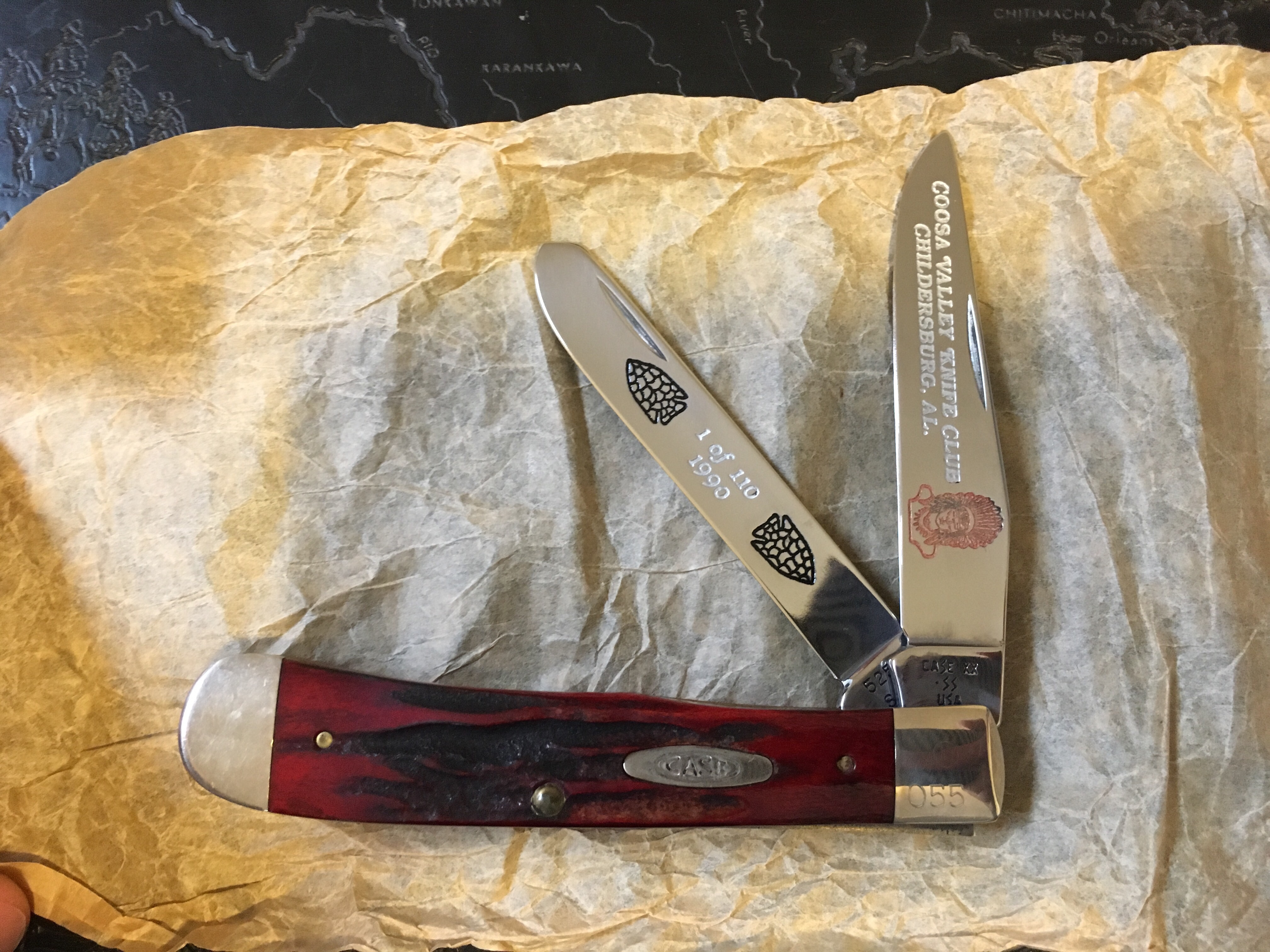
Uncle Jimmy gave me a red stag handled Case Trapper the year after my grandfather died. He would have been 55 years old. This knife is 55 of 110. Perhaps my first introduction to gun safety was when Dad took me out by the chicken pen and sat up a milk jug full of water as a target. He raised his shotgun, drew a bead on the milk jug and BOOM! The milk jug exploded. I was just barely out of diapers looking with amazement, first at Dad and then to where the milk jug had been. Ever the teacher, Dad said, “This is not a toy.” Wide eyed and unblinking I nodded back at him. This is the principle rule of gun safety.

My cousin Kent could have benefited from a demonstration like that.  When Kent was about seven, his grandfather took him hunting. Kent sat down beside him and they waited for a deer to walk by. Which is the part of hunting that seems the least exciting to me. Perhaps Kent felt the same way because his eyes began to wonder from the field over to his grandpa who was watching and waiting diligently. Then Kent’s eyes wondered to his grandpa’s shotgun, which he held directly in front of him, the barrel directly under the bill of his cap. Then Kent’s eyes wondered to the trigger, which was closer to him as he sat the on the ground. Eventually curiosity got the better of him and he slowly and quietly, sneakily probably is a better word, reached over and pulled the trigger. Booom! I can only imagine his grandpa’s surprise as the shotgun fired, blowing his hat off.

This brings us to the final rule of gun safety, in general, one gun is as dangerous as the next, but some people are far more dangerous than others.