Doris McDaniel

She wore pearls and drove a Cadillac; a great big gold Cadillac.

Mrs. Doris McDaniel spoke with an old Southern accent. An accent not easily imitated even by Southerners; Hollywood always gets it wrong. She dropped her R’s which made her sound like 19th century southern aristocracy. She also wore pearls and drove a Cadillac; a great big gold Cadillac. This certainly encouraged my childhood idea that Mrs. McDaniel had descended from royal stock. I thought she was the richest woman in Shelby County. She may also have been the sweetest.

Already in her 70’s when I was a child, she still owned and ran an old store right in the middle of Vincent. Prime real estate which set the halfway mark for the Christmas Parades. I don’t know how long she had the store, it was just always there. Kind of like her: a fixture in the town. As long I could remember, she kept odd hours at the store. People knew the store was open if her Cadillac was parked out front. The store was the only place in Vincent where you could buy a set of snow skis. It was like a permanent indoor yard sale. I think she kept the store open just to get out of the house, and to see people. People always made her smile. I think people came in to see her too. They certainly weren’t looking for snow skis.

Mrs. McDaniel was Jared and Creed’s grandmother. They called her Granny Mac. She would watch them sometimes during the summer. Whenever we got a little rowdy, she would say things like, “Oh my! Boys, that’s not nice.” She had a way of sort gasping the “Oh my”, and stretching “Boys” out to have an extra syllable. Even so, I never saw her lose her composure: She was a lady.

We would hang out at her store sometimes; stopping in to say hello and to feel the air conditioning for a moment. It was usually a checkpoint before we went gallivanting down the railroad tracks. She was always happy to see us, or anyone else that came in. She treated everyone that came into her store the same way.

The last time I saw her I was an adult. “My, my, my! Look how you’ve grown.” She said energetically. I had never noticed how petite she was until I was grown.

I introduced my wife. “How are are you hon?” She reached in for a hug.

“She is beautiful Zane.” She had a way of throwing an extra syllable in my name too.

Mrs. Doris McDaniel passed away on January 11th, 2020 at the age of 95.

If you ever drive through the town of Vincent, Alabama, you’ll probably take the old parade route: Highway 231. You’ll know you’re in town once the speed limit drops to 35 miles per hour, but you really aren’t downtown until you drive under the railroad overpass. The Christmas Tree will be on your left and Florey St with all the municipal offices on your right. There is a building on the right with a big sign that reads Doris McDaniel. Just know that one of the sweetest ladies that ever lived used to run that old store.

If that sign isn’t still there, it ought to be.

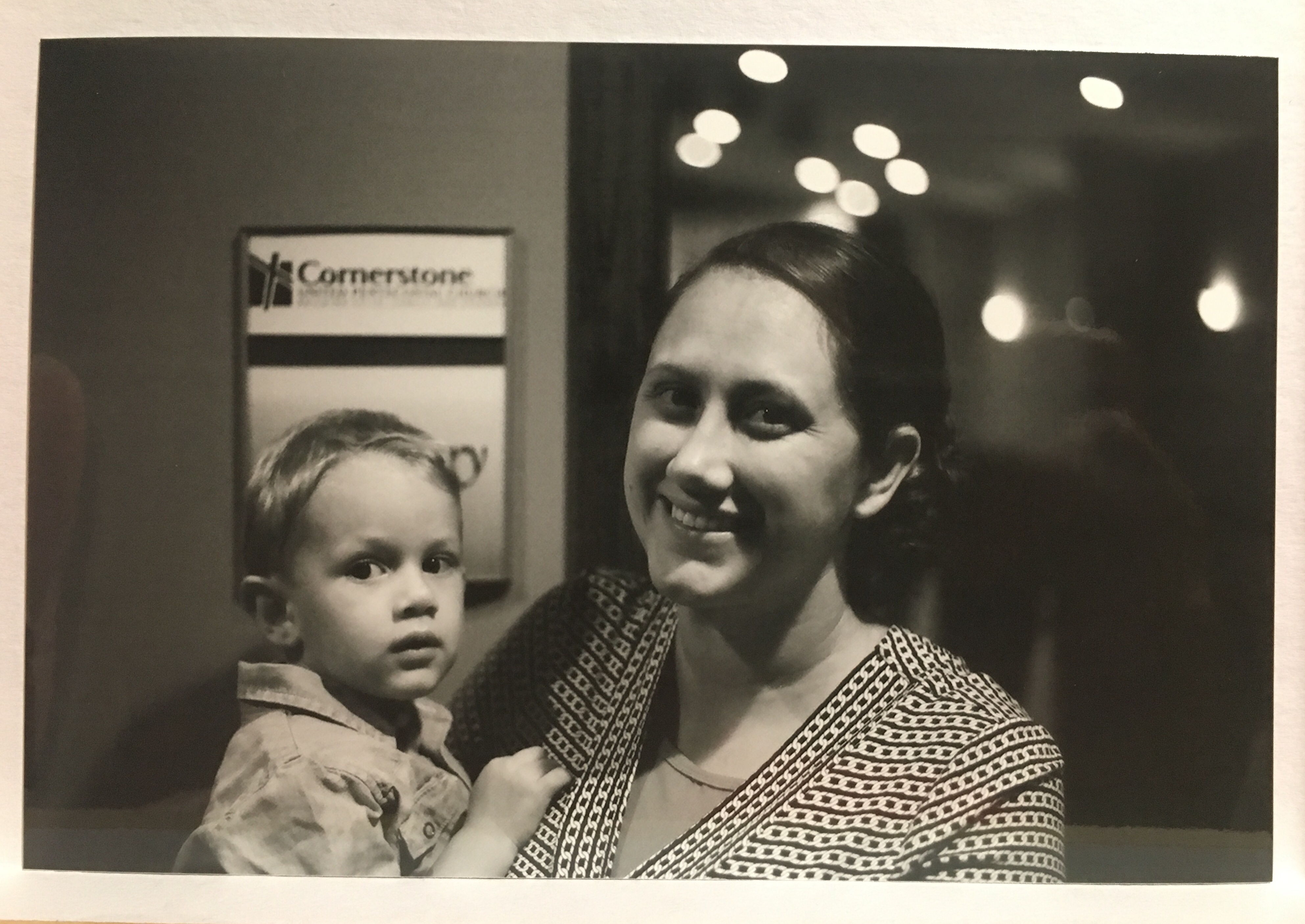
My wife and I window shopping at Mrs. McDaniel’s store.

The Churn

It’s just in human nature to use things against the manufacturer’s recommended use.

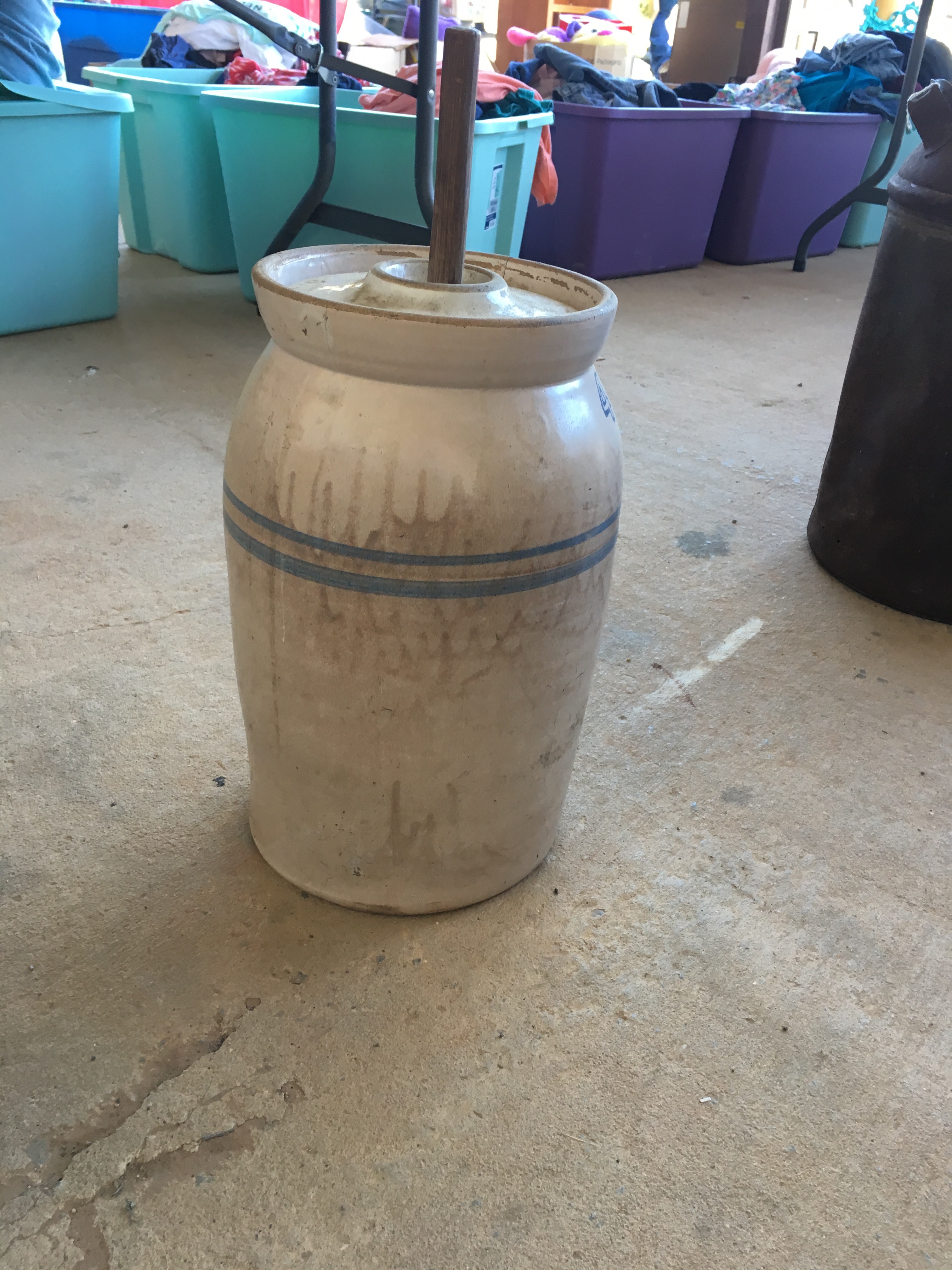
We had an old churn in the kitchen. I can’t remember it not being there. Our churn was never employed to make butter or anything like that, it just kept the refrigerator door closed. It’s just in human nature to use things against the manufacturer’s recommended use.

There was a big indoor yard sale at the Cullman County Ag Center a while back, and they had a churn just like the one that I remember from growing up. I say remember, but until I saw the one at the yard sale I hadn’t thought about that churn since we got a new refrigerator in 1997.

The yard sale made me think of the churn. This kind of thing happens to me all the time. Something will trigger my memory and I don’t just remember, I’m there. I think that’s why I like to go to yard sales and and thrift stores.

The churn took me back to the kitchen with it’s ancient white and black tile in a curious pattern. There was the refrigerator with it’s faux wooden inlays on the handles. Inside the fridge was the mystery Country Crock containers that Mom used for leftovers. Once she sent a bunch of them full of Mexican Cornbread (or something like that) to work with Dad so he could share with coworkers. One poor man opened his container to find actual Country Crock. I think we used Country Crock instead of butter because my grandfather had died of a heart attack.

The new refrigerator door stayed closed, so the churn was retired to the mud room. We were too emotionally attached to it to get rid of it, ugly as it was. The lid was long gone and it the finish was cracked and chipped, but because it had been with us so long it had earned a permanent spot on the register of Wells Home Furniture: we were not getting rid of it. It’s funny how you can become attached to a thing no matter how useless it has become.

When I was a teenager, we had an extended guest who broke the churn after carelessly moving it. I think my Mom cried. Because it had outlived it’s original use and it’s ad hoc use we didn’t replace it, its only function was sentimentality, a curio relic from a bygone era.

It would have been impossible to replace it anyway. It would be like replacing a family member. Shopping for a new one would have only made you sad about the one that you lost.

Look at that. I’m tearing up about a churn. I didn’t buy that churn at the yard sale. But I did just buy a new refrigerator the other day. It’s got an alarm that dings at you if the door is open.

Camping

My earliest memories of camping were Dad taking Zach and me out to Black Jack, a vast wilderness owned by the paper company I think. We would set up a little dome tent and build a fire. Dad would let us play in the fire with a stick, probably the best part for a little boy. We always camped in the fall, no sense in camping with mosquitoes and rattlesnakes. 

Most of the time we roasted weenies and marshmallows, but one particular time Dad went all out and made some barbecue chicken quarters over the fire. He seasoned the chicken, wrapped it in aluminum foil and placed it on one of those flimsy folding metal grills that set over the fire. We sat patiently around the fire on our five gallon buckets staring into the flickering flames.  Just before the chicken was finished cooking it began to rain. First softly then a steady drizzle, then we retreated into the tent as the bottom dropped out of the sky. The water began to rise as we sat huddled in our sleeping bags hoping for the rain to subside. After about a half an hour and half an inch of rain in the tent, Dad decided to abandon camp. We loaded our essential belongings into the truck and headed home. We ended up leaving the tent to retrieve another day, but the saddest part was that we never even got to try the chicken. I don’t think we ever camped at Black Jack after that.

From then on we camped on some relative’s property that had a small lake where we often fished. Looking back now, I realize how little I was, out of diapers, but not in school. It was Dad’s rule that you had to be out of diapers to go camping. In the mornings, we would go hunting not far from where we had camped. I would sit against a tree with Dad while Zach sat by himself a few yards away. He probably had a better chance of killing a deer by himself, because I was making too much noise playing with action figures. I never did catch the hunting fever like my brother, but I still like to go camping, and it just doesn’t feel right to go camping without a gun.

Zach and I camped with Jared and Creed once on the back border of their Dad’s property. Mr. Sherwood McDaniel, their father, had cleared the perimeter and it was here that we spent many hours playing. Zach and Creed were old enough to work at the store, so Jared and I were supposed to tend the fire until their shift was over. The gainfully employed older brothers had gone shopping before hand and brought some provisions for that night. I’m sure they got some good food but what I remember is the knock off Grapicos, they were nasty. We, the keepers of the flame, discovered that a can of Coke, knock off or genuine, will explode with a tremendous noise if you place it in the fire and forget about it. Creed and Zach were not as impressed.

While Zach was still in high school it was not very hard to talk him into camping. We’d often make the decision ten minutes before the store closed and then rush to set up in the dark. I can’t tell you how many times we camped like this as teenagers. 

The older we grew, the less sleeping we did when we went camping. The most miserable part about camping is waking up about half frozen and filthy with smoke, your breath tastes like you been eating dirt all night, and then having to clean up all of the camping gear. There was a point when we stopped fooling with bringing a tent and just stayed up all night. This made it easier to camp at the drop of a hat, all we really had to pack was food. Food is the best part of camping when you’re a young man.

One night it snowed on us, a rare occasion in Alabama. It didn’t last long, but it was probably one of the most beautiful things I’ve ever seen. A big bright moon shining on freshly fallen snow, a few guys sitting around a campfire not fully appreciating the moment. 

I do not recommend taking your wife camping on your first anniversary.

This morning the air was crisp and cold, and full of that certain smell that comes with fall, a cool damp fragrance that almost burns. These are the conditions in which to camp. 

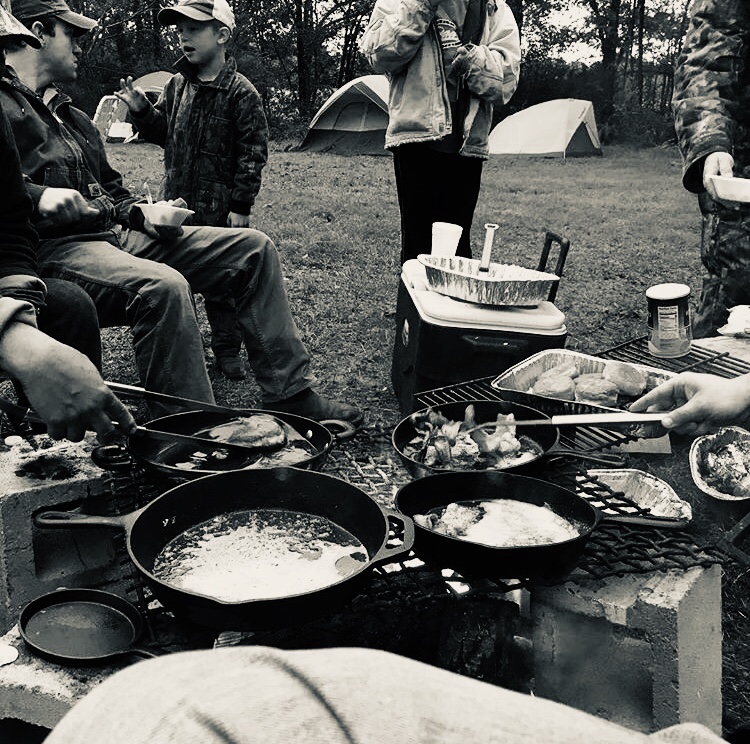
Last year my church organized a men’s camping trip. We had two fires, one to play in and one to cook in. It drizzled rain on us all night, but the little boys that went hardly seemed to notice. I still enjoy playing in the fire, and you better believe that I still enjoy eating around the fire, but as an adult, what I like most about camping is the comradery. There is something significant about the gathering together of men for the sole purpose of fellowship.

2018 Men & Boys Camping

“We’re going camping on November 1st Wesley.” I told Wesley a week ago.

“Do I need to start packing?” He replied.

Sports Page

I’ve always thought it was a strange to ask the losing coach what happened after an upset.

When I was growing up, the comics section was sometimes located in the Sports Page of the Birmingham News. Which created a bit of tension as the funnies were the most valuable part of the whole paper in our household: everyone read the comics. Added to their desirability was the fact that the crossword puzzle was attached to the comics; and Mom and Dad loved to work “The puzzle”, as Dad called it. It was a nice activity to exercise mental prowess and created a welcome diversion from a busy day.

The Sports section was only read by Dad and Zach. From time to time there would be something interesting in the Sports Page. Like when Perry Hodge shot a thirteen foot alligator not far from where we used to go fishing. Or the time an eleven year old boy killed a wild hog that weighed over half a ton and had five inch tusks. He shot it with a pistol. That kind of stuff is interesting, but the rest of the sports page I found pretty boring.

A friend recently sent me a job posting for a newspaper publisher. Not for the Birmingham News, but a smaller paper. I guess he thinks since I’ve been writing for a few years that I’m qualified to be a newspaper publisher. Do you ever wish that you believed in yourself as much as your friends do? Not that I hate my job, but I am for hire. All the happiness in the World can’t buy you money.

So I’ve been entertaining the thought of being a newspaper publisher. It must be something in my romantic nature to rally for dying causes like film photography, and print newspapers: and I like to day dream. The first thing I thought about was what would I do with the Sports Page? I mean, there has got to be a way to make it more interesting. If nothing else, it would confuse the tar out of a few old men who look forward to reading a football article every weekend.

Something fresh that I’m certain would get people’s attention would be to publish the half time marching band set from the lowest ranked football team in the wrong division. That article would need to be on the front of the sports page. I’d also like to get some post game analysis from some of the inebriated fans as they were leaving the stadium after their team lost. I’ve always thought it was a strange to ask the losing coach what happened after an upset. What kind of journalism is that? Did they not watch the game?

Covering some of the more odd ball sports out there might be fun. Cycling, fencing, chess, maybe thumb wrestling. Someone once told my brother, “I never knew that eating was a spectator sport until I met you.”

Let’s face it, most people in Alabama don’t even really like football; they just like Auburn or Alabama. Furthermore, I wouldn’t quite classify the attitude toward football in Alabama as a sport. The closest definition of sport offered by Webster that could apply to football is: a source of diversion. You can hardly call year round coverage of a seasonal activity as a diversion.

I’ve often made sport of the football situation in Alabama by referring to it as the State Religion. While I find it humoring, there are many who may wince at this because it hits close to home. During football season, many will not make it Sunday because their god was defeated on Saturday.

So if I ran the sports page, I would do my best to offer a genuine source of diversion. It’s safe to say that at this point in my life I can name more Grand Sumo wrestlers that I can football athletes, whether college or professional. What if the sports page covered Sumo Wrestling? Grand Sumo is a year round sport; but then again, it is also quite literally a religious ceremony. The only difference is that the Sumo Wrestlers don’t hide this fact.

There are something things in this life that I know I will never understand. Maybe the comics and crossword puzzle should always be in the Sports Page.

The Southern Simile

Do you have a favorite Southern saying?

You could hardly call me a well traveled man. I have been to Washington D.C. though, and that’s got to count for something. In the course of my limited travels I have taken note that Southerners, especially those who have traveled less than even me, are unique communicators. They have ways of describing things that are marvelously effective. In short, Southerners are masters of simile. 

For instance, “Heavy as a widow’s heart”. Instead of giving an exact measurement, you get an idea of something with an unfathomable weight that also speaks to your emotions. Most of the Southern story tellers I know have enough of these pithy descriptions to sink a ship. It’s usually this aspect of their tales that draw the greatest reaction from a listener. I’ve done my best to curate a short list of my favorite similes to help those who might want to exercise the poetic nature of language.

-Ugly as pootin’ in church. It doesn’t get much uglier than that.

-Mean as a snake.

Mean as a striped lizard. Be sure to pronounce striped with two syllables.

-Broke as a convict.

-High as a cat’s tail.

-Nervous as a cat in a room full of rockers.

-Colder than a mother-in-law’s love. To be fair, my Mother-in-law is great.

-Cold as a well rope.

-Hot as blue blazes.

-Crooked as a dog’s leg.

-Naked as a jay bird.

Strong as half an acre of garlic.

Tough as woodpecker lips.

-Goofy as an eight day clock.

Crazy as an outhouse rat.

-Poor as Job’s turkey.

-Wild as a team of goats. This is something that you say about children.

-Screaming like a coon hunter.

Slow as molasses.

-Rough as a cob. Takes on a new meaning given the fact that corn cobs were once used as toilet paper.

Hang in there like a hair in a biscuit. 

-Dark as a sack of black cats. 

Pretty as a pair of new shoes.

This is by no means an exhaustive list of similes, they sometimes only come to me when I need them. I’m sure some are coming to you right now and I’d like to hear them.

Thank you for reading. If it made you laugh, or cry, or remember someone that you love please share this with a friend. -Zane Wells

Support

Your patronage is greatly appreciated.

$5.00

Sorghum Syrup

My brother has asked me to write about the time we made sorghum syrup.

“I wasn’t there.” I told him.

“Yes you were,” He said, a little hurt.

“I know that I wasn’t there Zach.”

“You were too! You helped me load the cane in the mill. That mule almost kicked you in the head. We drank the juice straight from the tap.”

“That was you and someone else.”

“You was there Zane! We went with Pop. Twice!”

I wasn’t there, but I don’t think that discredits me from being able to take you there. After all, Mark wasn’t there and we count his book as Gospel. This is not a work of fiction, although I was not a firsthand witness. Either that or it was such a bad experience that I’ve suppressed it in my memory.

Most of the time when Pop picked us boys up we were going to work. There were a few occasions where Pop picked us up for an event that maybe he found entertaining, like a parade, or making syrup. No matter what mask of entertainment these activities donned, Zach and I had been around enough to see through the thin disguise and identify work. Alas, we hadn’t much say in the matter. So when Pop picked us up to make Sorghum Syrup, we were not under the illusion that we were going to merely observe the process of making syrup. We were going to be very much involved in that process.

Sorghum is a naturally growing plant in the South. If you cultivate enough of it, you can make sorghum syrup. I think it yields about three gallons to the acre. Sorghum syrup is a very thick and dark syrup with an acquired taste. There is a process for getting the syrup from the plants. First you need to gather the plants, or cane. Then you put the whole cane into a mill, which presses out the juice. You cook the juice which gives you syrup. As long as the syrup doesn’t burn, you can mix it with equal parts butter and put it on your biscuits and it’s delicious. Well I think it’s delicious, but I also eat Lengua and Cabeza at the Taco Truck. Zach thought it tasted like burnt motor oil.

The process sounds pretty straightforward, until you find out that you have to manually load the cane, or even worse be the mill engine. Fortunately, someone had already gathered the stalks into a trailer. All we had to do was feed it to the mill. Do you remember in Sunday School when you learned about the blinded Samson grinding at the mill? That’s what Zach had to do. At first there was a mule hitched to the mill walking in circles, but it almost kicked Zach’s brains out while he was feeding cane to the mill. In the end Zach ended up walking in circles to power the mill like a medieval serf. They did let him drink some of the pure sweet juice that was running out of a tap on the side of the mill.

This juice flowed through an open channel over a heated metal plate a few yards long. By the time it made it to the end of the line it was sufficiently cooked enough to be canned. They used what looked like old coffee cans to package the syrup. I’m sure it was great fun to Pop and all the old men that were sitting around at the end of the line talking and laughing while Zach worked like a borrowed mule. At the end of the day Zach was exhausted and grimy with sweat and dust after doing the work of a mule. As a token of their gratitude, the old men in charge gave him a can of syrup. I think I ate most of that syrup, but I know that I wasn’t there.

Film Photography

Do you remember taking photographs on film?

I love yard sales. Previously loved merchandise. Everything you never knew you couldn’t live without can be found at a yard sale. Part of the fun of a yard sale is digging through the junk to find the treasure. Sometimes it’s only digging through junk. Even when you do find treasure, it sometimes only seems like treasure because the junk makes it look better. This is how I got back into film photography.

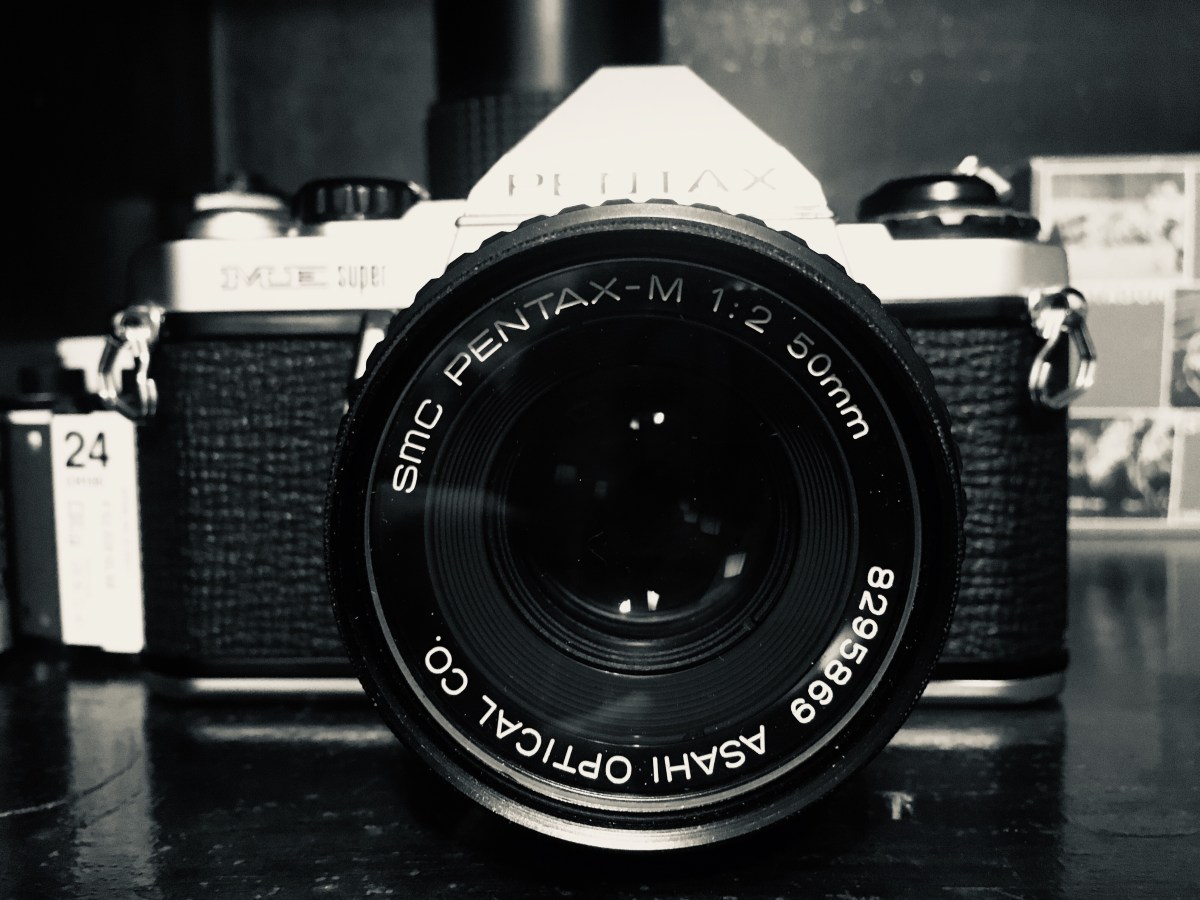
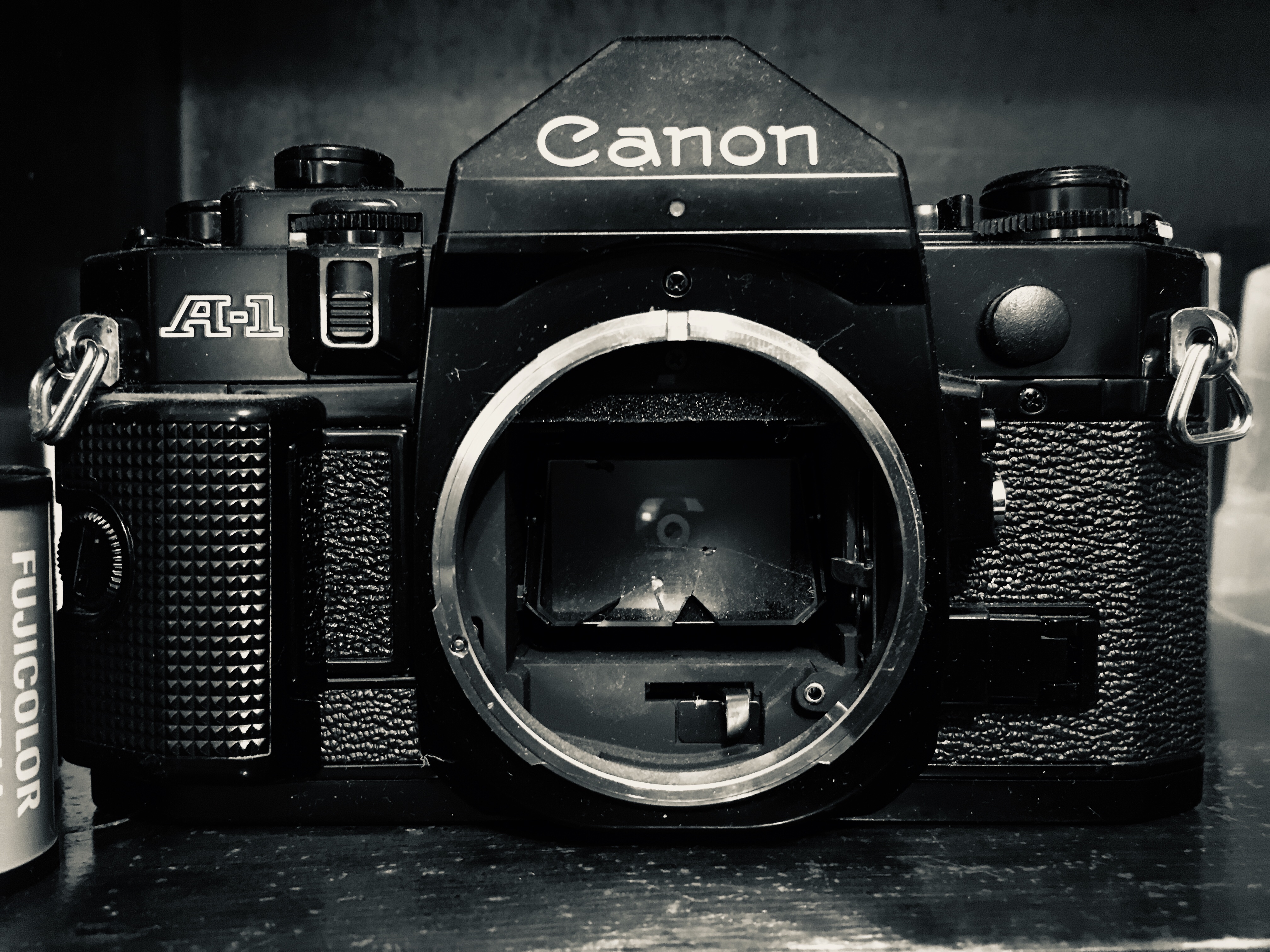
I have a recurring dream that I find a cache of treasure (usually guitars) for sale dirt cheap at some yard sale or thrift store. From time to time it comes true. Like the time I found a bunch of pocket knives at an estate sale. Today I’m thinking about the time I stumbled upon the motherlode of film camera equipment at the church yard sale. The yard sale itself had a half acre of merchandise spilling off of tables and onto tarps. There was an entire table full of lenses, filters, flashes, and bulbs. On the edge of the table was whicker basket full of film cameras. My mind went back to photography class when I spotted a pristine Canon A-1 Camera with a 50mm lens. I picked it up and instinctively focused the lens on one of the yard sale characters walking around. I advanced the film lever and clicked the shutter release button. There was the unmistakable whir of a shutter quickly opening and closing. A sound that even kids born in the 21st century will recognize from their iPhone camera.

I was hooked. Camera in hand, I walked over to Sis. Tina Updike, who was running the cash register that day. “How much for the camera Sis. Tina?” I asked. She frowned at me like she’d never seen a camera before she asked, “Is $10 too much?” I quickly paid for the camera before I had a chance to talk myself out of taking up a new hobby. I also went and scooped a couple of lenses, another SLR camera, and an enlarger so I could develop my own film.

As I fiddled with the camera and did a little bit of research to refresh my new found venture in to film photography, I began to think abstractly how film photography is more like life than the convenient digital photography that has cemented it’s place in our culture over the past twenty or so years. There was a time when cameras were investments, now they are just features on our phones. Camera phones have made us all photographers.

Think about when you were a kid. Unless you don’t remember having to take pictures with a camera, take your undeveloped film to Wal-Mart, shop around for an hour until you could finally pick up an envelope of actual pictures. Not only did you have to purchase film, but you had to pay for the pictures before you could decide that you were a terrible photographer. You kept the pictures anyway, and couldn’t wait to show them to your friends. The next time you had company, you’d pass around your pictures and you’d all laugh at the ones that didn’t come out like you wanted. The few pictures that came out great got an elevated frame or refrigerator status.

The first roll of film that I shot with my Canon A-1 was interesting. There were 24 frames. It made me stop and think before I snapped the shutter. I had to manually focus each picture. I had to wait a couple of weeks before I could see the fruit of my labor. Long enough to almost forget what I’d shot. Opening that first envelope of pictures was quite emotional. I sat down and looked through them with my wife. Like any roll of film, there were some duds. An image with uninteresting subject material, a poorly focused shot, or improper exposure. Even so, there were few really good pictures that I framed.

A photograph is frozen moment in time. Henri Cartier-Bresson spoke of the decisive moment, or the perfect moment to freeze in time. You can’t retake the same picture, because time will move forward. You’ll stop and refocus, changing the composition. Life is much more like a roll of film with a set amount of frames than a digital phone camera where we can take endless pictures in order to capture an image of how we think we should look. It’s a sobering thought, time.

Mostly From Memory is me sharing with you my life’s roll of film. Sure, I get to edit the pictures a little bit to make the subject material shine, but I can’t go back and take more pictures. Neither can you. Each season in our life is a frame of time on a limited roll. I wish that we could simply “delete” some pictures in life because of uninteresting or embarrassing subject material. Or a poorly focused shot. Or improper exposure.

I have a strong desire to make each season in my life count.

I can’t remember if I was thinking along these lines as I loaded the second roll of film into my now beloved Canon A-1, but I did know that I hoped to make every shot count. I think I took a few pictures of my kids, who wouldn’t be still to for anything in the world. The next day I took my camera to work so I could take pictures of downtown Winchester on my lunch break. There was one shot that I planned on taking. Every day I looked out from the fourth floor of the parking garage across the alley to the fire escape of the George Washington Hotel. The metal staircase against the backdrop of brick formed a perfect Z.

Z for Zane. I focused my camera on the target, but to get the composition just right required me to stand on the concrete barrier a foot from off of ground and lean against the railing with my knees. I took my time focusing and double checked my exposure before I firmly pressed the shutter release. Satisfied that I had not wasted a frame of film, I stepped back from my perch into reality. I was a hair higher than I expected and when my foot didn’t reach solid ground I grabbed for the rail, which was only barely above my knee. I panicked. In my desperation to regain my balance, my prized camera slipped from my hand. I watched it tumble through the air from four stories up. It fell for a long time, almost in slow motion, getting smaller and smaller until it smashed into the concrete and burst into pieces that fled the impact. I stared at the wreckage for quite a while before I realized that I could never take another picture with that camera. Then I walked down the stairs and picked up the pieces.

My busted Canon A-1. A testament to fragility of life.

The Liar’s Bench

Does your local gas station have a bench out front?

Back when I was in the hay and fence building business with Pop, we would often stop for fuel and refreshments at Watson’s Grocery in Vandiver. There were a couple of good reasons for that. First, the base of operations, or “Barn”, was located half a mile from the store. Second, and perhaps more important, Watson’s Grocery was the only store in town.

We often frequented the store at the crack of dawn when working men filled trucks with diesel and filled cups with black coffee, and while old retired men sat on a bench outside to fill everyone’s ears with their good natured banter. My Dad told me that was called the Liar’s Bench. He said it in an official way, as if it were an elected office.

Anyone could sit on the bench, but not everyone could operate from the office of the bench. Similar to how having your picture taken sitting in your congressman’s big leather desk chair does not give you authority to lower taxes. In order to fill the office of Liar’s Bench, and not merely occupy a seat in front of a gas station, I believe that there were a set of unwritten requirements. It seemed like you needed to be an old man. You had more credibility (if indeed there was any credibility on the Liar’s Bench) if you were retired. It also didn’t hurt to have a nickname, like Jitter, or Buddy. If you couldn’t swing a nickname, an informal prefix like “Big” would do.

You also had duties, you couldn’t just sit and not talk. You had to be willing to engage every person you saw come to the store with a chiding remark about getting a late start or something like that, but not in a mean manner. You had to have a laugh rate of at least 90%. If the customers were clearly out of towners, it was ok to just nod your head at them. When people came out of the store you had to engage them again, this time with a heartfelt inquiry about their family, like “How’s ye mom’n’em?” This is when you found out who was in the hospital, who got fired, who got arrested, who had a heart attack and important things like that.

Above all, you had to be an entertaining talker to occupy a place on the bench. Some of the best hunting and fishing lies were told there along with ancient jokes. Every once in a while you meet people that can read the phone book in an entertaining way. Such were the men of the bench. As Jerry Clower said, “They didn’t tell funny stories, they told stories funny.” I found myself grinning and chuckling just overhearing these men talk.

I think they became great talkers because they didn’t sit on the bench to seek solitude, they sat on the bench because they wanted to talk to someone. Perhaps it was loneliness that got those old men up at the crack of dawn to sit in front of a convenience store and stare like puppies at the work trucks pulling in to fill up. They’d brag about being retired when they saw the weary looks of the working men on Mondays, but I think there was something in them that wished they could pile in the truck and go to work. Just like there was something in those working men that wished that could sit on the bench and waste the day away.

These worlds met briefly each morning and communed together at the Liar’s Bench. It was the Roman Forum of the community. A place where the local news and gossip were disseminated. I strongly doubt there were many original ideas, or great breakthroughs in ingenuity ever developed on the bench. But you might get a different answer if you drive out to Vandiver and ask one of the men who currently hold down a seat on the Liar’s Bench.

Support

$5.00

Spring Water

On the winding road to Nonna and Pop’s house, just after you crossed the railroad tracks, there is an iron pipe that sticks out from beneath the parking lot of an ancient store and gushes crystal clear spring water. Dad would stop there occasionally when we were rambling and we’d drink with cupped hands out of that rusty cast iron pipe. The water was always freezing cold, and on a hot day there was nothing that could compare in taste.

HR Justice Store. The spring is on the opposite side.

I remember going to that store, the HR Justice Store, with my Dan-Dan, but for most of my life the store has set empty. A memorial of time past. I do remember that the store had hardwood floor, and a there was an old man behind a counter who talked with my grandfather. I was too young to pay attention to what kind of merchandise the store stocked, I only remember that they carried Grapico. I think it was once a genuine general store.

Until today, I’ve never really thought about where that water came from, I just new that it was good to drink. Long after the store had shut down, folks would still go there to fill up old milk jugs with the refreshing water flowing out of the pipe. It seems strange now to think of doing that, especially in a world where many people only ever drink water out of a plastic bottle. If you close your eyes and think hard, you can remember a time when buying bottled water at the grocery store seemed ridiculous. And maybe it still is, but we’ve just gotten used to it. It makes me wonder what else we’ve gotten used to.

Mr. McGraw

Do you remember an influential teacher? What were they like? How did they influence you?

In my Senior year of High School I stayed in my Chemistry class long enough to realize that it was going to require more math skills than I cared to exercise, so I asked the guidance counselor to place me in a different science class. I ended up in Zoology, which was decidedly less academically strenuous. Furthermore, it was on the middle school side of the school. Vincent Middle/High School is in one building with two wings separated by a courtyard, which may not have made the class easier but it seemed like it did. We also had a new teacher, a recent college graduate. This was his first teaching job, and we were his only Senior class, the rest were seventh grade science class. I guess the administration just wanted to feed him to the lions. He had a rough go with those seventh graders, and we watched him grow more frazzled by the week. He only lasted about three weeks before he walked face first into the edge of partially opened door, which broke his glasses and cut his face so severely that he had to go immediately to the hospital and I never saw him again. The principal, Mr. Minnick, came in and finished the rest of the class teaching us about vernal equinox and summer solstice, and the seasons. Which I guess could be tied somehow remotely to zoology. Even so, he did a really good job and it was eye opening for a few of my classmates who had missed or forgotten our science teacher, Mr. Byrne, a former NASA employee, give a far superior explanation when we were in the seventh grade.

We went through a slew of substitute teachers. There was one particular guy that was very rude and liked to embarrass students in front of the class. I hope he got a job somewhere that didn’t have good air conditioning. Mr. Minnick, our principle, sat in a few more times because there must of been a shortage of substitute teachers.

Then one day we had substitute teacher that I recognized as a frequent shopper at Smith and Son’s Grocery where I had been gainfully employed the summer before, and as one of my Dad’s turnip green customers. He drove a mint green Cadillac and had gold rimmed glasses. This was Mr. McGraw, one of the first graduates of the newly integrated Vincent High School in early 70’s. He had come over from the segregated black school to join the football team with Harold Garrett, who had the misfortune of teaching my 8th grade sex education class. Anyway, apparently they had been a dynamic duo of quarterback and receiver, or at least been good enough for me to read about it in the newspaper thirty years later, and for the school to name the football stadium for Mr. Garrett.

That first day Mr. McGraw introduced himself as our permanent substitute for the rest of the year, informing us that our original rookie teacher had quit. We learned that Mr. McGraw was originally from Vincent, but didn’t make any boasts about football as I recall, and that he had recently retired from teaching in Ohio and moved back home to be with his mother.

Mr. McGraw was not in the least intimidated by the unruly seventh graders, having spent the past thirty years teaching High School in Toledo, Ohio. I believe that he also understood that for the most part, our senior Zoology class did not consist of overachievers and that we did not have very high expectations of him. Or rather, he didn’t have high expectations of us. 

I realized this after we spent a week studying ungulates and he wheeled in the TV from the library and we watched, “Mysteries of the Deep” a documentary about ocean life. We watched that film about five times that year. No one complained, we were all just ready to graduate.

The only lesson germane to Zoology that still stands out vividly from that class is when we learned about marsupials. “When I was kid, we caught a possum and dipped it in kerosene. Then set it on fire.” He offered this information in a matter of fact tone as a side note while he was teaching. It kind of took the class off guard. He followed it up by saying, “It took off through the field running.” He chuckled as his memory took him back to being a kid. It was not a chuckle of sadistic delight. It was a older man reflecting back on his childhood and chuckling at poor decisions. I don’t blame him though, there wasn’t much more to do in the rural Alabama in which I had grown up. 

We probably learned more about life and being an adult from Mr. McGraw than we did about Zoology. He was no nonsense, without being rude. He lacked that thin sheen of professionalism that greases many transactions in the corporate world. He was the same person in the classroom that he in the grocery store. That was probably more valuable than anything we could have learned in a cop out course. 

It’s often amazing how strange events can bring you into proximity to people that make an impression on you. After all these years I can still remember minute details about Mr. McGraw. The gold ring, and gold chain around his neck. The torn rotator cuff that was giving him trouble. The inflexion of his voice. How he pronounced certain words. But I’ve forgotten our original teacher’s name.


Support

Your patronage is greatly appreciated.

$5.00