Thanksgiving

Thanksgiving is probably my favorite holiday. It’s just like Christmas, but you don’t have to get anyone a gift. I don’t really need any help getting sentimental, but Thanksgiving seems to draw it out of me. I am genuinely thankful for all that God has done for me, and I think it’s proper to have a holiday set aside to be grateful.

Every good gift and every gift is from above, and cometh down from the Father of lights, with whom is no variableness, neither shadow of turning. James 1:17

Though it is my favorite holiday, I’m not attached to any Thanksgiving traditions. Perhaps in part because my grandfather Tinker Reynolds died on Thanksgiving day in 1989. He had suffered a heart attack earlier and it affected him so deeply that he asked the Lord to just take him the next time rather than put him through another heart attack. After he died, we never developed a Thanksgiving tradition that stuck as a family; it was different nearly every year. This just adds to the charm for me.

The first year I was away at college, a friend invited me across the Mississippi River to spend Thanksgiving with his family in Illinois. The extended family came over to eat and other than actual home made cranberry sauce not from a can, stuffing that was made from croutons instead of cornbread, and the midwestern accents, it reminded me of being back at home. I did turn out to be a big fan of whip cream on the pumpkin pie, I don’t know why we never thought of that. I was thankful to get to spend the holiday with family, even if it wasn’t my family.

I had to report to work the next morning at my retail job, so a different friend and I rode back to the college dorm on Thanksgiving night. The interstate was almost like a parking lot, there were so few cars. The campus was nearly deserted. I think there were only a couple of Canadians camped out in their dorms enjoying the week off. The abandoned college campus called to our adventurous nature and we forcefully explored one of the older buildings after a friend cut his hand on a broken window. I’m not sure how the statute of limitations works on all that, but I think the Lord has forgiven me.

I skipped Thanksgiving a few years ago to move into the first house I bought. But I haven’t missed a Thanksgiving with Zach and Lindsay since our Mom died. Our kids think that this has always been a tradition. They don’t know that when Lindsay asks me to taste the dressing we are both secretly comparing it to Nonna’s. They don’t know that when we consciously add the extra butter to melt on top of the mashed potatoes we are doing it because that’s what Mom did. In short, our kids don’t know that we don’t really know what we are doing. They just know that they are with their cousins.
One day I’ll be a proper old man with a pocket full of peppermints.

This year my sister introduced us to a brand new baby boy. He doesn’t even know that we are celebrating Thanksgiving as we pass him around and spoil him. Other than his birthday, this is his first holiday. He will probably always think of me as an old man. This will lend me credibility as I help establish Thanksgiving traditions for him. We may teach him how to carve a turkey one day. But maybe he’ll just figure it out by watching us. That’s how we learned how to do everything at Thanksgiving.

Compliments

Are you better at giving or receiving compliments?

I imagine that most people like to have nice things said about them. Especially the Words of Affirmation people. I never remember exactly what my love language is because I never finished reading that book. There wasn’t enough plot for me. However, I have always enjoyed complimenting people. Although my sister-in-law, sister, and even my wife sometimes tell me that I am not very good at it. They say things like, I never know if you are being nice or making fun of me.

Compliments are like bubble gum, its ok to chew on them for a while, just don’t swallow them.

For instance a generic compliment to one of them might sound something like this, “I like that dress.” That is boring, and easily forgotten. To give a good compliment you have to imagine that your 3rd grade teacher is grading you on your effort. “I like that dress” is at best average. It lacks creativity and inspiration. Now try something like, “That dress reminds me of some curtains I saw at a museum exhibit about Japanese textiles.” See how that is more memorable? Some thought went into that. But even my best efforts get responses like Zane, no woman wants to hear that her clothes look like curtains.

Death and life are in the power of the tongue: and they that love it shall eat the fruit thereof.

Proverbs 18:21

Maybe I am not very good at giving compliments but I really do try because I believe in the power of words. I believe that words can be a source of inspiration. I believe that words can set a person’s mind in the right direction. This is why I feel compelled to write. But maintaining a blog in the era of the reel to sometimes feels like a lost cause. I must admit that I occasionally wonder if my energy is being wasted. And it is difficult to find inspiration to write when you are questioning whether what you are doing matters.

And then I’ll meet a real live person who has read my blog and they will compliment me on my writing and it inspires me so much that I stay up until 2:45am writing run on sentences because I am drawing inspiration from the power of their words.

Let me back up a little bit. I know that people read my blog because the website tells me these kinds of things. But it uses numbers and I have always thought that numbers were so impersonal. So meeting a reader in person gives me a clearer context for the numbers.

Whenever someone approaches me to tell me that they read my blog I feel incredibly vulnerable. I usually write in isolation so to me it feels like I am merely putting thoughts into words as a mental exercise. Some of the essays that have reached the most people were really not intended for entertainment but were my way of grieving. Many of the things I have written are simply thoughts that will not leave me alone and I only get peace when I release them to the outside world. There is something cathartic about reaching into the infinite and grabbing hold of something and wrestling it into the finite so that others can view it.

I also feel that since no one saw me write it that no one knows that I wrote it. I take refuge in this assumed anonymity. Furthermore, because I feel like that what I write already exists in a perfect form in the infinite, I can only take a small amount of responsibility for making it finite. These personal psychological constructs give me a false sense that no one really reads anything I write.

Whenever you read someones work you get an insight into their mind. In a sense you become familiar with the deepest part of that person. As the reader you also enjoy a sense of real anonymity in relation to the author. This is why I always feel vulnerable when I meet with someone who is a fan of my work because I feel like they can read my mind, but I cannot read theirs. But I can see it in their eyes if they really have read. Maybe they cried with me. Maybe they have the same questions that I do. Maybe they too used to go swimming in the creek with the town drunk when they were kids.

It happened to me last night as I was walking out of the conference center here in Pigeon Forge, TN. They took me by surprise.

“Brother Wells I read your blog and I love your style of writing.”

Whenever something like this happens I just say “Thank you!” But I try to say it in italics because I really mean it and I am otherwise speechless. I always think of something nice to say or questions that I should have asked hours later.

Then they said, “I feel like I know you.” This may be one of the highest compliments I have received on my writing. Complimenting someone involves a going out of yourself in much the same way that writing does. Saying something has the power of putting your thoughts into words and transferring them into someone else’s mind. And you may never know how much your words may help someone.

The Art of Listening

Whether or not you are a musician, how good of a listener are you?

I have worked with a lot of musicians over the years. Most of them have been church musicians that learned to play by ear. This does not always mean that they cannot read sheet music, or lack a strong understanding of music theory. It usually simply means that they do not sight read traditional musical notation in real time. I only know a few people that can sight read sheet music. And they are fantastic musicians. The rest of us have to study traditional sheet music in order to play it.

There is no shame in being a musician who plays by ear. There are even a lot of advantages. For instance when someone has a good enough ear they can listen to a song once and be able to play it. This is also our greatest handicap; many times we need to have heard a song before we can play it. The danger comes when we think that we are good enough to stop listening.

Many master musicians have spent years practicing ear training. Remember when you were learning your multiplication tables or when you were first introduced to Algebra? You may have struggled to even understand the concepts and the thought of being able to do these complicated formulas in your head seemed out of reach. But after practice you can probably now do simple math and even Algebra mentally and it feels natural. This is also true for music. For most ordinary humans it takes practice to be able to identify intervals, find your vocal part, or pick out a melody or chord progression. But ear training immerses you into the language of music and after a while things start to make perfect sense.

“Listen!”

This is what my Dad would say from behind a book whenever one of us kids was making too much noise. We would quieten down and strain as if we could hear. Hear what? I never know exactly what we were listening for. Was he about to say something? If we tried hard enough could we hear the book he was reading playing out in his head? It took me a long time to realize that he was simply telling us to be quiet. I catch myself telling my kids the same thing these days.

Whether or not you are a musician, how good of a listener are you? Listening is so much more than a musical skill. At the very least listening is half of communication. Listening is a vital ingredient in healthy relationships. It becomes even more important when we understand that faith comes by hearing.

So then faith cometh by hearing, and hearing by the word of God.

Romans 10:17

Whenever I take those learning style tests I always score high on a preference for auditory learning. I believe this is accurate. I really enjoy listening to audiobooks. I can recall things better when I give my undivided attention to auditory information. I think that is what makes someone a good listener, the ability to give their undivided attention.

How do you listen to music? Do you like it in the background or full blast?

When I was a teenager listening to music was a ritual. Digital music off of the internet via Napster and Limewire was in full swing, but I always felt the computer speakers sounded weak. I preferred to buy my music in compact disc form from the music section at Wal-Mart. I would bring the unopened CD home, carefully peel the cellophane and stickers off, and insert the disc into my three CD player stereo. I would listen to the whole album straight through in one sitting without any repeats or skips. Doing nothing but listening with my undivided attention. I still think this is the best way to listen to music.

I have a hard time listening to background music. I would rather listen to background silence than barely audible mosquito music. I am drawn to focus on the music and when it is too quiet any disruption seems amplified.

All of this has me thinking about things that inhibit being a good listener.

I tend to get distracted by noise. I have a hard time going to restaurants if the music is too loud, or if there are a bunch of TVs playing different programs. It is very difficult for me to have a conversation while there is music playing. The worst thing is when there are two songs playing at one time. I sometimes wonder if that makes me a bad listener. Perhaps it means I am susceptible to distractions. To some extent I do not have control over external noise.

I can control internal noise. Have you ever been listening to someone talk only to realize that you have no idea what they are talking about because you were thinking about something else? We call this spacing out, or zoning out. If used properly, the ability tune everything out and focus your attention on your thoughts is a valuable skill. But an inability to control your thoughts can also make you a poor listener. It becomes a matter of will. Will you listen to what this person is saying or will you let your mind wonder?

Your attitude is largely controlled by your will and is another internal factor that can an inhibit and an enhance listening. Imagine the worst political figure that you can. If you are like me, you will have a hard time listening to that person say anything. There is an internal block that keeps us from being open to people that we do not trust. Have you ever noticed in political debates that people are always interrupting one another? There is not a lot of listening going on. What we have here is a failure to communicate. There are many deep issues in this example, but a lot hinges on being unwilling to listen.

As musicians, if we really claim to play by ear, then we should understand the importance of listening. We must constantly practice active listening. We must listen to the song to learn what to play. We must listen to the music director for instruction. We must listen to the other musicians in order to play together and not simply at the same time, like two political candidates arguing over one another. This also applies to relationships.

He that hath an ear, let him hear what the Spirit saith unto the churches.

Revelation 2:29;3:6;3:13,22

I read something interesting this week in This Is Your Brain On Music by Daniel Levitin. Pitch, loudness, and sound in general are purely psychological phenomena. All of these perceptions are just how our brain interprets air pressure. You literally cannot hear without an ear. This has really been heavy on my mind.

I hope that we can all be better listeners.

Identity

“Well Uncle Perry, there are some girls in my class and there are some boys in my class. And I’m one of the boys.”

My Dad had a special way of talking to children. He didn’t believe in baby talk. He talked to preschoolers the same way he would talk to the postman, or the President of the United States. You had to be a real imbecile- a word I hear in Perry Wells’ voice- for him to not want to talk to you. In a way I have inherited this characteristic. I guess you could say it is part of my identity.

Dad was really good at it. He was able to have conversations with children and children can say some profound things. Dad asked my cousin Kyle what he learned on the first day of Kindergarten.

“Well Uncle Perry, there are some girls in my class and there are some boys in my class. And I’m one of the boys.”

And we laughed. But Dad said, “That’s good! That’s a real important thing to learn.”

Identity is the fact of being who or what a person or thing is. I have been thinking a lot about identity lately. I believe that it is important to have a strong understanding of who you are. If someone does not not have a strong understanding of the fact of who they are, they become extremely vulnerable to someone else imposing a false identity upon them.

This is a very ancient and evil practice. Hananiah, Mishael, and Azariah were handpicked because They were Children in whom was no blemish, but well favoured, and skilful in all wisdom, and cunning in knowledge, and understanding science, and such as had ability in them to stand in the king’s palace, and whom they might teach the learning and the tongue of the Chaldeans.
‭‭Daniel‬ ‭1‬:‭4‬ ‭KJV‬‬

It is no coincidence that one of the first things that happened was the boys got a new name. The world empires of antiquity, especially The Babylonian and Persian empires, were able to maintain their vast land holdings by allowing the conquered people to have their own local rulers. These Hebrew boys were brought to Babylon to adopt Babylonian customs and culture and possibly become administrative leaders in the empire. This was exactly what happened to Daniel.

The second definition for identity is the characteristics determining who or what a person or thing is. Babylon tried to strategically change the characteristics of these captive boys. I’m not sure if it happened at once or was a process, but Babylon changed their location, diet, name, education, and possibly their sexual identity. We kind of skipped over the eunuch definition in Sunday School, but there is a strong likelihood that these Hebrew boys were made eunuchs. If they were eunuchs it only strengthens the point that Babylon was unsuccessful in shaking off the true identity of Hananiah, Mishael, and Azariah. They refused the king’s food, and most significantly they refused the king’s god. If you have never read their story you can find it in the book of Daniel.

An identity crises is a period of uncertainty or confusion in a person’s life. It seems that exploring your identity is a growing trend these days. I have recognized that there is a powerful force that expects people-especially young people-to question their identity, as well as everything else. And sadly it led to a sea of confusion. And God is not the author of confusion.

But what if you have a strong understanding of who you are, and you do not like you who are? Furthermore you do not like what, we’ll just say Babylon has to offer. I firmly believe that identity can be changed for the better.

Therefore if any man be in Christ, he is a new creature: old things are passed away; behold, all things are become new.
‭‭2 Corinthians‬ ‭5‬:‭17‬ ‭KJV‬‬

Identity is a central theme in the greatest story ever told. Everyone who got a name change in the Bible had a spiritual encounter. Abraham, the Father of the Faithful, received a name change from the Lord. Abram to Abraham. Jacob to Israel. Simon to Peter. Saul to Paul. Zane to Jesus. When you are baptized in Jesus’ Name you take on his name. It is part of becoming a new creature.

For as many of you as have been baptized into Christ have put on Christ.
‭‭Galatians‬ ‭3‬:‭27‬ ‭KJV‬‬

The Valley of the Shadow of Death

It is the waiting room to eternity and time doesn’t always behave properly because it must yield to a higher authority.

One of the most difficult and strangest places to be emotionally is while you are waiting for a loved one to pass on. The 23rd Psalm calls this place the valley of the shadow of death. It is not an easy place to walk through alone. You’ll need a shepherd. Perhaps you have been there. It is when the doctors do not give you any hope. And the hope that God offers doesn’t always make sense. Nothing really makes sense. On one hand you would never wish for someone to die, but on the other hand there is a realization that death is imminent and you don’t want to see someone suffering. It is the waiting room to eternity and time doesn’t always behave properly because it must yield to a higher authority. Day to day schedules no longer take precedent and you begin to wonder if the clock is accurate because you seem to float in time, suspended in the memories with your loved one. One minute you are bawling your eyes out and the next minute you are crying from laughter. You are not sure how you are supposed to feel. And that is ok.

I think you truly enter into this valley when you know that your loved one is no longer aware of your presence. It hurts.

People pop in and out of the waiting room like characters from another universe. They make you feel better. They bring food and memories. They mourn with you.

A good name is better than precious ointment; and the day of death than the day of one’s birth. It is better to go to the house of mourning, than to go to the house of feasting: for that is the end of all men; and the living will lay it to his heart. Sorrow is better than laughter: for by sadness of the countenance the heart is made better. The heart of the wise is in the house of mourning; but the heart of fools is in the house of mirth. Ecclesiastes 7:1-4

As a younger man I found this a difficult passage of scripture to reconcile with my limited understanding and narrow perception of death. And also life. After a little more hands on experience with loss I now find great comfort in the words of The Preacher in Ecclesiastes.

It is good to mourn. Everyone mourns differently. I tend to write.

Morning Person

Are you a morning person or do you drink coffee? What is your routine?

I haven’t always been a morning person. Mom would often have to summon me by my full name to get out of bed for school. I have always been a breakfast person though. Maybe some morning people are born, but I believe that more often something makes you into a morning person.

I think I started being a morning person when I was working at Parks & Recreation and I had to be at the school by 6:30am. I was forced to be awake by the feeling of responsibility of running the before school recreation program, knowing that a couple dozen parents were depending on me to be there. But after a while, I just started enjoying being up that early.

There is something special about being awake before the sun comes up. The air smells and feels different in the morning. The atmosphere isn’t clouded with traffic and it is easier to think.

There is a difference between being a morning person and having to be at work early in the morning. If you have ever worked early in the morning you will understand what I mean. Morning people usually have a routine that happens before they even think about going to work. This baffles non-morning people. A morning person’s routine might consist of running a six miles, working in the garden, or even laundry.

Although there is something therapeutic about a morning routine, what I like most about the mornings is the morning sunlight. The kitchen in the house I grew up in faced due East. I can still see the light pouring through the window onto the kitchen table. That’s where much of the human interaction in our home happened. These days I enjoy seeing the sunlight peak over the horizon as I ride my bike through the backroads around my house.

I could tell you about it. I could even show you pictures. But it is really something that you have to experience for yourself. Maybe it will make you into a morning person.

Marriage

It is significant that Jesus began his ministry at a wedding.

I recently had someone ask me some honest questions about marriage. There were several questions, but this one carried the essence of them all:

“What is in it for me?”

In the current hedonistic, godless culture that Hollywood has been so successful in helping to create, this question does not seem irrational. There are tax benefits in some instances for not being married. The 20th century Feminist movement that challenged gender roles has now ushered in the gender identity crisis which has further convoluted the very idea of marriage. To ask “What is in marriage for me?” today, as selfish as it sounds, is a sincere question; and it needs an answer.

In order to answer this question properly, we have to define what marriage is. Marriage is the God ordained union between one man and one woman. The marriage contract precedes all human government and even the church. You could say that marriage is the only thing that survived the fall of man: a remnant of paradise.

Marriage comes with the great responsibility and commission from God to be fruitful and multiply. It is God’s intent for marriage, and especially the role of women, to sustain human life on Earth.

Marriage is also a metaphor for God’s relationship with the church. The Old Testament book Song of Solomon, or Song of Songs, is dedicated entirely to this purpose. In the New Testament the church is portrayed as the Bride of Christ.

It is significant that Jesus began his ministry at a wedding.

What is in marriage for me also depends on your values. Do you value trust, commitment, and companionship? If these things are more important to you than tax breaks then you are starting to understand marriage. Do you value life? Do you value your children having a stable home, or are you ok with someone else raising your children? Do you value the other person? If you truly value a significant other there is no higher degree of commitment and love than marriage.

The Bible has an interesting term for misplaced value: unnatural affection. People who are inhibited by unnatural affection will not see any value in marriage.

Lastly, we must address the selfish nature of the question, What is in it for me? Marriage is one of the most selfless commitments that someone can take. I would argue that selfishness is the root cause of many marriage failures.

Husbands, love your wives, even as Christ also loved the church, and gave himself for it; That he might sanctify and cleanse it with the washing of water by the word, That he might present it to himself a glorious church, not having spot, or wrinkle, or any such thing; but that it should be holy and without blemish. Ephesians 5:25-27

Marriage requires so much more than many are willing to pay. How expensive is giving yourself?

The same question that was asked by my friend in regard to marriage also applies to The Church. There is only one church, that’s the one that Jesus gave himself for. That church is holy and without blemish. Just like the many contracts that fall short of marriage-open marriages, friends with benefits, partnerships, and such like-there are a myriad of places that try to offer some sort of perverted substitute relationship with God that do not meet the high standard God places for His Church.

My relationship with God and my relationship with my wife are the two most important things in my life. These relationships provide the context for dealing with every other thing in the cosmos. My answer to the question what is in it (marriage) for me? Everything.

On Time

The art of time management is a very grown up thing. It is ultimately what distinguishes us as adults.

I suppose I have the same self awareness as I did in my earliest memories. But lately I’ve been feeling very grown up.

Perhaps it’s is because I have a mortgage now. A death pledge to pay a lot of money plus interest. There was a time when I would roll my eyes at stuffy grown ups who didn’t know how to loosen up and have fun. Now I wonder when silly young people are going to quit wasting time and get serious about life. I think there is a keener awareness of time that comes with age and gives older people the ability to be sharp and direct with words. I haven’t reached that point yet, but I can see it in the distance.

A lot things that adults have to do are not enjoyable, which is why a lot of people are reluctant to become adults. People who do not choose to evade responsibility are grown up. Responsibility often looks like a father working to provide for a family, a mother taking care of a home, a child taking care of a pet or a toy.

I think the main reason that I am feeling so grown up lately is because I am keenly aware that I cannot do everything that I would like simply because of time.

One of the greatest things about being a grown up is being a master of your own time. One could argue that working a job does not make one a master of their own time. I suppose that may be the case for many people, but I tend to look at time as currency that I can trade for resources to support my family.

The art of time management is a very grown up thing. It is ultimately what distinguishes us as adults. Time is the ultimate responsibility. How someone spends their time defines them. If you don’t believe this ask someone who is doing time.

How we treat time perhaps is more telling of our character than how we spend time. One could hardly deny that the irascible, impatient, reckless driver forcing his way through traffic like a Bull of Bashan has a concept of his own time, but a total disregard for the time, and indeed the life, of others. These people are bound by time, not masters of it. Frankly, they are not grown up.

There is chronological time, which is what most of us think about when we think of time. You can measure chronological time with the steady predictable ticking of a clock. We can think of this kind of time horizontally, like a timeline. And there is kairological time, which cannot be measured with a clock and could be thought of vertically. Heaven often operates on kairological time.

Jesus spoke of “The times and the seasons.” Chronos and Kairos. Acts 1:7

Kairological time is manifest when an unpredictable event comes and unapologetically crashes into chronological time. The birth of Jesus Christ, The Crucifixion, The Resurrection, and The Day of Pentecost are the most significant kairological events in the history of mankind. But kairological events are not limited to these. Every time the Word of God is preached there is potential for a kairological moment. Every time someone is filled with the gift of the Holy Ghost is a kairological moment.

The Apostle Paul wrote to Timothy Preach the word; be instant in season, out of season; reprove, rebuke, exhort with all long suffering and doctrine. II Timothy 4:2.

Instant in season and out of season: Kairos and Chronos.

It is simpler to get a handle on chronological time. The whole world operates on chronological time. And how we handle it defines us as humans. But there is much less awareness of kairological time. The entire Cosmos operates on Kairological time. And how we handle it defines us as spiritual beings.

Between Books

There is a certain amount of guilt that comes with giving up on a book.

Sarah can always tell when I start reading a new book that is really good because I’ll stay up past 9:30pm. There is nothing quite like a book that really captivates you. You’ll find yourself thinking about the characters and plot even when you’re not reading. When you finally do finish it there is a bit of sadness because it is over. Then you have to hope that the next book your pick up is as good, but you never know. Sometimes you feel obligated to press on through an uninteresting book. You try to press on, but when a book is boring there is no motivation to read, and instead of staying up to read you close the book and go to sleep. There is a certain amount of guilt that comes with giving up on a book. When you finally make the decision to ditch a bad book you run the risk of going through this whole process again. This is what I call being stuck between books.

I guess now is as good of a time as any to confess that I am a bibliophile. I don’t just love to read, I love books. A book case is the first thing you see when you walk into my home. I love the smell of a century old book. I love the feel and color of old paper with words that were mechanically printed with ink and typeset. My parents bought books not only to read, but to display.

When a book is really good it becomes a part of our family language: an integral part of how we express ourselves.

Being between books demands a decision. We can either reach back for old books that we’ve already read (and there are some books that should be re-read) or we reach forward for the unknown of a new, hoping that we will chance upon a story that will become a part of us. Or we can stop reading.

In a larger sense, we can compare our lives to a series of books. There is romance, love, horror, tragedy, adventure, mystery. There is one exception though, you can’t really re-live any of these books. You cannot start over, but you can start new. And there is still a possibility of getting caught between books.

In life it is sometimes hard to tell when one book ends and another begins, which can make for dangerous transition traps. Thankfully, early on these lines are drawn more clearly for us. We go from Kindergarten to first grade and so on; each school year a new volume in the library of life. Once we graduate we lose the preset beginnings and endings that school provided for us yearly from age five until whenever we stopped our schooling. Because of this, we can all too easily forget the feeling of beginning anew once we become adults, and many people feel the pressure to somehow to make forty year run until retirement with no new fresh starts. In short, it is quite difficult for people to affect a new positive change in their lives-or even recognize a when a change is necessary- without help from an outside force.

As a result people get caught between books in life. Or worse, they continue re-reading a bad book hoping in vain to finish with a different ending, or without a concept of ever finishing. To use Bible language, these people are drifting aimlessly through life “having no hope.”

The basic message of Christianity is repentance. Or making a complete new start with the understanding that the routine that I was in before is no longer an option. It takes a lot of guts to make a new start like that. Jesus Christ said it best:

The law and the prophets were until John: since that time the kingdom of God is preached and every man presseth into it.

Luke 16:16

John came preaching “Repent, for the Kingdom of heaven is at hand.” What an offensive word: Repent. It is still as offensive today as it was then. No one wants to hear that they are doing anything-much less that they are living and thinking-wrong. But the message of Christianity has not changed since the birthday of the church in the book of Acts, and the preaching of the repentance still pricks people in their hearts, or cuts them to their hearts. This kind of preaching demands a decision.

There are many people who see what this kind of change requires and are unwilling to pay that kind of price, and they go away sorrowfully like the rich young ruler.

In fact a lot of “churches” have long ago quit preaching any semblance of conversion, because they also have quit preaching repentance in an effort to be less offensive. These assemblies, or congregations-I’ll not call them churches-offer no hope to people who desperately need a new start.

Therefore if any man be in Christ, he is a new creature: old things are passed away; behold, all things are become new. I Corinthians 5:17

So, what have you been reading?

Dan Theo Wells, 1935-2021

Ology is often translated as the study of. It is from the root word logos, word in Greek. It is more accurately translated as what can be said of.

Theology- that which can be said about God.
Psychology- that which can be said about the mind.

What can be said about Dan Theo Wells?

We must first establish his identity. Who is Dan Theo Wells?

He is a man of many titles: Bub, Slim, Pop. I suppose that some of my cousins could say that they lost Uncle Bub, Uncle Slim, and Uncle Dan and elicit treble condolences from sympathetic friends.

But when the roll was called in the Army only one name was read out, Dan Theo Wells. After a moments hesitation, Slim and Bub both stepped forth.

I knew him as Pop. My paternal grandfather. And really the only grandfather I knew. Tinker Reynolds- or Brant Douglas Reynolds, both one and the same- died when I was only two years old.

Most people knew Pop as Slim. But unless you were one of my cousins from Chicago, it only sounds right if you say it with a Southern accent. For anyone who struggles with a Southern accent, when in doubt make the vowel a diphthong: Slee-um.

Pop was incredibly economic in his elocutionary endeavors. I have ridden from Sterrett to Irondale and back with Pop and said fewer than three sentences.

Throughout my life, Pop was not a church-going man. I used to screw up the courage to invite him to church from time to time.

“Pop, you ought to come to church with us tonight.”

“I know son.” He would sigh.

I remember reading James 1:27 as a teenager and immediately thinking about Pop.

Pure religion and undefiled before God and the Father is this, To visit the fatherless and widows in their affliction, and to keep himself unspotted from the world.
‭‭James‬ ‭1:27‬ ‭KJV‬‬

In part, Pop was a deeply religious man. He always kept a substantial garden. Perhaps it may seem a small thing to many, but he grew it to share. I guess you could say that he visited the widow of Tinker Reynolds in her affliction. Among many others.

Pop was also a man of principle. Pop never allowed alcohol at any of the barbecues he hosted. In his way, he more than once warned his employees in the hay business-Zach and me- about the dangers of alcohol.

“I took one drink when I was young and it tasted like horse ?¡$ś.”

I always thought that sounded pretty dangerous.

I think that because he was a man of principle he had an excellent reputation in his community. Integrity doesn’t require wealth or education, integrity requires character. Pop had character.

Around 2012 I think, Pop had an accident on an old Farm-All tractor. He started the tractor before he was fully seated and the tractor was already in gear. The sudden jerky motion threw him off balance and he fell off but his foot hung on one of the pedals and he was trapped in front of the engaged rear wheel. The tractor drug him a few feet until the barn post stopped the forward motion, but the huge tractor tire continued completely tear off his left quadriceps.

Nonna eventually heard him screaming and she ran out to the barn.

“Turn off the tractor!” He said.

It was the hand of God that Dennis Brasher-I think this is the right name, forgive me if I am wrong- happened to be driving by listening to the police scanner. He instinctively knew that the call was for Pop.

“Slim, I’m sorry this is going to hurt.” He said as he applied pressure to the gruesome wound. He kept his hands on what was left of Pop’s thigh for the whole ambulance ride to Birmingham. it is a testimony to Pop’s toughness that he remained conscious for the entire ordeal.

I honestly thought Pop was going to die then, so I got on an airplane and flew to Alabama from Virginia. But he was made of tougher stuff than I thought and lived another nine years out of spite I believe.

Time would fail me to recount a lifetime of fond memories of Pop. Perhaps the best thing that I can say about Pop, is that he had a good name. Even if few used it and even fewer knew it.

A good name is rather to be chosen than great riches, and loving favour rather than silver and gold.
‭‭Proverbs‬ ‭22:1‬ ‭KJV‬‬

The last time I saw him coherent was October 27th. He and Nonna had soundly whipped COVID-19 much to my surprise and delight, but something had interfered with Pop’s Parkinson’s medicine and he had begun to hallucinate.

One moment he would be talking to me as clear as he was capable and the next moment he would just be talking to himself, or to whoever would listen about something that happened 40 years ago. Then he would be in the present 40 years ago, or perhaps in a dream.

But he knew who I was when I walked in.

“Is that Zane? Set me up.”

“I’m sorry you got to see me like this.” He said referring to the hospital bed.

“I’ve been worried about y’all’s sugar so I brought y’all some peach pies.”

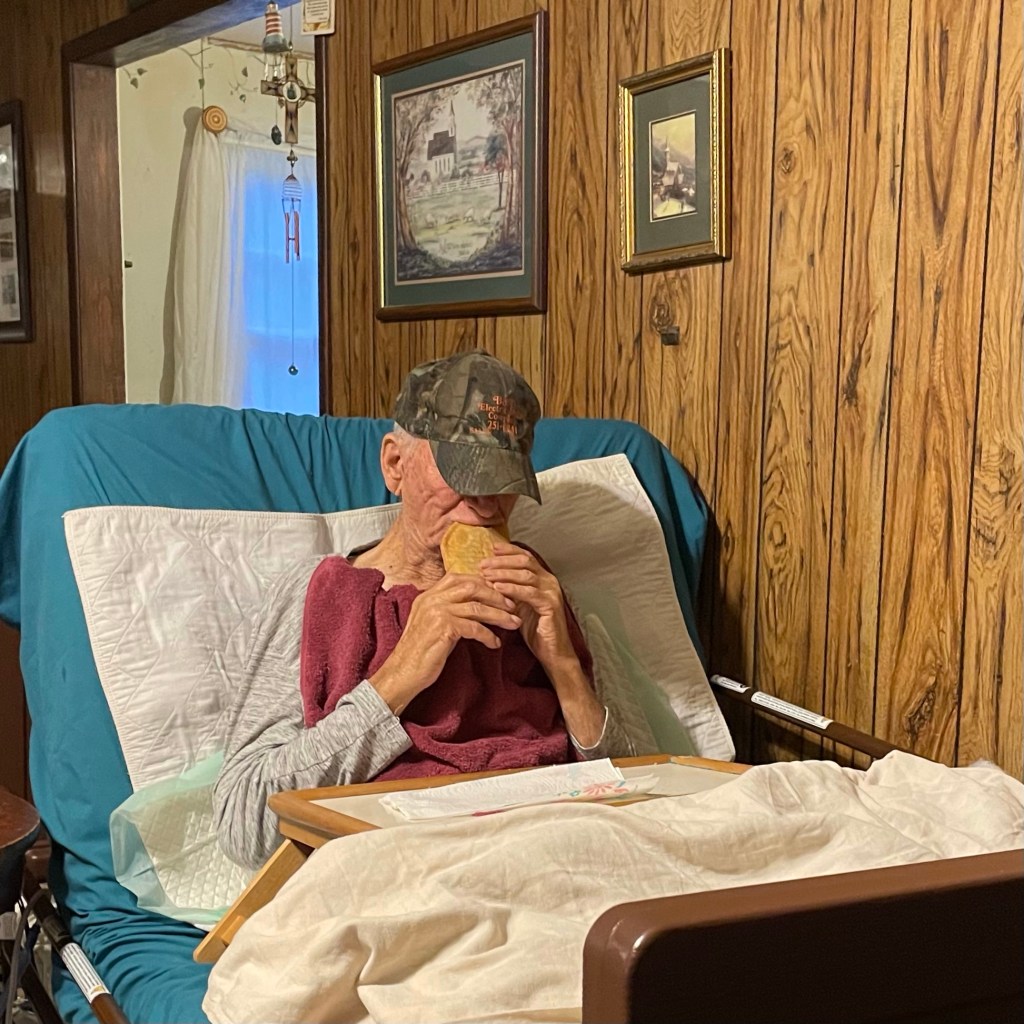
We chatted for a little bit. Before Pop said, “Give me one of them pies.”

“The more I eat it, the better it gets.” He said with a grin

I must confess that this is not how I want to remember Pop. Sure the hat is there and those look like his hands. But I want to remember the Pop who hit a charging cow with a 2×4. And the Pop who lifted me with one hand into his Toyota pickup truck because I was too little to climb in by myself. And the Pop who brought me a cowboy hat one night after his trip to Tennessee. And the Pop who would bring all of us grandkids an Icee.

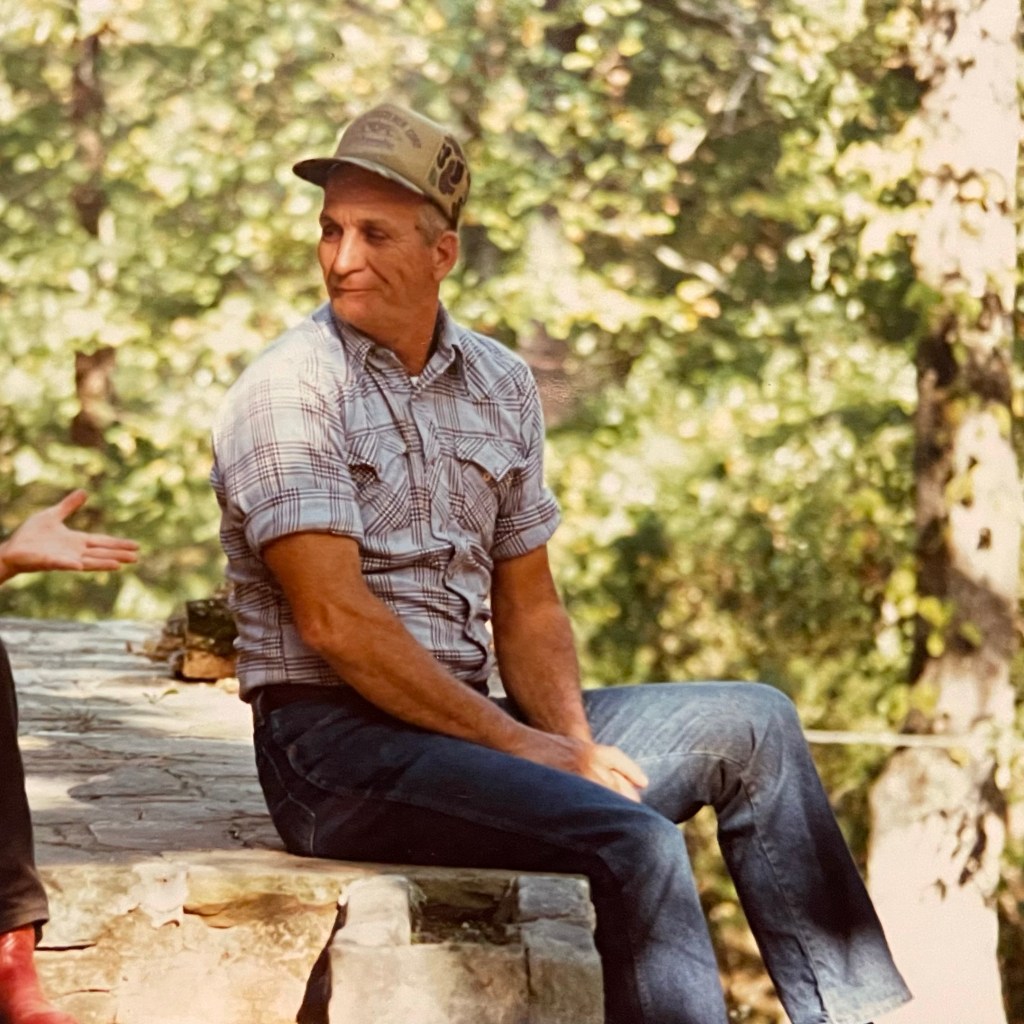
Dan Theo Wells

I want to remember this Pop. And I hope you do too.

I love you Pop.

Dan Theo “Slim” Wells, was born on April 16th 1935 to Daniel Webster Wells and Dovie Dunnaway Wells. He served the United States Army in the 3rd Armored Division from 1958-1960. He married Nola Mae Brasher. They had three children Perry Charles, Melvin Johnny, and Jason Theo.

Mr. Wells began working for Stockham Valves and Fittings shortly after his discharge from the Army. He retired from Stockham in the mid 1990s before the plant closed. During his time at Stockham he helped cast many of the valves for the Alaskan Pipeline.

Dan Theo Wells passed from this life in his home on November 12th, 2021.