Spanish

In 2020 I listened to the audiobook version of Don Quixote by Miguel Cervantes. I chose that book because it was included in my subscription to Audible and I didn’t have to use any of my precious credits. It turned out to be hilarious. I really appreciated how the 400 year old humor still made me laugh out loud today. It really made me think If the book was that funny in English, how funny was it in Spanish? It is because of this literary masterpiece and too many other books to name about the Spanish conquest of Mexico, pre-Columbian America, and Mesoamerican civilization that I decided to download the DuoLingo app and start learning Spanish. My Mom died that summer and I found studying Spanish a welcome distraction. And by Thanksgiving I became determined to make studying Spanish a part of my daily activity. That was over 1,000 days ago.

Some days I feel like I haven’t learned any Spanish at all. I am sure I would be further along if I was forced to speak in Spanish every day instead of doing the simple grammar exercises. I get the same feeling sometimes about guitar. To put things in perspective I flip the guitar over and try to play a few chords left handed and it makes me feel better about how far I have come. I have done this so much over the years that I am starting to get good playing left handed. With Spanish there are a couple of similar motivation reminders: I can understand spoken and written Spanish far better than I can speak it.

The other day I was at our church’s Fall Festival Fellowship standing around the grill with a bilingual brother and two Spanish speakers. We were eating grilled corn on the cob and they were jabbering away in Spanish. I wasn’t really paying attention to what they were saying until one of the Spanish speakers started talking about eating iguanas. It dawned on me that I was comprehending more or their Spanish conversation than I was not. “Iguana con leche de coco…es muy buena.”

La iguana es el pollo de los árboles

The most rewarding thing about learning Spanish has been being able to communicate with people who still only speak Spanish. Even though I still feel pretty vulnerable because I have to take my time forming my thoughts. There is something wonderfully exhilarating about communication.

Studying Spanish has also allowed me to see and hear English in a different perspective. Because of its silent letters, irregular verbs, and borrowed words from other languages, English is a difficult language to learn for a non-native speaker. You probably even know native speakers of English that still do not speak it well. Language, whether native or foreign, is a skill and must be honed. Studying Spanish has made me want to be a better English speaker.

A person’s vocabulary is a reflection of the books they have read.

There are some things in Spanish that just make sense. Like having punctuation at the beginning of a sentence, letters that only have one sound, accent marks that do not get ignored, and I almost hate to say it, adjectives after the noun instead of before.

I am a long way from writing in Spanish as well or as quickly as I can in English. But I still practice on my wife. When I think about writers like Joseph Conrad, who wrote in English, a language foreign to him, I am encouraged that some day I will be able to express myself in Spanish on such a level.

Apostolic Youth Ministry

The Bible does not contain a youth ministry model separate from adults, children, or elders.

Sarah and I drove from Alabama to Virginia this last weekend to attend the funeral of a man who had been a young person while we were leading youth ministry. Being there and seeing the teenagers-now grown people with families-whom we spent nearly every Friday night of our 20s with brought back a flood of memories. I love those people. And I still recognize a familiar connection that is not easily built with people.

In light of eternity, I am reminded that not everything we can involve ourselves with has equal importance. Not all activities or pursuits weigh the same. There are weighty things like righteousness, temperance, and the judgment to come, that make people uncomfortable to talk about. So they pursue, and try to find purpose in the frivolous and trivial. There is a grave danger in binding your life up in superficial things that have no eternal significance. Coming through The Valley of the Shadow of Death has also caused me to reflect on the eternal weight of glory that was being stored up in youth ministry. There are some things that we do that are far more important than other things. I wholeheartedly believe that Youth ministry is one of the important things that I have ever done.

And as he reasoned of righteousness, temperance, and judgment to come, Felix trembled, and answered, Go thy way for this time; when I have a convenient season, I will call for thee. Acts 24:25

In the name of personal development, I have read some superfluous and shallow books on the topic of Youth Ministry.

While there are many books about Youth Ministry, there are not many books about Apostolic Youth Ministry. As an Apostolic Christian, I believe in the Oneness of God, and have obeyed the commandment of the Apostle Peter-the man with the keys to the Kingdom- in Acts 2:38. This distinction-and many others-set Apostolic believers apart from mainstream Christendom. So when a non-Apostolic attempts to write a book on Youth Ministry it fails to address foundational concepts of Apostolic Christianity. To be clear, I make no claims to being an expert in Youth Ministry. Indeed I have made many mistakes. But I did serve for 12 years as a Youth Pastor and for a while now I have felt the gravity of the need to write about Youth Ministry from an Apostolic perspective. So today is a start at the very least.

The Bible does not contain a youth ministry model separate from adults, children, or elders. There are instructions at times to these demographics, but no formula for a church service that is unique to a specific age group. This is something that was largely ignored in the many youth ministry seminars, clinics, and training sessions that I attended in pursuit of excellence. Something else that was never at the forefront of these training was an emphasis on preaching in Youth Ministry. In fact there was often a strong emphasis on teaching in place of preaching. I think this is a mistake. Without doubt it is possible to build something without anointed preaching, but it will not be an Apostolic Youth Ministry.

I stood in front of that casket this past weekend and relived those Friday night youth services from days gone by. It was not the shoestring budget that we operated on, nor whatever trendy teaching series that was in circulation, or any hip stage design that came to mind-all these things are fleeting. It was preaching and the response to preaching that made the difference. At its essence, Apostolic Youth Ministry must contain prayer, and preaching. And not just any prayer and preaching, but the kind of prayer that shakes the house, and the kind of preaching that turns the world upside down.


For after that in the wisdom of God the world by wisdom knew not God, it pleased God by the foolishness of preaching to save them that believe.            I Corinthians 1:21

I wrestled with a man nearly all night when I learned that I would be saying something at the funeral. Not because I didn’t know what I would say-God had already told me- but because of how important words are, and how not all moments are created equal. I did not get rest until I had prayed and written this out:

Think not that I am come to send peace on earth: I came not to send peace, but a sword.
Matthew 10:34

Preaching is an offensive action. Its about the most offensive thing that you can endure.
There is no more offensive word than repent. The Word of God is a sharp sword that goes for the jugular. But God chose preaching to save them which believe
.

The law and the prophets were until John: since that time the kingdom of God is preached, and every man presseth into it.
Luke 16:16

Matthew records this same passage in this manner:

And from the days of John the Baptist until now the kingdom of heaven suffereth violence, and the violent take it by force.
Matthew 11:12

There is something combative about the Kingdom of God.

When I think of Brandon I first see a skinny little middle school aged boy sweaty from playing basketball before Youth Service on a Friday night. And there was preaching. And I see Brandon now as a teenager at Youth Camp not as sweaty anymore because he is trying to impress Makayla. And there was preaching. I see Brandon every Sunday morning, every Sunday night, and every Wednesday night with his crooked glasses. And There was preaching. And I see Brandon now as a young man of God in his office praying, and listening to preaching.

The preached Word of God speaks to us in our essence, or our full potential in the Spirit world. This is why the angel of the Lord spoke to a cowering Gideon threshing wheat by the wine press as a Mighty Man of Valor.

I watched Brandon look into the mirror of the preached Word of God and see Brandon, the man of God that could be.

Brandon heard the Word preached, mixed it with faith, and pressed his way violently into the Kingdom of God. And as his youth pastor, I watched him wrestle with heavenly potential. I could cheer him on, but it was his fight alone.

And Jacob was left alone; and there wrestled a man with him until the breaking of the day.
Genesis 32:24

I can see Brandon in those altars, alone, without his parents, wrestling with God; the Brandon who Was wrestling with the Brandon Who Could Be.

And I see him grab ahold of God and not let go. I see him wrestle some things to the ground. And I see him walk away, limping, and victorious.

At last I see him by faith, leaning on the top of his staff and worshipping as he died.

Brandon…you are the kind of person that I want to be: a man who died In the Faith.

I never really think about who may read whatever you want to call what I write, until I meet them in person and they tell me. If you are in Youth Ministry today I want to speak directly to you. Have a nice stage. But Preach the Word. Have great music and cool lights. Don’t try to give a TED Talk, Preach the Word.

I charge thee therefore before God, and the Lord Jesus Christ, who shall judge the quick and the dead at his appearing and his kingdom; Preach the word; be instant in season, out of season; reprove, rebuke, exhort with all long suffering and doctrine. For the time will come when they will not endure sound doctrine; but after their own lusts shall they heap to themselves teachers, having itching ears; And they shall turn away their ears from the truth, and shall be turned unto fables. II Timothy 4:1-4

Dog Walker

I went for a walk at my brother’s house while visiting him for Thanksgiving. I picked up a stick out of a brush pile on the side of the road. It just feels right to walk with a stick. And the last time I went on this walk a dog bit me. I would not describe myself as a dog person. No sooner had I picked up the stick a dog came running towards me. I was ready for it. But when I saw the dog cower down and still continue to crawl to me, like a servant bowing before a king, I lowered my scepter. I mean my stick. Still a bit unsure I decided to just tell the dog to go home and continue on my walk. The dog did not go home, but trotted along side of me. I concluded that if a dog was going to be this agreeable I would welcome a companion on this walk. After all, the thing hadn’t even barked.

The first time a car slowed down to pass me I didn’t even think about the dog. It was not my dog, why should I care if the thing was run over and killed?

So on we walked, the dog darting back and forth across the road, wandering into yards, and occasionally glancing over at me. Once it stopped and growled a low growl at a house sitting close to the road. I couldn’t see what he was growling at, but I took a good look at the house in case the dog was trying to communicate some important information to me.

The next car that came along I felt that I should return the favor and keep the dog out of the road. I don’t remember cars slowing down that much for just a person walking on the side of the road.

I made it all the way to the highway and I was about to turn back. I felt it was my responsibility to tell the dog it was time to go back home. He kept right on following me as I headed back the way we came.

About halfway back a group of three little white and black dogs came running and barking at us. Growling and snapping at Rover. We’d come this far together I felt I needed to call him something. I raised my stick and broke up the little ruckus.

The dog followed me all the way home today. And I hope we can do this again tomorrow.

The Spirit of Ignorance

Poverty has many roots, but the taproot is ignorance.

Lyndon B. Johnson

Ignorance simply means the lack of knowledge or information. If you pause to reflect on how many books are in your local library, or better yet how much information is on the internet (64+zetabytes) you can begin to see how much there is to know that you don’t know. You may become overwhelmed with how ignorant you are. Before you get caught up feeling bad about this it is important to understand that it takes people a lifetime of study to become masters in a single field. That is why we call a particular branch of knowledge a discipline. A microbiologist may be an expert on cyanobacteria but have virtually no understanding of group theory, the Battle of Tours, or even how an internal combustion engine works. Even the immortal Sherlock Holmes baffled Dr. Watson with his ignorance of heliocentric motion because it was outside of his desired field of study. It is safe to say that we are all ignorant of many things, and that is perfectly acceptable in most cases. You’ll probably be fine if you do not understand game theory, statistics, or the psychoacoustics. But If you do take some time to study these topics I believe that your life will be enriched by this knowledge. That is the wonderful thing about learning, it is the only way to deliver you from ignorance.

Through wisdom is an house builded; and by understanding it is established: And by knowledge shall the chambers be filled with all precious and pleasant riches. Proverbs 24:2-4

To reject knowledge or instruction in our ignorant state is a dangerous folly, and to prefer ignorance over understanding is the root of the Spirit of Ignorance. I grew up in a small community where most of the people were working class. I didn’t know many people that had gone to college, I’m sure they were there, but I just didn’t know them. There was an extremely gifted young man a few grades ahead of me that was simultaneously revered and ridiculed by his peers for his remarkable intelligence. On one hand they were proud to know someone who was so smart, on the other hand he was unable to get them to embrace learning for themselves and in that regard they failed to understand him and considered him a freak of nature rather than an a disciplined independent learner. He graduated with high honors and went on to study at a prestigious university and never came back. This is what happens in small communities, all the smart kids end up moving away. Sociologists call this phenomenon Brain Drain and after a few generations it takes a tremendous toll on rural areas. What is left is a perfect breeding ground for the Spirit of Ignorance.

My people are destroyed for lack of knowledge: because thou hast rejected knowledge, I will also reject thee… Hosea 4:6

Ignorance can be deeply rooted, but often manifests itself as pride. People may feel personally attacked when their ignorance is confronted. No one enjoys being told that they are doing something wrong, or they don’t know what they are talking about, especially if they have been doing it for a long time.

Sometimes when people say they have done something for 20 years what they really mean is they have have repeated one year’s experience 20 times.

Dr. Nathaniel Wilson

This is one of the principle ways that the Spirit of Ignorance can be defeated: unlearning what you thought was true. When someone’s understanding is built upon fallacy, or false preconceptions, these must be confronted before any real learning can happen. I am reminded of Galileo’s conflict with the Catholic church over heliocentric motion. The Catholic church was in predicament because it was confronted with evidence contrary to its doctrine on heavenly bodies. The Catholic church failed in its response to Galileo and rather chose willful ignorance. Furthermore it waited over 400 years to fumble an opportunity at an apology.

“Experience keeps a dear school, but fools will learn in no other, and scarce in that.”

Poor Richard’s Almanack, Benjamin Franklin

There is a strong possibility that I will face a new concept, or a better way, that may challenge what I have always done or thought. I cannot afford to be hard-headed, or stiff-necked to borrow a Bible term when in these opportunities. Neither can I ignore them. Ignorance contains the root word ignore. To ignore something takes a conscious decision. This is the essence of the Spirit of Ignorance: ignoring truth.

It was important to the Apostle Paul that we would not be ignorant on certain topics or doctrine. I would not have you ignorant… There are a few people in my life that when I hear them talk, teach, or preach I get a strong sense that they too alongside of Paul are at war against the Spirit of Ignorance. And they make me want to join in the fight.

Downhill Uphill

“He went downhill fast.” That’s the kind of thing we say when someone gets terminally ill and doesn’t recover. It is a difficult thing to watch people go downhill. This is one of the reasons that I dread visiting nursing homes.

I was thinking about this phrase this morning as I was going down a steep hill on my bicycle. It really doesn’t take much effort at all to go downhill. Everyone can go fast downhill. You just keep it in the road, if that is the course that is set before you. But it takes real work to go uphill. And to go uphill fast demands an extraordinary amount of energy.

Do you ever get caught in this situation? You are riding shotgun and the driver answers the phone and the phone call plays through the vehicles sound system. You become an involuntary, nonspeaking party to the phone call. It is not that you are intruding by listening, but you would be intruding by talking. You go through something similar in real life watching people make decisions. I guess that is some how wrapped up in minding your own business. Anyway, It is hard for me to not pay attention to a conversation. By the way, do you ever quit listening to someone that is talking to you because you overhear a more interesting conversation off to the side? That is something that I struggle with. I won’t go into the finer details of what the conversation was about but this line stood out to me.

Things are going well but its all uphill.

I guess that means that they are putting in the effort. It sure sounded like it. And that is the point I am trying to make: making progress is really just a gentler way of saying that you are doing a lot of hard work and it is paying off. And you know, work is fun to watch. Especially if someone else is doing it.

I remember when we added an education wing to the church in Winchester. Cecil and I met every morning just down the hill from the church before we started our mowing rounds. I was not the early riser that I am today and Cecil always beat me to work. I’d pull in and start getting the truck and mowers in order before I almost had to drag him away from the construction site. He would be up there talking to the workers, pointing at things, telling them God knows what. Checking on that construction site really made him grin. Old men and little boys can watch bulldozers all day. I think we all like to watch work because it is inspiring.

I catch myself doing it now. Man they didn’t waste any time getting that house built! (Is this how you talk to yourself?) Progress is exciting. My community is patiently waiting for our Chick Fil A to be rebuilt. We are all emotionally invested in the progress of that building. We celebrate at each milestone. They got the sign on the wall!

When you are actually working on the construction site, or really any kind of project it can be difficult to appreciate your progress because you are constantly seeing it. Watching children grow up is a similar phenomenon. You hardly notice it when you see them every day, but the folks that just see them at Thanksgiving are shocked by their growth. If you are working on something that matters, it is good to remind yourself every once that your labor is not in vain.

Galatian 6:9 And let us not be weary in well doing: for in due season we shall reap, if we faint not.

Out of Tune

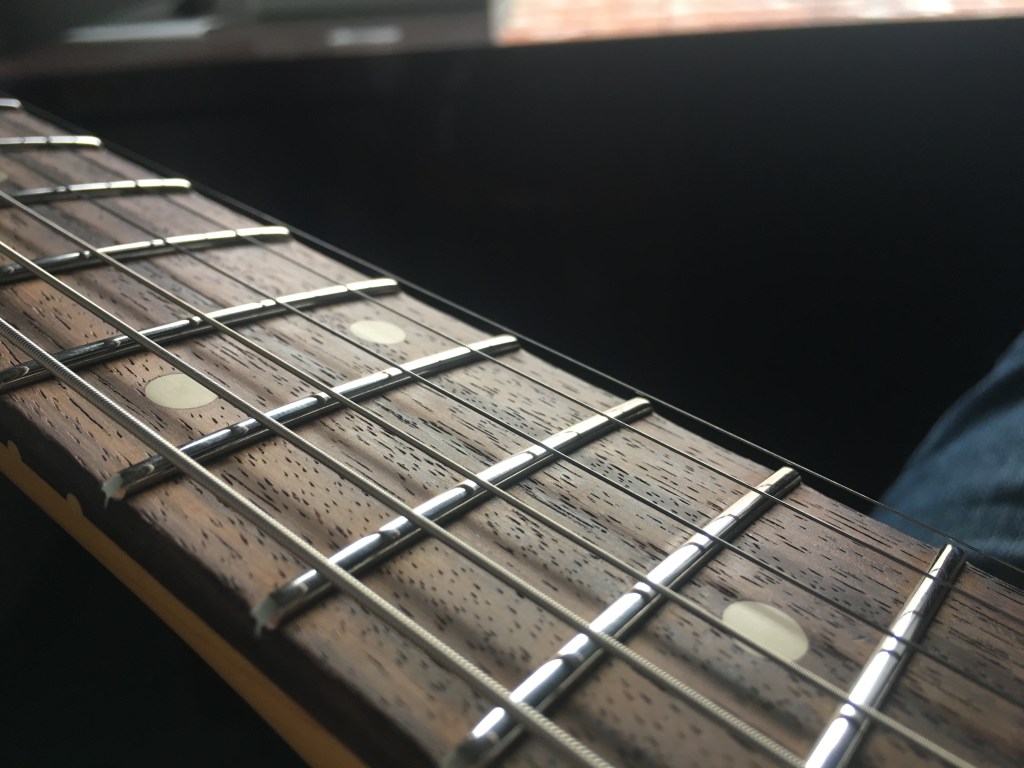
Have you ever wondered why guitars have frets and violins do not? I didn’t think so. I guess I better tell you what a fret is now. A fret is a thin strip of metal that runs perpendicular to the strings on a guitar. In theory it makes it easier to play a correct note. On a fretless instrument you have to rely in your ear and not a fret to play the correct note.

I do not own a violin but I spent a little time with one in my first round of college. I kept asking the wrong questions. Where is C? I should have asked, What does C sound like? I have come a long way since then on guitar. And I am beginning to understand why the concert music world did not respect the guitar until players like Andreas Segovia and Julian Bream paved the way for classical guitar in the twentieth century. I suppose I might as well tell you now that the guitar is out of tune. Or you could say it is equally in and out of tune. And this has bothered me for years.

I discovered this issue as a young player when I realized that guitars need regular maintenance. You need to tune a guitar’s open strings every time you play, but occasionally you have to check the guitars intonation. That means you make sure that the guitar is in tune at the 12th fret octave as well as the open string. If it is flat at the octave you can adjust the guitar’s bridge to make the string shorter and therefore sharpen the pitch. You lengthen the string to flatten it if the pitch is sharp at the octave. But there is a mathematical problem with tuning that is highlighted on fretted instruments: you can either have the octaves in tune, or the Fifths in tune, but not both. (Fifths are the fifth degree of the major scale and are the foundation of western music.) I did not have this information all of those years ago, I just noticed that I could never get the tuning perfect. And I thought there was something wrong with my instrument. It turns out it was not my guitar, but the whole tuning system in general. The piano suffers from the same problem.

I am tuning an octave on this old piano by ear. When you play two frequencies that do not match, say 400 hertz and 445 hertz, you can hear the difference of 5 hertz as a thumping sound called beats. You should be able to hear the beats disappear as the octave is brought in tune.

There have been a number of attempts made to deal with this issue over the past thousand or so years. Various temperaments, or tuning systems have been developed to to mitigate the Pythagorean Comma, or tuning gap. Apparently Pythagorus- yes that Pythagorus from your geometry class- wrestled with this issue.

Now that we have the tuning system worked out people only want to write four chord pop songs.

Enter the guitar around 500 years ago. I’d like to think that a prototypical guitar player invented the guitar. He was probably aware of the tuning issues, and thought, What if I just put these frets on the neck, make everything straight, and hope for the best? Guitar players are infamous for not being able to read music. Maybe he put frets on the fingerboard because he was tired of guessing where to put his fingers. Maybe he didn’t want to memorize notes but was happy to play patterns. At any rate guitars have been using equal temperament tuning since the renaissance and pianos waited to adopt it until right after the Boer Wars. And I think that’s why the guitar didn’t start gaining notoriety until the 1930s. Equal temperament tuning compromises the fifths in each key so the instrument can play fairly in tune across all the keys. This is why I have never been able to tune my guitar to my idealists standards. That brings me a small amount of psychological pain. But I have fallen in love with the guitar and I believe we can work our differences out.

Imagine now if this tuning phenomenon did not plague musicians and instrument makers. What if we could have the octaves and the fifths in tune? I don’t think that music would be what it is today. Part of the beauty of music is figuring out what works and what doesn’t. If everything was perfect there would be no dissonance, and how could we write music about pain and suffering without dissonance? J.S. Bach wrote his masterpiece The Well Tempered Clavier on an imperfect instrument. He wrote a piece of music in every key for the Harpsichord or Clavichord. These are stringed keyboard instruments that predated the piano. The genius of these pieces are the notes that he avoids because the well tempered tuning system still had some major dissonance issues. This piece is still studied today by aspiring pianists.

Think about this: more than likely, all of the piano music that you have ever heard in your whole life has not been in tune.

I suppose every good story needs a moral. Life is not always perfect. It can be frustrating to find the perfect balance because there may be no perfect balance. You just have to do the best that you can do with what you have. And often that ends up being the most beautiful thing anyway.

Open For Business

There aren’t many things that I have done that have been more fulfilling than teaching music.

My parents bought me my first guitar. I kind of forced them into it by signing up for guitar class at school. I didn’t learn a whole lot about playing guitar in that class, but I got a refresher on music theory. Eventually a proper flat-picker wandering into our church and showed me how to read tabs and chord diagrams, the major scale, how to play Bluegrass rhythm in G, and one Tony Rice lick before he told me, “I can’t show you anything else. If you really want to learn you will.”

In one sense, being told it is time to sink or swim really motivated me to learn. Conversely, I still had so much to learn and I had to learn it the hard way. Not having a teacher forced me to be a scholar. Learning how to learn on your own is what teachers really mean when they say you need to study. I have been studying guitar for over twenty years. As the physicians say, I am a practicing musician.

Learning to play guitar did wonders for my self confidence as a teenager. As an adult it still amazes me that I can play. This skill has also opened significant doors in my life.

Earlier this year the Lord delivered me from my one hour commute to work. The first things I did was start teaching guitar lessons again. There aren’t many things that I have done that have been more fulfilling than teaching music.

Get something in your life that God can bless.

Pastor Jeremy Wilbanks

Pastor has been saying that a lot lately to the church. It is one of the reasons that I wanted to start teaching again. I also feel like I need to put some of things I have learned while studying business in college into practice. Most significantly, I feel a responsibility to help musicians avoid having to learn the hard way. And God is blessing it.

Here are the answers to some of the frequent questions I get asked about learning guitar.

Should I start out on acoustic or electric? Choose the one that you want to play. You won’t be motivated to practice the acoustic if you really want to play electric.

What age do they need to be to learn? The youngest that I have successfully taught was seven. As long as they can pay attention and have enough hand strength to fret a note I can work with them.

Am I too old to learn? You are never too old to learn.

So if you or anyone you know is interested in learning guitar or bass guitar please send them my way.

zanewells@yahoo.com

Names I’ve Been Called: Volume II

Today is my last day at work with the State of Alabama. I will miss the people, but I will not miss the phone. This job has involved a lot of answering the phone and having the same conversation with different people every day. It is always pleasant to talk to someone who has mastered professional phone etiquette. But it is more entertaining to talk to the unprofessional callers. Have you ever been serenaded through the phone by a drunk plumber playing the guitar? I have.

Something I have noticed at this agency is that the people who really have their act together found all of the answers to their questions on the FAQ section of the website. Everybody else called to ask me their questions and they were never really ready for the answers.

“Give me just a second, I got to find a pen.”

“Hold on, I’m driving, let me pull over.”

“Can you e-mail me that? I ain’t got nothing to write with.”

My parents named me Zane after the dentist turned western novelist Zane Gray. I realize that this name has grown in popularity in subsequent generations, but not many of my peers share my name. Couple this with speaking through the phone and it is understandable that people mishear my name. To be clear, it doesn’t bother me when people get my name wrong over the phone. I gotten so used to it over the years that I have made a game of it. I have been updating an Excel spreadsheet titled Names I’ve Been Called since December 2018 and I wanted to share it with y’all. I omitted all of the cuss words.

I should have included Buddy and Boss. I’m not sure why people in this particular industry have adopted those two nick names. For the record I prefer Shane over Buddy.

  • Bande
  • Bill
  • Chad
  • Chaim
  • Dan
  • David
  • DeWayne
  • Gene
  • George
  • Ian
  • Jay
  • Jimmy
  • Josh
  • Kyle
  • Lloyd
  • Sam
  • Shay
  • Vane
  • Vann
  • Wayne
  • Zang
  • Zen
  • Blaine (2)
  • Dean (2)
  • Sane (2)
  • Sean (2)
  • Jay (4)
  • Jane (5)
  • Lane (6)
  • Zach (6)
  • Dane (30)
  • James (34)
  • Shane (93)

I made a similar list a while back that you can read here.

On Time

The art of time management is a very grown up thing. It is ultimately what distinguishes us as adults.

I suppose I have the same self awareness as I did in my earliest memories. But lately I’ve been feeling very grown up.

Perhaps it’s is because I have a mortgage now. A death pledge to pay a lot of money plus interest. There was a time when I would roll my eyes at stuffy grown ups who didn’t know how to loosen up and have fun. Now I wonder when silly young people are going to quit wasting time and get serious about life. I think there is a keener awareness of time that comes with age and gives older people the ability to be sharp and direct with words. I haven’t reached that point yet, but I can see it in the distance.

A lot things that adults have to do are not enjoyable, which is why a lot of people are reluctant to become adults. People who do not choose to evade responsibility are grown up. Responsibility often looks like a father working to provide for a family, a mother taking care of a home, a child taking care of a pet or a toy.

I think the main reason that I am feeling so grown up lately is because I am keenly aware that I cannot do everything that I would like simply because of time.

One of the greatest things about being a grown up is being a master of your own time. One could argue that working a job does not make one a master of their own time. I suppose that may be the case for many people, but I tend to look at time as currency that I can trade for resources to support my family.

The art of time management is a very grown up thing. It is ultimately what distinguishes us as adults. Time is the ultimate responsibility. How someone spends their time defines them. If you don’t believe this ask someone who is doing time.

How we treat time perhaps is more telling of our character than how we spend time. One could hardly deny that the irascible, impatient, reckless driver forcing his way through traffic like a Bull of Bashan has a concept of his own time, but a total disregard for the time, and indeed the life, of others. These people are bound by time, not masters of it. Frankly, they are not grown up.

There is chronological time, which is what most of us think about when we think of time. You can measure chronological time with the steady predictable ticking of a clock. We can think of this kind of time horizontally, like a timeline. And there is kairological time, which cannot be measured with a clock and could be thought of vertically. Heaven often operates on kairological time.

Jesus spoke of “The times and the seasons.” Chronos and Kairos. Acts 1:7

Kairological time is manifest when an unpredictable event comes and unapologetically crashes into chronological time. The birth of Jesus Christ, The Crucifixion, The Resurrection, and The Day of Pentecost are the most significant kairological events in the history of mankind. But kairological events are not limited to these. Every time the Word of God is preached there is potential for a kairological moment. Every time someone is filled with the gift of the Holy Ghost is a kairological moment.

The Apostle Paul wrote to Timothy Preach the word; be instant in season, out of season; reprove, rebuke, exhort with all long suffering and doctrine. II Timothy 4:2.

Instant in season and out of season: Kairos and Chronos.

It is simpler to get a handle on chronological time. The whole world operates on chronological time. And how we handle it defines us as humans. But there is much less awareness of kairological time. The entire Cosmos operates on Kairological time. And how we handle it defines us as spiritual beings.

Ice Cream

I love ice cream. I once received an emergency haircut after I snuck out of bed to finish off the ice cream. I stuck the empty plastic ice cream bucket over my head and licked the sides. There was no hiding the evidence in my hair the next morning on the way to take Zach to school.

My parents had an old Amana ice cream maker that was louder than three holiness preachers. Like so many other appliances from the 80s, it was brown and tan. I am not sure it came from the factory that loud. When you’re a kid you think broken things are normal, like the refrigerator that won’t stay closed. The noise didn’t ever stop us from partying though. And my parents hardly ever made ice cream without it being a party. After all, what you need to have a party is special food and special people. So by that definition, every night was a party at our house.

I suppose the rackety Amana was better than the hand crank ice cream makers that some of my older friends have told me about. I guess you’ll gladly do whatever it takes to have some ice cream. I imagine you could rig up an exercise bike to an ice cream maker if times were tough and you were smart enough. I bet Creed could do it. Anyway, I’m not thinking about engineering, I’m thinking about ice cream.

Like I was saying, the ice cream machine noise was part of the atmosphere of a party. All the adults would be sitting around the table playing Rook. They yelled anyway, but they had to put in extra effort to raise their voices above the electric motor whining away in the kitchen. The kids probably got away with more mischief since the noise was running interference for them. No one ever said anything about the noise until someone turned the machine off.

“Man that was loud.” Somebody would say as if Jesus had just rebuked the sea and the disciples were marveling at the calm.

They always made vanilla and strawberry. Those were the only flavors I thought homemade ice cream came in. Man was it ever good. Strawberry is probably still my favorite, but ice cream has to be real bad for me to not like it. In Virginia they made Grape-Nuts Ice Cream and acted like it was the best thing ever. If you’re not familiar with Grape-Nuts then you probably don’t know about fried bologna neither. It’s a cereal that poor people used to eat instead of food. Just put a little bit of fine gravel in the vanilla next time you make a batch of homemade ice cream and you’ll get the same texture and maybe a little better taste. It tastes bad because you had to grow up eating it for it to taste good.

To someone out there, homemade ice cream with Grape-Nuts in it will bring back a flood of fond memories. It just didn’t do it for me.

Sis. Beane made some lemon ice cream one time at youth camp. She put it three or four times the amount of lemon flavoring that the recipe called for. Bro. J.L. Parker took a big bite and made a sour face. “Sister, that’s the best I ever tried to eat.”

Dad used to tell us about how Pop would ask him and Uncle Melvin what kind of ice cream they wanted from the store.

“Rocky Road!”

“Chocolate!”

No matter what they asked, Pop always brought back Cherry Vanilla.

Dad would laugh about that story.

It was around the time that he knew he was about to die that Dad asked for some Cherry Vanilla Ice Cream. As many times as he told that story, it was the first time that I ever remember seeing it. One of the last things I saw dad eat was Blue Bell Dutch Chocolate. I fed it it to him. I don’t think I’ll ever be able to eat that flavor again and not think of him.

So I’m thinking about getting an ice cream maker, or seeing if Creed can do the bicycle powered deal. I want to experiment with some different flavors. I think peach ice cream would be good. And apparently they used to make that at Nonna’s, but I just don’t remember it. Or maybe we can use some of these blackberries that grow on the back fence. I mean just about any fruit will be good in ice cream.

“Anything with five cups of sugar in it is bound to be good.”

-Bo

I think I’ll start with strawberry though.